
Designing a streamlined home workspace or an elegant living room entertainment hub often comes down to managing the small, unseen details. As desktop cases shrink into sleek mini-PCs, gaming consoles hide inside mid-century media consoles, and home office laptops double as heavy-duty workstations, modern solid-state drives (SSDs) generate substantial heat under load. An M.2 NVMe drive drawing 6 to 12 watts of power during heavy file transfers or gaming can easily reach thermal throttling thresholds above 70°C (158°F), degrading drive longevity and slowing down system performance.
When selecting the right cooling solution for your home hardware, evaluating a graphene pad vs copper heatsink for nvme cooling is one of the most practical decisions you will make. While both aim to keep your storage running fast and cool, they tackle heat management in fundamentally different ways. Graphene pads offer ultra-slim profiles that fit inside the tightest spatial footprints, whereas solid copper heatsinks rely on raw thermal mass and surface area to draw continuous heat away from sensitive flash memory controllers.
As an Amazon Associate we earn from qualifying purchases at no extra cost to you.


Top 3 picks at a glance
Quick Verdict
Choose a graphene pad if you are cooling a space-constrained device like a laptop, a compact home-theater PC (HTPC), or a tight motherboard slot directly behind a graphics card where physical clearance is under 1.5mm. Specialized options like the Thermal Grizzly KryoSheet (33x33x0.2mm) or phase-change solutions like the Thermal Grizzly PhaseSheet PTM (50x40mm) excel in ultra-thin environments while eliminating messy liquid pastes.
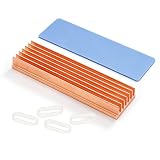
Opt for a copper heatsink if you have 3mm to 15mm of vertical clearance in a desktop PC, PS5, or dedicated home network server. Massive metal coolers like the Awxlumv M.2 Heatsink Pure Copper Nvme 2280 SSD Heat Sink 7 Copper Fin design, or slim laptop-focused variations like the Laptop NVMe M.2 Heatsink with Nano Thermal Pads, offer superior peak thermal dissipation during extended, high-wattage write tasks.
Side by Side
| Feature | Graphene Pad / Advanced Thermal Sheet | Copper Heatsink Assembly |
|---|---|---|
| Ease of Installation | Extremely high; simple cut-to-size or drop-in sheet placement. | Moderate; requires mounting clips, silicone bands, or screws. |
| Durability & Maintenance | Zero maintenance; solid carbon/phase-change sheets do not dry out. | Indestructible copper mass; underlying silicone pads may need swap after 3–5 years. |
| Price Range | $12.00 – $26.00 | $8.00 – $20.00 |
| Physical Clearance Needed | 0.2mm to 1.0mm (virtually zero spatial footprint). | 2.0mm to 15.0mm of vertical overhead clearance. |
| Aesthetic Impact | Hidden/Invisibly integrated; maintains clean interior lines. | Visible industrial copper accent; variable visual match with hardware. |
| Added Hardware Weight | Less than 2 grams. | 15 to 55 grams depending on fin depth and mass. |
| Versatility & Reusability | Reusable if handled carefully; delicate thin sheets require steady hands. | Highly reusable across multiple drive generations over time. |
| Sustained Load Cooling | Moderate; reliant on surrounding airflow to bleed off transferred heat. | Superior; copper surface area absorbs and dissipates sustained thermal spikes. |
| Best For | Ultra-thin laptops, tight ITX home PCs, low-profile expansion slots. | Desktop workstations, home media servers, PS5 console expansion bays. |
Where Graphene Pad Wins
The primary advantage of a graphene thermal pad lies in its extraordinary planar thermal conductivity combined with a non-existent physical footprint. Graphene features an anisotropic structure, meaning it transfers heat across its lateral surface area with exceptional speed. For homeowners looking to maintain ultra-clean, silent home office builds or maintain slim notebook profiles, this form factor is unmatched.
When working in tight confines, standard metal heatsinks simply will not fit. A 0.2mm high-performance layer like the Thermal Grizzly KryoSheet slides effortlessly between an M.2 drive and a laptop chassis or low-profile motherboard cover plate. It creates a direct, highly effective thermal bridge without placing physical pressure on delicate printed circuit boards (PCBs).
Furthermore, advanced phase-change materials and solid sheets, such as the Thermal Grizzly PhaseSheet PTM, do not suffer from the pump-out effect or drying out over time, which often plagues standard thermal pastes in warm room environments. Graphene pads generate zero noise, require zero air volume, and allow home builders to conceal cooling hardware completely out of sight for a minimal, uncluttered workspace aesthetics.
Where Copper Heatsink for Nvme Cooling Wins
Where graphene pads manage thermal distribution, pure copper heatsinks excel at thermal storage and heat dissipation. Pure copper boasts an intrinsic thermal conductivity rate of approximately 385–400 W/mK—far superior to aluminum—and provides actual physical mass to absorb sudden heat spikes from high-performance PCIe 4.0 and PCIe 5.0 drives.
For home servers, video editing rigs, or media center consoles operating in warm rooms, high-density metal structures like the Awxlumv M.2 Heatsink Pure Copper Nvme 2280 SSD Heat Sink 7 Copper Fin design pull heat straight off the NAND flash and controller chips, distributing it into elevated fins where natural convection or cabinet fans can carry it away. These multi-fin configurations increase surface area by several hundred percent compared to a flat drive label.
Even in slightly restricted environments, dedicated low-profile metal solutions—such as the Laptop NVMe M.2 Heatsink with Nano Thermal Pads—utilize a thin 1mm to 2mm solid copper plate to spread thermal loads far more effectively than standard drive labels, making copper the undisputed choice for continuous, heavy read/write workloads.
Cost Over 5 Years
Evaluating the total cost of ownership between a graphene pad vs copper heatsink for nvme cooling involves looking past the modest initial price tag to consider long-term durability and hardware reuse across home computer builds.
A pure copper heatsink assembly ($8.00 to $15.00 upfront) is essentially a lifetime purchase. Copper does not degrade, lose mass, or wear out. The only component that may require replacement after 4 to 5 years is the soft interface silicone pad underneath, which costs less than $3.00 to refresh. Over a 5-year period, a solid copper cooler costs approximately $1.60 to $3.00 per year.
Graphene sheets and high-end thermal phase-change pads ($13.00 to $26.00 upfront) carry a slightly higher initial cost per square inch. While carbon structures like graphene do not dry out like grease, ultra-thin dry sheets can tear if you frequently migrate drives between home computers or upgrade storage drives. Over 5 years, if left undisturbed in a primary home workstation, the cost breaks down to roughly $2.60 to $5.20 per year—an negligible difference for premium thermal management.
Which One for Your Home
Small Apartment / Minimalist Setup
In compact living spaces, small-form-factor (SFF) PCs and sleek all-in-one desks are essential for keeping room clutter to a minimum. If your computer sits in an ultra-small ITX case with less than 2mm of clearance above the M.2 slot, a high-conductivity sheet or phase-change pad is the ideal choice. It allows you to close up your sleek aluminum case without clearance issues while keeping fan noise low in small living areas.
Family with Kids / Pets (High-Traffic Media Center)
Living room gaming consoles and home theater PCs frequently live inside closed TV cabinets or media consoles, where dust, pet dander, and reduced ambient airflow create challenging thermal conditions. For a PS5 expansion slot or living room console, a robust copper heatsink with passive cooling fins is superior. The added physical copper mass absorbs heat rapidly during long gaming sessions, preventing thermal throttling even in warmer cabinet environments.
Rental (Temporary / Low-Impact Upgrades)
If you use a work-from-home laptop or rent your computing setup and need an upgrade that leaves zero trace, opt for a ultra-slim copper shim setup or non-conductive graphene sheet. These solutions can be removed cleanly without leaving residue or altering factory physical tolerances, making it simple to return hardware to stock condition when moving or returning leased gear.
Long-Term Home (Dedicated Workstation or NAS Server)
For home offices equipped with permanent network-attached storage (NAS) devices, media backup servers, or professional content creation stations, passive cooling stability is paramount. As high-speed PCIe 5.0 drives become standard in 2026 home computer builds, pairing your primary system drive with a dedicated, finned copper heatsink ensures maximum continuous write speeds during heavy terabyte-scale backups without relying on loud cooling fans.
FAQ
Can I stack a copper heatsink directly on top of a graphene pad?
Yes. Combining a thin graphene pad or phase-change sheet between the SSD controller and a solid copper heatsink creates an effective interface that eliminates micro air gaps. However, for most home setups, standard high-performance thermal interface pads supplied with copper heatsinks are sufficient.
Will a multi-fin copper heatsink fit inside a PS5 expansion slot?
It depends on the height. The PlayStation 5 expansion bay supports heatsinks up to 11.25mm total thickness. Multi-fin copper coolers designed specifically for the 2280 M.2 form factor fit comfortably, provided overall vertical height remains below that threshold.
Do graphene thermal pads electrical conduct electricity inside my PC?
Pure graphene is electrically conductive, so caution should be taken to ensure raw carbon sheets do not overlap exposed electrical components on the motherboard. However, specialized thermal pads designed for consumer electronics feature insulated coatings or phase-change matrix structures to prevent short circuits.
How do I know if my home NVMe drive actually needs active cooling?
If your storage drive consistently operates above 60°C (140°F) during normal home office tasks, or exceeds 70°C (158°F) during large file transfers, thermal throttling is occurring. Installing a graphene pad or copper heatsink typically lowers drive operational temperatures by 10°C to 20°C, preserving performance and drive reliability.


