
The Short Answer
It depends on your drive and your motherboard — but for most people using an NVMe boot drive for everyday computing, you do not strictly need an aftermarket heatsink if your motherboard already has a built-in M.2 heat spreader.
The one condition where you do need one: If your motherboard has a bare M.2 slot with no included shield or thermal pad, and you are installing a PCIe Gen 4 or Gen 5 NVMe drive as your boot drive, you should add a basic $6 to $10 heatsink. Without any cooling, those faster drives can hit 75 to 80 degrees Celsius under sustained writes and trigger thermal throttling, which slows boot times and large file transfers. If you have a Gen 3 drive or a motherboard heatsink already installed, you can skip the extra purchase.
As an Amazon Associate we earn from qualifying purchases at no extra cost to you. Product prices and availability are accurate as of the date shown and are subject to change.

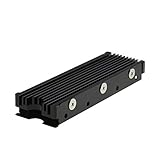
What You Actually Get
An aftermarket M.2 2280 heatsink is a simple passive cooler, not an active fan. The two common budget options shoppers see in 2026 are single-piece or double-sided aluminum designs that sell for around $5.99 to $6.99.
A typical unit measures about 70 to 72mm long, 22 to 24mm wide, and 8 to 12mm tall with the fins included. Weight is usually 25 to 45 grams. In the box you get an aluminum heatsink body, one or two blue or gray silicone thermal pads that are 0.5mm to 1.0mm thick, small mounting clips or screws, and sometimes a tiny screwdriver.
Installation is tool-light and takes about 5 minutes. You peel the film off the thermal pad, stick it to the drive or to the underside of the heatsink, place the heatsink over your 2280-size NVMe drive, and secure it with the provided clip or by using the motherboard’s existing M.2 standoff screw. The heatsink works by increasing surface area so heat from the controller and NAND chips dissipates into the airflow inside your case.
Most of these coolers are rated for M.2 2280 drives, which is the standard 22mm x 80mm size used for nearly all PC and PS5 boot drives. Double-sided versions include a top and bottom pad to cool drives that have chips on both sides, while single-sided versions only cool the top. Both are compatible with PCIe NVMe and M.2 SATA drives, but the benefit is largest for NVMe.
Power draw is zero. Unlike a CPU cooler or case fan, a heatsink does not use wattage and does not add noise. It relies entirely on your existing case airflow to carry heat away.
Pros
- Prevents thermal throttling on Gen 4 and Gen 5 boot drives: Keeps the controller below the typical 80 to 85 degree throttling threshold during long installs, updates, and game loads.
- Helps maintain consistent boot and load performance: A cooler drive is less likely to briefly drop from 5,000 to 7,000 MB/s down to 800 to 1,000 MB/s when hot.
- Very cheap insurance: At $5.99 to $9.99, it costs far less than the NVMe drive itself and far less than replacing a drive early.
- Zero noise and zero power use: No cables, no extra wattage, no fan failure points.
- Extends component lifespan: Running NAND and the controller 10 to 20 degrees cooler under load reduces thermal stress over years of daily boots.
- Easy to install and remove: No BIOS changes needed and it can be transferred to a new drive later.
- Fits most builds including PS5: Low-profile aluminum designs clear most GPU slots and fit the PS5 expansion bay, which requires a heatsink for any added NVMe.
Cons
- Often redundant: If your motherboard already includes an integrated M.2 shield with a thermal pad, an aftermarket cooler adds little to no benefit and may not fit underneath it.
- Can interfere with other components: Taller fin stacks around 10 to 12mm high can conflict with large GPUs, motherboard armor, or tight laptop chassis. Most laptops cannot use them at all.
- Does not help a slow or failing drive: It will not fix slow boots caused by a full drive, old SATA protocol, insufficient RAM, or a corrupted Windows install.
- Double-sided models add thickness: Sandwich-style heatsinks add height and weight that can stress the M.2 slot if the system is moved frequently.
- Thermal pad quality varies: Budget pads can be oily or leave residue, and reusing them after removal gives poor contact.
- Negligible gain for light use: For web browsing, office work, and booting a Gen 3 drive that idles around 35 to 45 degrees, you will not notice a difference.
Who Should Buy It
You should buy an M.2 heatsink for your boot drive if any of these describe you:
If your motherboard has a naked M.2 slot with no metal cover, you need one. Most budget B650, B760, and older B450/B550 boards ship with only one slot that has a heatsink and one or two that are bare. Putting a Gen 4 drive like a 1TB or 2TB model rated at 5,000 to 7,400 MB/s sequential read in a bare slot as your Windows boot drive without cooling is where throttling is most common.
If you are building in a small form-factor case, console, or a compact prebuilt with weak airflow, you need one. Mini-ITX cases, the PS5, and office PC conversions often have little direct airflow over the M.2 area, so temperatures climb faster.
If you do sustained writes regularly, you benefit most. That includes installing large games of 80 to 150GB, cloning your old boot drive, video editing with 4K footage, or keeping the drive more than 70 percent full, all of which keep the controller hot longer.
If you bought a high-performance Gen 4 or Gen 5 drive without a factory heatsink, a basic aluminum cooler is the intended solution. Many bare drives are sold without one to keep the price down and let you use the motherboard cooler or add your own.
Who Should Skip It
You can safely skip it if your motherboard already provides a heatsink. That thick metal strip screwed down over the M.2 slot is functionally the same as an aftermarket cooler. Just make sure to remove the plastic film and use the pre-applied thermal pad underneath, and do not stack two heatsinks on top of each other.
Skip it if you are using a PCIe Gen 3 NVMe as a boot drive for general use. Gen 3 drives typically draw 3 to 5 watts under load compared to 6 to 11 watts for Gen 4/5, run cooler overall, and rarely throttle in a desktop case with even one intake and one exhaust fan.
Skip it if you are in a laptop. Most laptops use a thin copper shield or leave the drive bare by design to fit the chassis. A tall aftermarket heatsink will not fit and will void the ability to close the bottom panel. If a laptop drive runs hot, a repaste or cleaning the fans helps more.
Also skip it if clearance is tight. Measure first. If the gap between your M.2 slot and your graphics card is less than 10mm, a finned heatsink may press against the GPU backplate.
Cheaper Alternatives
| Option | Cost | Trade-off |
|---|---|---|
| Use motherboard’s included M.2 shield | $0 | No extra cost or fit issues, but only available if your board shipped with one. Performance is similar to a $7 cooler. |
| Improve case airflow | $0 to $15 | Adding or repositioning a 120mm case fan for $10 to $15 lowers temps for the whole system, not just the SSD, but requires fan headers and space. |
| Buy NVMe with factory-installed heatsink | $10 to $25 more than bare drive | Cleaner look and guaranteed fit with warranty intact, but you pay a premium and cannot reuse the cooler separately. |
| Thin copper heatsink or graphene pad | $4 to $8 | Very low profile at 2 to 3mm tall so it fits under GPU or in tight cases, but dissipates less heat than a finned aluminum block. |
FAQ
Will an NVMe boot drive overheat without a heatsink?
For short bursts like booting Windows in 10 to 15 seconds or launching an app, no. The drive will stay within safe limits even without a heatsink, usually 40 to 65 degrees. Overheating becomes a risk during sustained operations that last minutes, such as copying 100GB+ at once, installing games, or running benchmarks. Gen 4 and Gen 5 drives are much more likely to reach 75 to 82 degrees and throttle without any heat spreader than Gen 3 drives.
Can I use the heatsink that came with my motherboard instead of buying one?
Yes, and you should. The motherboard heatsink is designed to make proper contact with a 2280 drive using the included thermal pad and standoff. Remove the protective film, seat the drive, and screw the shield down with even pressure. Do not add a second aftermarket heatsink underneath it, as stacking coolers prevents proper mounting pressure and can actually trap heat.
Does a heatsink make my boot drive faster?
Not directly. It does not increase the rated sequential read or write speed of the drive. What it does is help the drive sustain its advertised speed for longer without dropping due to thermal throttling. In everyday boots you may see no difference, but during long writes or when the drive is hot inside a warm case, a cooler drive holds closer to 5,000 to 7,000 MB/s instead of dipping.
What size heatsink do I need for a boot drive?
Buy a 2280-size heatsink for almost all desktop PC and PS5 boot drives. 2280 refers to 22mm wide and 80mm long. Confirm your drive is labeled 2280, which covers the vast majority of 500GB to 4TB NVMe boot drives. If you have a shorter 2242 or 2230 drive, common in some small PCs, a full 2280 cooler will not fit correctly and you need a size-specific pad instead.
