
The Short Answer
It depends: you need an SSD heatsink only if your M.2 NVMe drive does not already have one and regularly handles sustained, demanding workloads. For ordinary web browsing, office work, light gaming, and occasional file transfers, many PCIe 3.0 and PCIe 4.0 SSDs run perfectly well without an added cooler. But a heatsink is inexpensive insurance for a fast NVMe drive that sits under a graphics card, lives in a warm compact case, or spends long periods moving large files.
First, check your motherboard. Many midrange and high-end boards include one or more M.2 covers with thermal pads underneath. That cover is already an SSD heatsink. In that situation, do not stack a separate heatsink on top unless the motherboard manual specifically shows there is enough clearance. Two heatsinks can create fit problems, interfere with GPU installation, or prevent proper contact with the thermal pad.
As an Amazon Associate we earn from qualifying purchases at no extra cost to you.
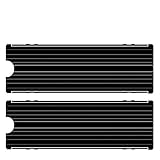

For a bare 2280 NVMe SSD—the common 80 mm-long format—an aftermarket aluminum heatsink usually costs about $2 to $10. That is a modest upgrade when it is actually needed, but it is not a universal requirement.
What You Actually Get
An M.2 SSD heatsink is a small aluminum or copper cooling plate that attaches to the top of an NVMe drive with a soft thermal pad. Most budget versions are designed for the 2280 form factor: approximately 80 mm long and 22 mm wide. They commonly add 3 mm to 8 mm of height above the drive, although taller finned designs can reach 10 mm to 15 mm.
The thermal pad transfers heat from the SSD controller and NAND chips into the metal heatsink. The metal then releases that heat into the air moving through the case. A heatsink does not make the SSD actively cold; it simply helps spread heat and slows heat buildup during long reads, writes, game installs, video exports, backups, and large downloads.
Most simple kits include one heatsink, one or two silicone thermal pads, and either elastic retention bands or small clips. Multi-pack options can be especially practical for a workstation or a board with several M.2 slots. For example, basic two-piece kits often sell near $9, while five-pack 2280 heatsink sets can cost around $6 to $10. They are lightweight—usually just a few grams each—and require no power cable, fan header, or software.
Compatibility matters more than price. These products are generally intended for M.2 NVMe SSDs, although some also fit M.2 SATA drives. They do not apply to 2.5-inch SATA SSDs, which use a rectangular enclosure and SATA cable. They also cannot fix a poorly ventilated PC case by themselves.
Pros
- Helps prevent thermal throttling: A heatsink can help an NVMe SSD maintain steadier performance during sustained work, especially on higher-speed PCIe 4.0 and PCIe 5.0 drives.
- Very low cost: Basic 2280 heatsinks typically cost $2 to $10, far less than replacing a drive or adding more elaborate cooling.
- No noise or power use: Passive heatsinks have no fan, draw zero watts, and add no moving parts.
- Useful in hot locations: They are particularly helpful when the M.2 slot is directly beneath a large GPU, where trapped heat can be significant.
- Easy installation: Most take about five to 10 minutes to install, provided you can access the M.2 slot and follow the motherboard’s instructions.
- Can improve long-session consistency: This matters more than peak benchmark speed for frequent backups, editing high-bitrate video, compiling code, or transferring hundreds of gigabytes at a time.
Cons
- Often unnecessary for casual use: A light-use PC may never push the SSD hard enough to benefit in a noticeable way.
- Possible clearance conflicts: Tall heatsinks can collide with a graphics card, motherboard shroud, CPU cooler, or the side panel in a slim case.
- Do not double up with a motherboard cover: If your board has an included M.2 thermal cover, use that system rather than piling on another heatsink.
- Installation can be fiddly: Thermal pads are sticky, easy to misalign, and should not cover the drive’s connector or interfere with the mounting screw.
- Not every chip needs coverage: SSD layouts vary. A thick pad placed incorrectly can create uneven pressure or keep the heatsink from sitting flat.
- Does not replace airflow: In a case with little intake or exhaust airflow, a passive heatsink has limited air available to shed heat into.
Who Should Buy It
Buy an SSD heatsink if you have a bare M.2 NVMe drive and any of the following describe your setup:
- You use a PCIe 4.0 or PCIe 5.0 NVMe SSD for large, repeated transfers.
- You edit 4K or 8K video, work with large photo catalogs, run virtual machines, compile large software projects, or create frequent system backups.
- You game on a PC with the SSD mounted under a heat-producing graphics card.
- You have a mini-ITX, small-form-factor, or otherwise warm case with restricted airflow.
- Your motherboard does not include an M.2 heatsink or thermal cover.
- You are adding several 2280 drives to a desktop or workstation and want a low-cost, consistent cooling setup.
It is also a sensible purchase for PlayStation 5 storage expansion, provided the heatsink and installed SSD together fit the console’s M.2 expansion-bay clearance requirements. Measure carefully before buying; a tall desktop-style heatsink is not automatically suitable for a console.
In 2026, faster drives are more common than ever, so checking the SSD manufacturer’s recommended cooling guidance is worthwhile—particularly for top-tier PCIe 5.0 models. Some premium drives already ship with a heatsink. If yours does, do not remove it or add another one unless the drive maker says it is safe and necessary.
Who Should Skip It
Skip an aftermarket heatsink if your motherboard includes a properly fitted M.2 shield with a thermal pad. Remove the protective film from the pad, install the SSD according to the manual, and use the included cover. That is normally the cleanest and best-fitting solution.
You can also skip it if you have a modest PCIe 3.0 NVMe SSD, a cool and well-ventilated desktop, and a workload limited to browsing, schoolwork, streaming, and routine documents. There is little reason to buy accessories for a problem you do not have.
Do not buy one for a 2.5-inch SATA SSD. Those drives generally run cool, and an M.2 2280 heatsink will not fit them. Similarly, an M.2 SATA drive used for light storage rarely needs extra cooling, though the physical size may be compatible.
Finally, skip tall finned models if your M.2 slot sits below the GPU and the clearance is uncertain. A low-profile heatsink, often around 3 mm to 5 mm tall, is safer than forcing a larger cooler into a cramped space.
Cheaper Alternatives
| Option | Cost | Trade-off |
|---|---|---|
| Use the motherboard’s included M.2 cover and thermal pad | $0 | Only available on boards that include one; fit is limited to the intended slot. |
| Improve case airflow with an existing front intake or rear exhaust fan | $0–$15 | Benefits the whole PC, but may require fan space, cables, and setup time. |
| Buy a basic low-profile 2280 aluminum heatsink | $2–$5 each in multipacks | May use thinner pads and simpler clips than premium single-drive kits. |
| Choose a two-pack 2280 heatsink kit | $7–$10 | Good value for two drives, but unnecessary if you only need one. |
| Move the SSD to a cooler M.2 slot | $0 | Not always possible, and moving the boot drive requires care. |
FAQ
Does every NVMe SSD need a heatsink?
No. Many NVMe SSDs work normally without one, especially PCIe 3.0 models and drives used for everyday tasks. A heatsink becomes more worthwhile when a drive faces sustained heavy transfers, limited airflow, or heat from a nearby GPU.
Should I use an SSD heatsink if my motherboard has an M.2 cover?
Use the motherboard’s M.2 cover, assuming it includes a thermal pad and is designed for your slot. Do not install an aftermarket heatsink underneath or on top of that cover unless the manual explicitly permits it. One properly fitted heatsink is better than two poorly fitted ones.
Can an SSD heatsink fit under a graphics card?
Sometimes, but measure first. Standard M.2 drives are 22 mm wide and commonly 80 mm long, while heatsink height varies substantially. If the slot is under the GPU, choose a low-profile model and check the distance between the installed SSD and the graphics card backplate or cooler.
Can a heatsink damage an SSD?
A properly installed heatsink is unlikely to damage an SSD. Problems usually come from using a pad that is too thick, blocking the M.2 connector, overtightening a mounting point, or creating clearance pressure against another component. Follow the drive and motherboard instructions, remove any plastic film from the thermal pad, and make sure the heatsink sits flat.


