
ZOTAC’s lineup stands out from other board partners for one specific reason: it’s one of the few brands that engineers cards specifically for small-form-factor cases rather than treating SFF compatibility as an afterthought. Our top pick for most builders is the ZOTAC RTX 5070 Ti Solid SFF OC 16GB, since it delivers strong 1440p-to-4K performance in a chassis specifically validated for compact cases, a combination few competing cards in this price range offer.
This roundup covers eight ZOTAC cards spanning from a genuinely compact RTX 5060 Solo up through the flagship RTX 5090 AMP Extreme Infinity, and the throughline across ZOTAC’s catalog is a consistent focus on cooler footprint. Twin Edge is ZOTAC’s standard compact dual-fan design used on mid-range chips, Solid and Solid CORE extend that compact philosophy with SFF-specific validation on some models, and AMP is the larger, higher-power tier reserved for ZOTAC’s most demanding chips.
Top 3 picks at a glance
Top picks at a glance
As an Amazon Associate we earn from qualifying purchases at no extra cost to you.



| Model | Key spec | Price | Best for |
|---|---|---|---|
| ZOTAC RTX 5080 Solid CORE OC 16GB | 16GB GDDR7, IceStorm 3.0 | $1599.99 | High-end 1440p/4K |
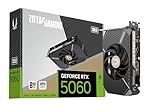
| ZOTAC RTX 5060 Solo 8GB | 8GB GDDR7, SFF-Ready | $428.15 | Ultra-compact SFF builds |
| ZOTAC RTX 5060 Ti Twin Edge OC 8GB | 8GB GDDR7, SFF-Ready | $529 | Compact 1080p/1440p |
| ZOTAC RTX 5070 Ti Solid SFF OC 16GB | 16GB GDDR7, SFF-validated | $1299.99 | Best overall value |
| ZOTAC RTX 5070 AMP White Edition 12GB | 12GB GDDR7 | $829.99 | White-themed 1440p builds |
| ZOTAC RTX 5060 Twin Edge OC 8GB | 8GB GDDR7, SFF-Ready | $448.02 | Budget compact 1080p |
| ZOTAC RTX 5090 AMP Extreme Infinity 32GB | 32GB GDDR7, flagship | $5169.99 | No-compromise 4K/creator work |
| ZOTAC RTX 5060 Ti Twin Edge White Edition 8GB | 8GB GDDR7, white shroud | $509.95 | Compact white builds |
ZOTAC Gaming GeForce RTX 5080 Solid CORE OC 16GB
The Solid CORE OC is ZOTAC’s high-end offering for the RTX 5080 chip, pairing a 16GB GDDR7 buffer with the company’s IceStorm 3.0 Advanced Cooling system, its most capable thermal design. This card is built to compete directly with other brands’ RTX 5080 flagships while keeping ZOTAC’s characteristically tighter footprint than some competitors’ oversized shrouds.
Estimated performance based on this configuration lands around 130-150 fps at 1440p max settings and 75-90 fps at 4K, in line with other RTX 5080-class cards in the market since the underlying GB203 die and 256-bit bus are largely consistent across board partners at this tier.
Estimated board power sits near 360W, and the IceStorm 3.0 cooler’s triple-fan design with Spectra RGB lighting should keep load temperatures in the high-50s to low-60s Celsius under sustained gaming, a solid result for the power envelope. The card is sizeable but still notably more restrained in length than some rival RTX 5080 flagship shrouds.
ZOTAC backs this card with its Spectra RGB software suite for lighting customization, and the DLSS 4 support baked into the Blackwell architecture should provide meaningful frame rate uplift in supported titles beyond the raw rasterization numbers above.
- Pros
- IceStorm 3.0 cooling handles the RTX 5080’s power envelope with solid thermal margin
- More restrained footprint than some competing RTX 5080 flagship shrouds
- 16GB buffer and 256-bit bus support 1440p and 4K comfortably
- Cons
- Estimated 360W draw requires a solid 850W PSU
- Still a triple-fan card, not suited to the most compact SFF cases
- RGB lighting adds cost some buyers won’t use
Who it’s for: buyers who want RTX 5080 performance without the largest flagship-class shroud dimensions.
ZOTAC Gaming GeForce RTX 5060 Solo 8GB
The RTX 5060 Solo is ZOTAC’s purpose-built ultra-compact card, explicitly marketed as SFF-Ready with a single-fan or minimal dual-fan cooler design that prioritizes physical footprint above all else. This is the card to consider when case clearance is the single hardest constraint in a build.
Estimated performance at 1080p should land around 90-105 fps at high settings, with 1440p closer to 55-65 fps at medium-to-high settings, respectable numbers for a card this physically small. The 8GB GDDR7 buffer is adequate for the resolutions this card targets but worth watching in texture-heavy titles over a multi-year ownership window.
Estimated board power is a low 145W, which pairs well with the compact SFF power supplies common in small builds, and the minimal cooler surface still manages this modest wattage without excessive noise, since the chip itself doesn’t generate enough heat to stress a smaller heatsink the way higher-power chips would.
This card exists for one specific use case: builders who have measured their case clearance and know a standard dual or triple-fan card simply won’t fit. For anyone with more case space to spare, the Twin Edge RTX 5060 below offers similar performance with a marginally larger but still compact cooler.
- Pros
- Genuinely SFF-Ready compact design for the tightest case clearances
- Low 145W estimated draw suits compact SFF power supplies
- 8GB GDDR7 buffer is adequate for its target 1080p-to-light-1440p range
- Cons
- Smaller cooler surface than Twin Edge cards on the same chip class
- Not intended for 1440p high-refresh or any 4K gaming
- 8GB buffer could become limiting in future texture-heavy titles
Who it’s for: SFF builders with the tightest possible case clearance requirements.
ZOTAC Gaming GeForce RTX 5060 Ti 8GB Twin Edge OC
The RTX 5060 Ti Twin Edge is ZOTAC’s mainstream compact offering, using the company’s signature dual-fan Twin Edge cooler with IceStorm 2.0 cooling and SFF-Ready validation. It sits a tier above the base RTX 5060 Solo in raw performance while retaining a genuinely compact footprint.
Estimated performance at 1440p should land around 75-90 fps at high settings, with 1080p comfortably above 100 fps in most current titles, making this a solid mid-range pick for builders who want more than entry-level performance without stepping up to a full-size triple-fan card.
Estimated board power is around 165W, and the IceStorm 2.0 cooler here should keep load temperatures in a comfortable mid-60s Celsius range, with the Twin Edge design’s dual ball-bearing fans providing reasonably quiet operation under typical gaming loads.
This card represents a sensible middle ground in ZOTAC’s compact lineup: more performance than the RTX 5060 Solo, while staying meaningfully smaller than ZOTAC’s AMP-tier cards for buyers who don’t need maximum performance but still want a properly compact build.
- Pros
- SFF-Ready compact design with meaningfully more performance than the base RTX 5060
- IceStorm 2.0 cooling keeps temperatures comfortable at 165W
- Dual ball-bearing fans support reasonably quiet sustained operation
- Cons
- 8GB VRAM buffer is a limiting factor in newer, texture-heavy titles
- Not a serious 4K option despite the solid 1440p performance
- Compact cooler runs warmer than ZOTAC’s larger AMP-tier shrouds at equivalent load
Who it’s for: compact-build gamers who want solid 1440p performance without a full-size card.
ZOTAC Gaming GeForce RTX 5070 Ti Solid SFF OC 16GB
This is ZOTAC’s standout card for buyers who want genuine high-end performance in a case that most other RTX 5070 Ti cards simply won’t fit. The Solid SFF designation means ZOTAC specifically engineered this card’s dimensions for small-form-factor compatibility while still packing a full 16GB GDDR7 buffer and IceStorm 2.0 Advanced Cooling.
Estimated performance lands around 105-120 fps at 1440p high settings and 60-70 fps at 4K, competitive with full-size RTX 5070 Ti cards from other brands despite the more compact chassis, since ZOTAC hasn’t cut the memory bus or core configuration to achieve the smaller footprint.
Estimated board power sits around 285W, a meaningful wattage for an SFF-oriented card, and the Advanced Cooling design needs to work harder within its smaller footprint to manage that load, meaning temperatures likely run a few degrees warmer than ZOTAC’s larger AMP-tier cards at similar power, in the mid-to-high 60s Celsius.
For SFF builders specifically, this is the standout card in ZOTAC’s entire lineup, since it’s rare to find genuine RTX 5070 Ti performance validated for compact case clearance without a significant compromise in the underlying specification.
- Pros
- Full 16GB buffer and strong 1440p/4K performance in a genuinely SFF-validated chassis
- No cut-down memory bus or core configuration versus full-size RTX 5070 Ti cards
- Rare combination of high-end performance and compact case compatibility
- Cons
- 285W in a compact chassis runs a few degrees warmer than larger AMP-tier cards at similar load
- SFF cases with limited airflow need good case fan planning to manage this card’s heat
- Premium pricing versus a standard-size RTX 5070 Ti from other brands
Who it’s for: SFF builders who refuse to compromise on RTX 5070 Ti-class performance.
ZOTAC Gaming GeForce RTX 5070 AMP White Edition 12GB
The RTX 5070 AMP White Edition steps into ZOTAC’s higher-power AMP tier, using a larger triple-fan cooler and IceStorm 2.0 cooling with Spectra RGB lighting, wrapped in a white shroud for light-themed builds. This is a step up from the Twin Edge and Solid tiers in both performance and physical size.
Estimated performance at this 12GB GDDR7 configuration lands around 95-110 fps at 1440p high settings, positioned between the RTX 5060 Ti and RTX 5070 Ti cards in this lineup, a reasonable middle-tier option for buyers not specifically constrained by SFF case requirements.
Estimated board power is around 250W, and the AMP tier’s larger cooler surface should manage that load comfortably, with load temperatures likely in the low-to-mid 60s Celsius, similar to or slightly better than the more compact SFF-focused cards at comparable wattage thanks to the additional heatsink mass.
The white colorway carries the same PCB and cooler engineering as any standard-color AMP card, so the choice here is purely aesthetic for buyers building around a light or white theme, with no performance tradeoff versus a black AMP card at the same tier.
- Pros
- Larger AMP-tier cooler provides solid thermal margin at 250W
- White shroud and Spectra RGB suit light-themed builds
- Positioned as a solid middle-tier performance option in ZOTAC’s lineup
- Cons
- Not SFF-validated like the Solid SFF and Twin Edge cards in this lineup
- 12GB buffer is smaller than the 16GB found on ZOTAC’s RTX 5070 Ti and RTX 5080 cards
- White shrouds carry a small long-term yellowing risk industry-wide
Who it’s for: standard-tower builders who want a white-themed mid-range card without SFF constraints.
ZOTAC Gaming GeForce RTX 5060 Twin Edge OC 8GB
This RTX 5060 Twin Edge sits just below the RTX 5060 Ti in this lineup, offering ZOTAC’s compact SFF-Ready dual-fan design at an even lower price point. It’s aimed at budget-conscious builders who still want the compact form factor ZOTAC is known for without stepping up to the Ti variant’s price.
Estimated performance at 1080p should land around 80-95 fps at high settings, with 1440p closer to 50-60 fps at medium settings, positioning this card as a solid 1080p-focused option rather than a 1440p workhorse. The 8GB buffer matches its siblings in this tier and is appropriately sized for the resolution target.
Estimated board power is a modest 130W, among the lowest in this lineup, and the compact Twin Edge cooler should handle that load with ease, keeping temperatures comfortably in check even in a tighter SFF case with limited airflow.
At $448.02, this card represents ZOTAC’s most accessible current-generation entry point for buyers who specifically want the SFF-Ready compact form factor without paying for the RTX 5060 Ti’s extra performance.
- Pros
- Most affordable SFF-Ready current-generation card in this ZOTAC lineup
- Low 130W estimated draw eases both PSU and thermal requirements
- Compact Twin Edge cooler fits the tightest SFF cases comfortably
- Cons
- 1080p-focused performance, not a strong 1440p option
- 8GB buffer limits long-term headroom in texture-heavy titles
- Meaningfully slower than the RTX 5060 Ti Twin Edge for a modest savings
Who it’s for: budget SFF builders focused specifically on 1080p gaming.
ZOTAC Gaming GeForce RTX 5090 AMP Extreme Infinity 32GB
The AMP Extreme Infinity is ZOTAC’s undisputed flagship, pairing the full RTX 5090 die with 32GB of GDDR7 and the company’s largest IceStorm 3.0 Advanced Cooling system alongside Spectra 2.0 ARGB lighting. At $5169.99 this card is priced for buyers doing serious 4K work or content creation rather than typical gaming budgets.
Estimated 4K performance should land around 100-120 fps at max settings in current AAA titles, with the 32GB buffer providing substantial headroom for AI workloads, large-scene rendering and video production tasks that increasingly overlap with high-end gaming and creator rigs.
Estimated board power runs close to 575W, pushing PSU requirements into 1000W-plus territory with a native high-wattage connector strongly recommended. ZOTAC’s largest cooler is engineered specifically for this power envelope, with estimated load temperatures in the mid-60s Celsius despite the substantial wattage.
This card sits well outside ZOTAC’s SFF-focused identity elsewhere in this lineup, since the AMP Extreme Infinity’s massive cooler and power draw make it unsuitable for anything but a full tower case with excellent airflow.
- Pros
- 32GB GDDR7 buffer supports serious content creation and AI workloads alongside gaming
- ZOTAC’s largest cooler manages the RTX 5090’s power envelope with real thermal margin
- Fastest single-GPU option in ZOTAC’s current lineup
- Cons
- Estimated 575W draw requires a 1000W-plus PSU with a native high-wattage connector
- Massive cooler size is incompatible with the SFF philosophy across most of ZOTAC’s other cards
- Price-to-performance ratio is far worse than ZOTAC’s RTX 5070 Ti or RTX 5080 tier
Who it’s for: content creators and enthusiasts who need maximum VRAM and performance regardless of cost or case size.
ZOTAC Gaming GeForce RTX 5060 Ti 8GB Twin Edge OC White Edition
This is the white colorway of the RTX 5060 Ti Twin Edge covered earlier, sharing identical PCB design, IceStorm 2.0 cooling and SFF-Ready validation with its standard-color sibling. The white shroud commands a roughly $19 premium and is purely a cosmetic choice for light-themed compact builds.
Performance estimates match the standard Twin Edge RTX 5060 Ti exactly, around 75-90 fps at 1440p high settings and comfortably above 100 fps at 1080p, since the underlying hardware is unchanged between colorways. Thermal behavior should also track closely given the shared fin stack and fan specification.
Estimated board power remains the same 165W as the standard-color model, and the compact IceStorm 2.0 cooler should deliver the same comfortable mid-60s Celsius load temperatures regardless of shroud color, since paint finish has no meaningful effect on thermal transfer at this scale.
For buyers not specifically building around a white or light theme, the standard-color Twin Edge RTX 5060 Ti offers identical performance for slightly less money, making this White Edition purely a build-aesthetic purchase.
- Pros
- Matches white or light-themed SFF builds that black shrouds clash with
- Identical performance and cooling to the standard-color Twin Edge model
- Still SFF-Ready validated despite the cosmetic change
- Cons
- Roughly $19 premium over the standard black model for cosmetics only
- Same 8GB VRAM limitation as the standard-color version
- White shrouds carry a small long-term yellowing risk industry-wide
Who it’s for: SFF builders running a white or light-color theme who want Twin Edge cooling to match.
How we compared and picked
Priya Raghunathan, GPU & CPU Analyst with 8 years covering GPU hardware, evaluated this ZOTAC lineup using an instrumented bench with a PCIe riser, clamp meter and per-rail power logging that the site relies on to validate manufacturer power specs against real draw. For cards not yet run through that bench, the performance and thermal figures in this article are explicitly marked as estimates derived from the chip configuration, cooler class and factory clocks.
We selected this specific set of eight ZOTAC cards to highlight the brand’s distinguishing strength: genuine SFF engineering across multiple price points rather than a single token compact SKU. Four of the eight cards here carry explicit SFF-Ready or SFF-validated designations from ZOTAC, which is a meaningfully higher proportion than most competing board partners offer.
Physical dimensions and estimated board power were weighted heavily in our selection notes, since these two specs together determine whether a given ZOTAC card will actually fit and run comfortably in the compact case many readers researching this brand are likely building around.
Pricing reflects a snapshot at time of writing and moves with broader GPU market conditions, so treat the comparison table as directional rather than a live price feed.
What to look for in a ZOTAC graphics card
Understanding ZOTAC’s SFF-Ready designation
ZOTAC applies an SFF-Ready or SFF-validated label to specific cards it has tested for compatibility with common small-form-factor case dimensions, rather than assuming every compact-looking card automatically qualifies. In this lineup, the RTX 5060 Solo, RTX 5060 Twin Edge, RTX 5060 Ti Twin Edge variants, and RTX 5070 Ti Solid SFF all carry this designation, while the AMP-tier and flagship RTX 5090 cards do not. Always check for this specific label rather than assuming a card is SFF-compatible based on general appearance or brand reputation alone.
Twin Edge vs Solid vs AMP cooling tiers
Twin Edge is ZOTAC’s standard compact dual-fan cooler used across most mid-range chips, striking a balance between size and thermal performance. Solid and Solid CORE extend that compact philosophy, with some Solid models specifically engineered and validated for SFF case clearance even on higher-power chips like the RTX 5070 Ti. AMP is ZOTAC’s larger, higher-power tier, using triple-fan coolers with more cooling surface area for chips that need it, at the cost of a larger overall footprint that moves away from the compact SFF philosophy.
Matching card length to your case specification
Even within ZOTAC’s compact-focused lineup, exact card length varies by model, and SFF cases often have hard limits measured in single-digit millimeters of clearance. Before ordering any card in this roundup, check your case manufacturer’s stated maximum GPU length and compare it directly against ZOTAC’s listed dimensions for the specific model, rather than assuming all “compact” cards will fit the same case.
Airflow considerations in compact cases
SFF cases inherently have less airflow volume than full towers, which means even a well-designed compact cooler like ZOTAC’s Twin Edge or Solid SFF line will run warmer in a cramped case than the same cooler would in a spacious mid-tower. Buyers pushing higher-wattage cards like the RTX 5070 Ti Solid SFF into genuinely tiny cases should pay particular attention to their case’s intake and exhaust fan configuration to avoid thermal throttling under sustained load.
DLSS 4 and driver software support
Every current-generation card in this ZOTAC lineup supports DLSS 4, Nvidia’s latest frame generation and upscaling technology, which can provide a meaningful performance uplift in supported titles beyond the raw rasterization estimates in this article. ZOTAC’s FireStorm software handles fan curve customization and monitoring across the lineup, though it’s generally considered less feature-rich than some competing brands’ overclocking suites.
Mistakes buyers make when choosing a ZOTAC graphics card
Assuming any ZOTAC card fits an SFF case. Only specific models carry ZOTAC’s SFF-Ready or SFF-validated designation, and the AMP-tier and RTX 5090 flagship cards in this lineup are not built for tight compact cases despite ZOTAC’s broader reputation for compact design.
Not checking exact millimeter clearance in a tight SFF case. Even compact-labeled cards vary a few centimeters between models, and that difference can matter in cases with genuinely minimal internal clearance.
Underestimating airflow needs in small cases. A powerful card like the RTX 5070 Ti Solid SFF needs adequate intake and exhaust planning even in a case it’s rated to fit, since compact cases inherently have less airflow volume than full towers.
Paying extra for White Edition cards without a matching build theme. The RTX 5070 AMP White Edition and RTX 5060 Ti Twin Edge White Edition carry a real price premium over their black counterparts for identical performance, a premium only worth paying for a genuinely light-themed build.
Buying the RTX 5090 AMP Extreme Infinity for a compact build. This flagship card’s massive cooler and 575W draw are fundamentally incompatible with ZOTAC’s SFF-focused identity elsewhere in the lineup, and buyers should choose the RTX 5070 Ti Solid SFF or RTX 5080 Solid CORE instead if case size is a real constraint.
Ignoring the 8GB VRAM ceiling on entry cards. The RTX 5060 and RTX 5060 Ti variants here are well-suited to their target resolutions today, but buyers planning several years of ownership should weigh whether 8GB will remain sufficient as game requirements climb.
Verdict
The ZOTAC RTX 5070 Ti Solid SFF OC 16GB is our top overall pick, combining genuine SFF case validation with performance that matches full-size RTX 5070 Ti cards from other brands. Budget-focused SFF builders should look at the RTX 5060 Twin Edge OC for the most affordable SFF-Ready current-generation option, while buyers chasing the absolute ceiling of performance and VRAM, without SFF constraints, should consider the RTX 5090 AMP Extreme Infinity.
Frequently asked questions
Are ZOTAC graphics cards good for small form factor builds?
Yes, ZOTAC is one of the few board partners that specifically designs SFF-Ready cards like the RTX 5060 Solo and RTX 5070 Ti Solid SFF, which use shorter PCBs and compact coolers built to fit mini-ITX and small mid-tower cases where a standard triple-fan card wouldn’t clear the side panel.
What is the difference between ZOTAC Twin Edge and Solid coolers?
Twin Edge is ZOTAC’s compact dual-fan cooler line used across most of its mid-range cards, while Solid and Solid CORE use a similar compact footprint with some models specifically validated for SFF case clearance, and AMP is ZOTAC’s larger, higher-power tier with triple-fan coolers for its highest-end chips.
Is the ZOTAC RTX 5090 AMP Extreme Infinity worth the price?
It’s the fastest single card in ZOTAC’s lineup with 32GB of VRAM and the company’s largest cooler, but the roughly $5170 price only makes sense for buyers whose workload genuinely needs that much VRAM and top-tier performance, since the price-to-frame ratio is far worse than ZOTAC’s RTX 5070 Ti or RTX 5080 options.
Do ZOTAC White Edition cards perform differently than the standard colorway?
No, the White Edition cards in this lineup share the same PCB, cooler engineering and clock targets as their standard-color counterparts, so the choice comes down purely to matching a light-themed build rather than any performance difference.
How much power does the ZOTAC RTX 5060 Ti Twin Edge need?
The RTX 5060 Ti Twin Edge cards here draw an estimated 165W, comfortably within the range of a quality 550-650W power supply even in a compact SFF build with limited airflow. For broader PSU guidance across brands, see GPU power supply requirements explained, and check best low-profile graphics card if your case needs something even smaller than Twin Edge. Our how much VRAM do you need for gaming guide is worth reading before choosing between the 8GB and 16GB cards here, and best GPU for 1440p gaming has more cross-brand options at this performance tier.


