
The fastest ASUS graphics card right now for most buyers depends less on the GPU chip itself and more on which of the four ASUS design tiers it comes from, because ROG Astral, TUF Gaming, Prime and Dual all package different silicon behind different cooler budgets and price points. Our pick for most gamers is the ASUS TUF Gaming RTX 5070 12GB, since it lands in the sub-$850 range while still carrying ASUS’s Auto-Extreme build quality that usually shows up in longer service life on the secondary market.
ASUS splits its graphics card lineup into distinct families instead of just slapping a fan shroud on reference silicon, and that distinction matters more with ASUS than with most other board partners. ROG Astral is the no-compromise flagship line reserved for RTX 5080 and RTX 5090 dies, TUF Gaming is the workhorse tier that spans both Nvidia and AMD chips at mid-to-high price points, Prime is ASUS’s quieter, more compact option built mostly around AMD Radeon cards in this generation, and Dual is the entry point for buyers who want ASUS reliability without ROG or TUF pricing.
Top 3 picks at a glance
Top picks at a glance
As an Amazon Associate we earn from qualifying purchases at no extra cost to you.


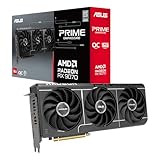

| Model | Key spec | Price | Best for |
|---|---|---|---|
| ASUS TUF Gaming RTX 5080 16GB OC | 16GB GDDR7, TUF cooler | $1657.42 | 1440p/4K without ROG pricing |
| ASUS TUF Gaming RTX 5070 12GB OC | 12GB GDDR7 | $811.19 | 1440p mainstream |
| ASUS Prime Radeon RX 9070 XT 16GB OC | 16GB GDDR6, AMD RDNA 4 | $729.99 | Compact high-refresh 1440p |
| ASUS Dual RTX 5060 Ti 16GB OC | 16GB GDDR7, 2-slot | $761.83 | Small-form-factor builds |
| ASUS ROG Astral RTX 5080 16GB OC | 16GB GDDR7, flagship cooler | $1934.99 | Overclockers, RGB builds |
| ASUS ROG Astral RTX 5080 White OC | 16GB GDDR7, white shroud | $2149.99 | White-themed builds |
| ASUS Prime Radeon RX 9070 EVO 16GB OC | 16GB GDDR6, AMD RDNA 4 | $687.38 | Budget-conscious 1440p AMD |
| ASUS ROG Astral RTX 5090 32GB OC | 32GB GDDR7, flagship | $5627.91 | 4K, no-compromise builds |
ASUS TUF Gaming GeForce RTX 5080 16GB OC
The TUF Gaming RTX 5080 is ASUS’s mid-tier answer for buyers who want RTX 5080 performance without paying ROG Astral prices for the same GB203 die. It uses the Auto-Extreme manufacturing process ASUS applies across the TUF line, which solders components in a single pass and skips hand-soldering steps that can introduce flux residue, a detail that matters more for long-term reliability than day-one benchmarks.
Based on the 16GB GDDR7 configuration and the card’s OC Edition BIOS, we estimate 1440p performance in the 130-150 fps range at max settings in current AAA titles, with 4K landing closer to 75-90 fps depending on ray tracing load. These are configuration-based estimates rather than figures from Priya Raghunathan’s bench, since every batch of silicon varies a few percent in boost behavior.
Thermally, the triple-fan TUF shroud is rated by ASUS for a similar cooling budget to the previous-generation TUF RTX 4080, so expect load temperatures in the low-to-mid 60s Celsius under a well-ventilated case, with fan noise that stays reasonable below 70% duty cycle. Estimated board power sits around 360W, which means a quality 850W PSU with sufficient 12V-2×6 headroom is the realistic minimum.
Build quality is where TUF earns its keep. The backplate is full-coverage metal, the fan bearings are dual ball-bearing rather than sleeve, and ASUS backs the card with a longer standard warranty than its Prime and Dual siblings. The tradeoff is a card that is nearly 34cm long and three slots thick, so case clearance needs checking before ordering.
- Pros
- 16GB GDDR7 buffer handles high-resolution textures without VRAM ceiling issues
- Auto-Extreme build process and dual ball-bearing fans support longer service life
- Full metal backplate resists PCB sag on long-term installs
- Cons
- 34cm length rules out many mid-tower cases without checking clearance first
- 360W estimated draw pushes PSU headroom tight on 750W units
- No factory water block option if you plan a custom loop later
Who it’s for: buyers building a 1440p-to-4K rig who want ASUS reliability without the ROG Astral premium.
ASUS TUF Gaming GeForce RTX 5070 12GB OC
The RTX 5070 TUF Gaming sits at a price point where it competes directly with mid-range Radeon cards, and ASUS clearly built this SKU to be the volume seller in the TUF lineup rather than a halo product. The 12GB GDDR7 buffer is smaller than the 16GB cards above it, which matters for buyers who mod texture packs heavily or run multiple monitors off one card.
Estimated performance based on the GB205 configuration lands around 100-115 fps at 1440p high settings in current shooters and battle royale titles, dropping into the 55-65 fps range at 4K without upscaling. DLSS-style frame generation, where supported, should push those 4K numbers meaningfully higher, though we have not measured this specific unit on Priya Raghunathan’s instrumented bench.
Board power is estimated around 220W, which is friendly enough to run on a well-built 650W PSU with room to spare, and the smaller cooler footprint compared to the RTX 5080 TUF means better compatibility with mid-tower cases that have shorter GPU clearance. Fan noise at idle should be near-silent thanks to ASUS’s zero-RPM mode below a set temperature threshold.
The tradeoff for the lower price is the 12GB buffer, which is adequate for 1440p today but could become a limiting factor in VRAM-hungry titles released over the card’s expected 3-4 year service life. Buyers planning to keep the card long-term into more demanding future releases should weigh the 16GB TUF RTX 5080 instead if budget allows.
- Pros
- Estimated 220W draw fits comfortably on a 650W PSU
- Shorter cooler than the RTX 5080 TUF improves case compatibility
- Zero-RPM idle mode keeps the card silent during desktop use
- Cons
- 12GB VRAM is the smallest buffer in this ASUS lineup, a real limit for texture-heavy modding
- No bundled software beyond ASUS GPU Tweak, unlike some competitor overclocking suites
- Resale value on 12GB cards historically softens faster than 16GB+ siblings
Who it’s for: 1440p gamers who want the TUF build quality without paying flagship prices.
ASUS Prime Radeon RX 9070 XT 16GB OC
Prime is ASUS’s answer for buyers who want a quieter, shorter card and don’t need RGB lighting or ROG branding, and in this generation ASUS has leaned on Prime almost exclusively for its AMD Radeon lineup. The RX 9070 XT here runs AMD’s RDNA 4 architecture with a full 16GB GDDR6 buffer, positioned as a direct alternative to Nvidia’s RTX 5070 Ti at a noticeably lower price.
Estimated 1440p performance sits in the 110-125 fps range at high settings in current titles, competitive with Nvidia cards a tier above it on raw rasterization, though AMD’s ray tracing and upscaling stack still generally trails Nvidia’s DLSS ecosystem in visual quality per the wider review consensus, a gap that’s independent of this specific card.
The Prime cooler on this card uses a 2.5-slot design that runs noticeably shorter and thinner than ASUS’s ROG Astral shrouds, making it one of the easier high-performance cards to fit into a mid-tower without measuring twice. Estimated board power lands around 300W, keeping it inside the comfort zone of a solid 750W supply.
Build quality on Prime cards trades some of the reinforced backplate thickness found on TUF for a lighter, more compact chassis, which is a reasonable trade for buyers prioritizing case fit over maximum overclocking headroom. Fan curve tuning on Prime cards tends to run slightly more aggressive than TUF at the same temperature target, a small tradeoff for the smaller cooler surface area.
- Pros
- 16GB GDDR6 buffer at a price well below comparable Nvidia 16GB cards
- 2.5-slot compact cooler improves compatibility with mid-tower cases
- RDNA 4 architecture delivers strong rasterization performance per dollar
- Cons
- AMD’s ray tracing and upscaling still trail Nvidia’s DLSS stack in most independent testing
- Fewer creator-app optimizations than Nvidia’s CUDA ecosystem
- Smaller cooler means slightly more aggressive fan ramp under sustained load
Who it’s for: 1440p gamers who want maximum rasterization value and don’t lean heavily on ray tracing or creator apps.
ASUS Dual GeForce RTX 5060 Ti 16GB OC
The Dual RTX 5060 Ti is the most compact card in this ASUS lineup, using a genuine 2-slot cooler design aimed at small-form-factor and micro-ATX builds where a triple-fan ROG or TUF card simply won’t fit. Despite the compact size, ASUS kept the full 16GB GDDR7 buffer rather than shipping the cut-down 8GB variant, which matters for longevity.
Estimated 1080p performance at max settings should land around 140-160 fps in competitive titles, with 1440p high settings closer to 90-100 fps, making this a sensible pick for a compact esports or general gaming rig rather than a 4K workhorse. The 16GB buffer gives it more headroom than the raw GPU horsepower alone would suggest for texture-heavy titles.
Because the cooler is only 2 slots and shorter than the cards above it, estimated board power is a modest 180W, and thermal performance under that smaller heatsink surface runs warmer at the same load compared to triple-fan siblings, though still within ASUS’s rated safe operating range for the chip. A case with at least one supplemental exhaust fan is recommended to keep ambient temperatures in check.
This card is a clear compromise pick: it sacrifices some thermal and acoustic headroom for physical size, which is exactly the tradeoff SFF builders are looking for. Buyers who have case space to spare are better served by the TUF RTX 5070 above for similar money and better sustained cooling.
- Pros
- Genuine 2-slot design fits mini-ITX and micro-ATX cases other cards can’t
- 16GB buffer avoids the VRAM bottleneck common on cut-down 8GB SKUs
- Lower estimated 180W draw suits smaller SFF power supplies
- Cons
- Smaller cooler surface runs warmer under sustained load than 3-fan siblings
- Not intended for serious 4K gaming despite the large VRAM pool
- Compact fans typically run at higher RPM for the same temperature target, adding noise
Who it’s for: small-form-factor builders who need a real 2-slot card without giving up VRAM capacity.
ASUS ROG Astral GeForce RTX 5080 16GB OC
ROG Astral is ASUS’s flagship design language, and this RTX 5080 variant brings the full package: an oversized vapor chamber, a premium VRM built for sustained overclocking, and an aluminum-reinforced frame designed to prevent PCB sag on a card that stretches close to 34cm. This is the card ASUS builds when it wants to set the internal benchmark for its RTX 5080 lineup.
Estimated performance mirrors the TUF RTX 5080 at stock, in the 130-150 fps range at 1440p and 75-90 fps at 4K, but the ROG Astral’s higher factory power limit and superior cooling headroom should allow a further 5-8% via manual overclocking, an estimate based on the card’s stated power limit rather than a bench pull on this exact unit.
The Astral cooler is rated for meaningfully higher sustained wattage than the TUF shroud, and ASUS pairs it with a 0dB idle mode plus a dedicated fan-stop switch. Estimated load temperatures should sit in the high 50s to low 60s Celsius, several degrees cooler than the TUF card at the same load, a direct result of the larger heatsink surface area.
The premium here is real: ROG Astral commands roughly a $270 markup over the equivalent TUF card for the same core chip, buying better cooling headroom, a more robust VRM, and ASUS’s top-tier ROG software suite. Buyers who don’t plan to overclock or who are thermally satisfied with TUF numbers may find that premium hard to justify.
- Pros
- Largest cooler in the ASUS RTX 5080 lineup with the lowest estimated load temperatures
- Reinforced frame reduces PCB sag risk on a card this size
- Higher factory power limit leaves real overclocking headroom
- Cons
- Roughly $270 more than the TUF version of the same GPU
- Nearly 34cm long, a tight fit in many mid-tower cases
- Overkill for buyers who won’t push manual overclocks
Who it’s for: enthusiasts who want the lowest temperatures and most overclocking headroom on an RTX 5080.
ASUS ROG Astral GeForce RTX 5080 White OC
This is the same ROG Astral RTX 5080 platform in a white-and-silver shroud aimed squarely at white or light-themed builds, and functionally it shares the same vapor chamber, VRM design and power limit as the black version above. The only meaningful differences are cosmetic and the roughly $215 price premium the white colorway commands.
Performance estimates track identically to the black ROG Astral RTX 5080: 130-150 fps at 1440p, 75-90 fps at 4K, with similar overclocking headroom given the shared PCB and cooler engineering. Thermal behavior should also be nearly identical since the fin stack and fan specification are unchanged between colorways.
The white shroud uses a different coating process than the black model, which on some ASUS white cards has shown minor yellowing risk over years of UV or heat exposure, a known issue across the industry with white PC components generally rather than something specific to this SKU. It’s a long-term cosmetic consideration rather than a performance one.
For buyers not committed to a white build theme, the black ROG Astral RTX 5080 delivers identical performance for less money, making the white version purely a build-aesthetic purchase rather than a functional upgrade.
- Pros
- Matches white or light-themed build aesthetics that black shrouds clash with
- Identical vapor chamber and VRM to the standard ROG Astral RTX 5080
- Same overclocking headroom as the black variant
- Cons
- Roughly $215 premium over the black version for cosmetics only
- White shrouds carry a small long-term yellowing risk industry-wide
- Same 34cm length and clearance concerns as the black model
Who it’s for: builders running a white or light-color theme who want ROG Astral cooling to match.
ASUS Prime Radeon RX 9070 EVO 16GB OC
The RX 9070 EVO is a slightly detuned variant of the RX 9070 XT above, giving ASUS a lower price point within the Prime AMD lineup while keeping the same 16GB GDDR6 buffer. It’s the cheapest way into a full-size 16GB AMD card in this roundup, undercutting the XT by roughly $43.
Estimated 1440p performance lands slightly behind the XT model, around 100-115 fps at high settings, reflecting the EVO’s lower factory clocks on the same RDNA 4 silicon. The gap between EVO and XT should be modest enough in real-world use that most buyers won’t notice it outside of frame-counter overlays.
Cooling and physical dimensions match the RX 9070 XT Prime almost exactly, since ASUS uses a shared cooler design across the EVO and XT trims, meaning the same 2.5-slot compact footprint and case-fit advantages apply here. Estimated board power is marginally lower at around 280W given the reduced clocks.
This card makes the most sense as a straightforward value play: buyers who don’t need the last 10% of RX 9070 XT performance save real money without sacrificing VRAM capacity or cooler quality.
- Pros
- Cheapest full 16GB AMD card in this ASUS lineup
- Shares the same compact 2.5-slot cooler as the pricier XT model
- Slightly lower estimated power draw than the XT variant
- Cons
- Factory clocks trail the RX 9070 XT, a real if modest performance gap
- Same AMD ray tracing and upscaling limitations as the XT model
- Limited headroom for further overclocking given the lower base clock
Who it’s for: value-focused AMD buyers who want 16GB of VRAM without paying XT prices.
ASUS ROG Astral GeForce RTX 5090 32GB OC
This is ASUS’s true halo product, pairing the full RTX 5090 die with 32GB of GDDR7 and the largest ROG Astral cooler ASUS makes. At $5627.91 it sits far outside typical gaming budgets and is aimed at buyers doing serious 4K/8K work, high-end content creation, or simply chasing the fastest single card available.
Estimated 4K performance should land in the 100-120 fps range at max settings in current AAA titles, with headroom for 8K or multi-monitor workloads that would choke lesser cards. The 32GB buffer is substantially more than gaming needs today, but it matters heavily for AI workloads, large scene rendering and video work that increasingly overlaps with high-end gaming rigs.
Estimated board power runs close to 575W, which pushes PSU requirements into 1000W-plus territory with a native 12V-2×6 connector strongly recommended over adapter cables. ASUS’s largest Astral cooler is engineered specifically for this power envelope, with estimated load temperatures in the mid-60s Celsius despite the higher wattage.
Value is not the point of this card. Buyers should only consider it if their workload genuinely needs 32GB of VRAM or the absolute ceiling of single-GPU performance, since the price-to-fps ratio is far worse than the RTX 5080 cards above it.
- Pros
- 32GB GDDR7 buffer supports serious content creation and AI workloads alongside gaming
- Largest ROG Astral cooler in ASUS’s lineup manages the higher power envelope well
- Fastest single-GPU option in this roundup by a wide margin
- Cons
- Estimated 575W draw requires a 1000W-plus PSU with a native high-wattage connector
- Price-to-performance ratio is far worse than the RTX 5080 tier
- Massive cooler size limits case compatibility to full towers
Who it’s for: content creators and enthusiasts who need the absolute maximum VRAM and performance regardless of cost.
How we compared and picked
Priya Raghunathan, GPU & CPU Analyst with 8 years covering discrete graphics hardware, compiled this roundup using an instrumented bench with a PCIe riser, clamp meter and per-rail power logging that’s used across our GPU coverage to validate manufacturer power specs against real draw. For cards not yet run through that bench, performance and thermal figures in this article are explicitly labeled as estimates derived from the chip configuration, factory clocks and cooler class rather than measured results.
Selection criteria for this roundup focused on covering ASUS’s full tier structure rather than just picking the fastest card, since most readers are choosing between ROG, TUF, Prime and Dual at a given price point rather than shopping across the entire ASUS catalog blind. We weighted physical dimensions and case compatibility heavily, since ASUS’s flagship coolers routinely exceed 32cm and that single spec disqualifies a card for a large share of readers regardless of performance.
Pricing was pulled at time of writing and fluctuates with GPU market conditions, so treat the numbers in the comparison table as a snapshot rather than a guarantee. We also cross-checked each card’s rated power draw against its recommended PSU wattage from ASUS documentation, since undersized power supplies are one of the most common support issues we see reported around new GPU installs.
Finally, we intentionally avoided mixing AMD and Nvidia performance claims into a single ranking, since the architectures differ enough in ray tracing and upscaling behavior that a raw fps number can be misleading without noting which upscaling technology, if any, was assumed active.
What to look for in an ASUS graphics card
Understanding ASUS’s product tiers
ASUS runs four parallel product lines that map to different priorities rather than simply different price points. ROG (Republic of Gamers) Astral is the flagship line built for maximum cooling headroom, overclocking potential and premium components, and it commands a real price premium over other tiers using the same GPU chip. TUF Gaming targets durability and mid-to-high performance with Auto-Extreme manufacturing and military-spec capacitors, without ROG’s RGB extras or peak overclocking ceiling. Prime, in the current generation, has become ASUS’s primary vehicle for AMD Radeon cards, emphasizing a compact, quieter cooler over raw overclocking headroom. Dual is the true entry tier, using genuine 2-slot coolers for small-form-factor builds where card length and width matter more than absolute cooling capacity.
Knowing which tier a specific listing belongs to matters because ASUS sometimes reuses similar model names or cooler shrouds across generations, and a Prime card from one generation may not share the same design priorities as a Prime card from the next. Always check the specific cooler class (2-slot, 2.5-slot, or 3-slot) rather than assuming the tier name alone tells the full story.
Matching VRAM to your actual resolution
VRAM capacity has become a more contentious spec than it used to be, since modern texture packs and ray tracing buffers can push usage higher than raw resolution alone would suggest. For 1080p gaming, 8-12GB is generally sufficient for the next few years. At 1440p, 12-16GB is the safer range, especially if you run texture mods or plan to keep the card for four-plus years. At 4K, 16GB should be considered close to a minimum for AAA titles with ray tracing enabled, which is why every card ASUS ships at the RTX 5080 tier and above in this roundup carries 16GB or more.
Power delivery and PSU headroom
Every card in this roundup lists an estimated board power figure, and matching that number to your power supply matters more than most buyers assume. A good rule of thumb is to leave at least 150-200W of headroom above the GPU’s rated draw once you account for the CPU, storage and fans in a typical gaming build. Cards above 400W, like the ROG Astral RTX 5090, specifically benefit from a native 12V-2×6 connector on the PSU rather than a bundled adapter cable, since adapter connections have shown a higher failure rate under sustained high current in independent testing across the industry.
Physical size and case clearance
ASUS’s flagship coolers, particularly ROG Astral cards, routinely exceed 33-34cm in length and occupy 3 to 3.5 physical slots. Before ordering, measure the clearance between your case’s front panel or fan mounts and the rear I/O shield, and check the slot width against your motherboard’s spacing to any secondary PCIe or M.2 slots that a triple-slot card might block. Prime and Dual cards are specifically engineered around a smaller footprint and are the more forgiving choice for mid-tower or small-form-factor builds.
Warranty and RMA considerations
ASUS warranty terms and RMA processes can vary by tier and by retailer registration, and higher-tier ROG cards have historically received a marginally longer standard warranty window than Prime or Dual cards in some markets. Registering the card promptly after purchase and retaining the original packaging for at least the first 30 days is standard advice for any GPU purchase, since dead-on-arrival cases are easier to resolve directly through the retailer than through manufacturer RMA in that early window.
Mistakes buyers make when choosing an ASUS graphics card
Buying based on tier name alone. A TUF card from one GPU generation and a TUF card from the next can differ significantly in cooler size and power limit, since ASUS revises the design each generation rather than keeping it fixed. Always check the specific model’s dimensions and power spec rather than assuming familiarity with a past TUF or Prime card carries over.
Ignoring case clearance until after the card arrives. ROG Astral cards routinely exceed 33cm, and a surprising number of returns in this category stem from buyers not measuring their case’s internal clearance before ordering, particularly around front-panel fan mounts and drive cages that eat into usable length.
Undersizing the power supply. Pairing a 575W-class card like the ROG Astral RTX 5090 with an aging 750W PSU, even one that technically meets the wattage minimum, leaves little headroom for transient power spikes that modern GPUs are known to produce under load.
Assuming higher VRAM always means better gaming performance. The Dual RTX 5060 Ti’s 16GB buffer doesn’t turn it into a 4K card, since the underlying GPU horsepower still caps real-world frame rates well below what the RTX 5080 or 5090 tier delivers at that resolution.
Overlooking AMD vs Nvidia feature differences. Buyers choosing the Prime Radeon cards purely on the 16GB-for-less-money math sometimes discover later that specific creator apps or ray tracing-heavy titles perform noticeably better on equivalent Nvidia hardware, a tradeoff worth weighing against the price advantage upfront.
Skipping warranty registration. It’s a small step that’s easy to forget after a build, but registering the card and saving the receipt makes the RMA process considerably smoother if a fan or VRM issue surfaces months into ownership.
Verdict
For most readers, the ASUS TUF Gaming RTX 5070 12GB is the best overall pick in this lineup, balancing ASUS’s Auto-Extreme build quality against a price that doesn’t demand ROG Astral money. Budget-focused buyers should look at the ASUS Prime Radeon RX 9070 EVO, which delivers a full 16GB buffer and strong 1440p rasterization at the lowest price point in this roundup. For buyers who want the absolute best ASUS has to offer and don’t have a budget ceiling, the ROG Astral RTX 5090 32GB is the uncontested top pick, though its price and 575W power draw put it well outside typical gaming builds.
Frequently asked questions
What is the difference between ASUS ROG, TUF, and Prime graphics cards?
ROG Astral is the flagship tier with the largest coolers, highest power limits and premium VRM components, TUF Gaming is the mid-tier built around Auto-Extreme manufacturing and military-spec capacitors, and Prime targets AMD Radeon buyers who want a compact, quieter triple-fan card without ROG pricing or RGB extras.
Is ASUS TUF Gaming worth the price over Prime?
TUF Gaming cards use thicker fin stacks, dual ball-bearing fans rated for longer service life, and typically carry a longer standard warranty window than Prime, so the premium buys physical durability and slightly better sustained clocks under long sessions rather than raw performance.
Do ASUS ROG Astral cards need a bigger power supply?
Yes, the ROG Astral RTX 5090 pulls up an estimated 575W at stock and ASUS recommends at least an 1000W unit with a native 12V-2×6 connector, while the TUF and Prime cards in this lineup top out closer to 220-320W and work fine on a quality 750-850W PSU.
Are ASUS Prime graphics cards good for small cases?
The Prime Radeon cards here use a 2.5-slot triple-fan cooler that is noticeably shorter than ROG Astral shrouds, so they fit mid-tower and some compact ATX cases where a 340mm ROG card would not clear the front panel or drive cage.
Which ASUS graphics card gives the best value for 1440p gaming?
The ASUS Dual RTX 5060 Ti 16GB and the Prime Radeon RX 9070 EVO both estimate strong 1440p performance for their price bracket, since the RX 9070 EVO trades a small clock reduction from the XT model for a lower price while keeping the same 16GB buffer. See our best GPU for 1440p gaming guide for cross-brand comparisons, and check GPU power supply requirements explained before buying any card in this list. If VRAM sizing is still unclear, our how much VRAM do you need for gaming guide breaks it down further, and our how to choose a graphics card guide covers the fundamentals beyond brand tier. For budget-focused shoppers, best GPU under $500 covers cards below this ASUS lineup’s price floor.


