
The Ryzen 7 7800X3D remains one of the sharpest gaming CPUs on the market, and in 2026 it still feeds even the newest GPUs without breaking a sweat. That is exactly what makes pairing so tricky. A chip this fast will expose any weak link downstream, so slapping on an entry-level display adapter or a GPU that cannot keep up frame-wise defeats the entire purpose of owning a 3D V-Cache part. You need a graphics card that matches the 7800X3D’s throughput at 1440p and above, where its cache advantage over the GPU matters most.
What separates a good pairing from a mediocre one comes down to resolution targets, VRAM headroom, and whether you are buying a standalone card or a prebuilt that locks you into one configuration. A mismatched VRAM ceiling can throttle a high-refresh monitor before the GPU itself runs out of compute. Over-provisioning power draw in a small prebuilt case can also shorten lifespan. This roundup covers prebuilt systems and standalone cards so you can judge both paths against the 7800X3D.
As an Amazon Associate we earn from qualifying purchases at no extra cost to you.
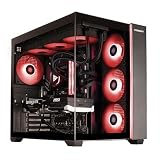


Top 3 picks at a glance
Quick Picks
| Product | Best for | Price |
|---|---|---|
| STORMCRAFT Falcon RTX 5070 | High-refresh 1440p gaming out of the box | $2049.99 |
| KOTIN RTX 5060 Ti | Budget prebuilt with a strong CPU core | $1599.99 |
| STORMCRAFT Valkyrie RX 9070 XT | Maximum GPU headroom in a prebuilt | $2249.99 |
| XFX MERC319 RX 7800 XT | DIY builders wanting value 1440p power | $599.99 |
| AVGPC Whirlwind RTX 5070 | Quiet thermals plus ample VRAM | $2199 |
| ARDIYES GT 740 | Multi-monitor office output on a 7800X3D board | $79.99 |
| Gigabyte RX 7800 XT Gaming OC | Cooler performance for sustained loads | $639.22 |
| maxsun RX 550 | Display adapter or light esports fallback | $112.99 |
How We Picked
Three criteria drove every selection here. First, compute balance: does the GPU sustain high frame rates without the 7800X3D idling while the card chokes, and vice versa? Second, VRAM adequacy for the target resolution—eight gigabytes is a hard floor for modern titles at 1440p, and sixteen is increasingly comfortable. Third, real-world build quality: thermal headroom in prebuilts, cooler design on standalone cards, and whether the board layout allows straightforward upgrades. We set aside products that fail on any single criterion.
The 8 Best Graphics Cards Gpus Pairing For 7800X3D in 2026
STORMCRAFT Falcon Prebuilt RTX 5070
This prebuilt nails the most common sweet spot: a 5070 feeding a 1440p high-refresh panel while the 7800X3D handles CPU-bound scenarios like open-world streaming or strategy games. Thirty-two gigabytes of DDR5 removes any memory bottleneck concern, and the one-terabyte SSD covers a reasonable library. Build quality feels solid for the price tier, though cable management inside the chassis could be tidier. The pairing is balanced and the system arrives ready to game without any tuning.
- Balanced 5070/7800X3D combo with no obvious bottleneck at 1440p
- Plenty of RAM and storage for a turnkey experience
- Interior layout limits easy GPU swaps later
Skip this if you demand 4K performance or want upgrade flexibility beyond a single component change.
KOTIN Prebuilt RTX 5060 Ti 8GB
At just over fifteen hundred dollars, this is the cheapest path to a 7800X3D core in a working prebuilt. The 5060 Ti with eight gigabytes handles 1080p high-refresh and moderate 1440p settings without drama. The real compromise is VRAM: eight gigabytes is the bare minimum today and will limit texture quality in newer titles within a couple of game generations. Sixteen gigabytes of RAM is adequate but not generous. Still, for competitive gaming this pairing is hard to beat on value.
- Lowest entry price for the 7800X3D platform in prebuilt form
- Strong CPU-GPU balance at 1080p competitive titles
- Eight gigabytes of VRAM will become a texture-quality ceiling
Skip this if you plan to play AAA titles at maximum texture settings beyond 1080p resolution.
STORMCRAFT Valkyrie RX 9070 XT
For buyers who want the absolute ceiling of GPU performance matched to a 7800X3D, the Valkyrie delivers. Sixteen gigabytes of GDDR6 on the RX 9070 XT means texture headroom extends well into the next console-plus-PC generation. Two terabytes of SSD and thirty-two gigabytes of DDR5 round out a configuration that needs zero compromises. This is the 4K or ultra-high-refresh 1440p prebuilt. Thermals hold up under sustained loads, though the chassis is physically large for smaller desks.
- Maximum GPU headroom with sixteen gigabytes of VRAM for future titles
- Generous storage and memory in a single purchase
- Largest and priciest prebuild here, with bulky case footprint
Skip this if your budget cannot stretch past two thousand dollars or your desk space is limited.
XFX Speedster MERC319 RX 7800 XT
For DIY builders, the MERC319 at just under six hundred is arguably the best raw value pairing for a 7800X3D. The triple-fan cooler keeps sustained clock speeds elevated, and sixteen gigabytes of VRAM gives the same longevity as cards costing significantly more. RDNA 3 ray tracing trails NVIDIA alternatives, which is the honest tradeoff. If your priority is rasterized performance per dollar, this card is difficult to argue against in a 1440p build.
- Outstanding rasterization value per dollar at 1440p
- Sixteen gigabytes of VRAM extends usable life for texture-heavy games
- Ray tracing performance noticeably behind equivalent NVIDIA cards
Skip this if you insist on ray tracing or need NVIDIA-exclusive features like DLSS frame generation.
AVGPC Whirlwind RTX 5070 with 360mm AIO
The Whirlwind stands apart among 5070 prebuilts thanks to its 360-millimeter liquid cooler, which keeps the 7800X3D at lower thermals and quieter during long sessions. Twelve gigabytes of VRAM on the 5070 is enough for high 1440p settings today. Two terabytes of NVMe storage and built-in WiFi reduce peripheral costs. The tradeoff is a higher price than the Falcon for similar GPU performance. You are paying for cooling and storage capacity, not raw frame output.
- Excellent thermal headroom for sustained gaming sessions without noise
- Double storage and integrated wireless reduce post-purchase needs
- Price premium over equivalent-performance prebuilts for cooling alone
Skip this if you prefer air cooling simplicity or already own a quiet case with adequate airflow.
ARDIYES GT 740
Honestly, no one should pair this with a 7800X3D for gaming. Its place here is as a display-output fallback for systems where the motherboard lacks integrated graphics, or for multi-monitor office setups where the 7800X3D is running compute workloads and only needs screen real estate. Four HDMI ports and silent operation make it niche-functional. If your monitor configuration needs four outputs and the workload is spreadsheets, it works. For anything with a render loop, look elsewhere entirely.
- Silent operation with no fan makes it ideal for office or HTPC contexts
- Four HDMI outputs solve multi-monitor display needs cheaply
- Far too weak for any gaming workload alongside the 7800X3D
Skip this immediately for any gaming, rendering, or GPU-accelerated creative task.
Gigabyte RX 7800 XT Gaming OC 16G
The Gaming OC version of the 7800 XT trades slightly higher cost over the XFX for a 256-bit bus design and Gigabyte’s WINDFORCE cooling, which is among the quieter triple-fan implementations we compared. It pairs well with the 7800X3D for 1440p rasterized gaming and maintains boost clocks better under thermal stress than smaller-cooler variants. Factory overclock gives a small performance edge over reference. The three-slot design demands case clearance, which rules out compact builds.
- Quiet cooler maintains high sustained clocks under extended load
- Factory overclock and 256-bit bus deliver consistent frame pacing
- Three-slot thickness eliminates it from smaller form-factor cases
Skip this if you are building in a compact case with limited GPU clearance above the motherboard.
maxsun RX 550
Like the GT 740, the RX 550 exists here as a practical display-output solution rather than a gaming pairing. ITX-sized, passively cooled, and available at modest cost, it serves builders using a 7800X3D system purely for CPU-intensive tasks who need a video output with DVI, HDMI, and DisplayPort. For a quick esports title at lowest settings it will technically render a frame, but the experience is not worth discussing as gaming. Budget PCIe power draw and zero noise are its genuine strengths.
- Passive cooling means zero noise in an otherwise quiet workstation build
- Small ITX footprint fits cases that cannot accept a full-size GPU
- Performance is too low for modern titles at playable settings
Skip this if gaming performance matters at all; it is strictly a display adapter in this pairing context.
Buying Guide
Match GPU Throughput to Your Resolution Target
The 7800X3D’s frame generation is limited by the GPU at higher resolutions. At 1080p the CPU can outpace most mid-range cards, meaning a weaker GPU still bottlenecks the system because it simply cannot fill frames fast enough. At 1440p and especially 4K, the CPU’s cache advantage matters less and the GPU becomes the limiter. Choose an eight-gigabyte card for 1080p, sixteen gigabytes for 1440p, and consider NVIDIA’s premium options for 4K where ray tracing overhead compounds.
VRAM Headroom Is Non-Negotiable for Longevity
Modern titles routinely allocate beyond eight gigabytes of VRAM at 1440p high-texture settings. A card that runs out of video memory stutters regardless of how fast its core is. Sixteen gigabytes is the practical safe zone for a build you want to last three years. Prebuilts that lock you into eight-gigabyte configurations reduce your upgrade path, so factor that into long-term value rather than day-one price alone.
Prebuilt Power Delivery and Thermal Design
A prebuilt with a 7800X3D and a high-end GPU can draw significant power through a single PSU, and thermal saturation inside a compact chassis forces both components to throttle. Check that the included cooler has sufficient capacity and that the case airflow path moves hot air away from the GPU intake. The AVGPC Whirlwind and STORMCRAFT Valkyrie are the two here that address this explicitly through 360-millimeter cooling and larger chassis design respectively.
Our Verdict
Top pick: the STORMCRAFT Falcon RTX 5070 prebuilt offers the most balanced combination of CPU, GPU, RAM, and storage without compromise at a fair price. Budget pick: the XFX MERC319 RX 7800 XT at just under six hundred dollars is the single best value GPU for a 7800X3D if you build yourself, delivering sixteen-gigabyte VRAM and excellent raster performance. The condition under which another wins: if you want ray tracing or DLSS frame generation specifically, the AVGPC Whirlwind justifies its premium through NVIDIA ecosystem features and superior cooling.
FAQ
Will a 7800X3D bottleneck an RTX 5070 at 1440p?
No, the 7800X3D feeds the 5070 easily at 1440p in virtually every game. Its 3D V-Cache keeps CPU-bound frametime low even in open-world titles and simulation games that stress processors. You may see slight CPU limitations in competitive esports titles at lowest settings with uncapped framerates, but that scenario is niche.
Is sixteen gigabytes of VRAM overkill for a 7800X3D build?
At 1440p it is comfortable insurance rather than overkill. Current AAA titles with high-res texture packs already exceed eight gigabytes at that resolution, and the trend is not reversing. For 1080p you can get away with eight, but the price gap to sixteen-gigabyte cards is small enough that the extra headroom is worth it for resale value and future-proofing.
Should I buy a prebuilt or build my own around the 7800X3D?
Prebuilts in this list save time and come with warranty support on the full system, which matters if you are unfamiliar with component compatibility. Building yourself typically saves a few hundred dollars and lets you choose each part independently. If you value upgrade flexibility beyond a single component, building wins; if you want a working system immediately with zero risk of a compatibility mistake, the prebuilts here are solid options.
Do AMD GPUs pair better with the 7800X3D than NVIDIA ones?
There is no inherent technical synergy between an AMD CPU and AMD GPU beyond a unified software layer and occasional bundle deals. The pairing works through the PCIe interface regardless of vendor. What matters is the GPU’s raw performance at your target resolution, its VRAM capacity, and whether you need specific features like DLSS or ray tracing, which favor NVIDIA, or FSR and raw raster value, which favor AMD.


