
Most buyers shop for an NVMe heatsink like it’s just a chunk of aluminum, then wonder why their SSD still thermal throttles or why the heatsink won’t fit at all. The most common mistake is assuming any 2280 heatsink will clear your motherboard’s built-in shield, GPU, or PS5 bay. A second mistake is ignoring the total stack height — heatsink plus thermal pad plus SSD plus motherboard standoff — and buying a towering fin stack that presses against a graphics card or laptop chassis. A third is picking the cheapest double-sided cooler with thick silicone pads that actually insulate the drive instead of cooling it, or using pads so thick they bow the board. Thickness clearance is not a minor detail; it determines whether the cooler physically fits, whether it makes proper contact, and whether it helps or hurts sustained write performance. Get the thickness right and everything else falls into place.
Top 3 picks at a glance

Decide These 3 Things First
Before you compare brands or fin counts, lock in these three decisions. They narrow the field from hundreds of options to a handful that will actually work in your system.
As an Amazon Associate we earn from qualifying purchases at no extra cost to you. Product prices and availability are accurate as of the date shown and are subject to change.


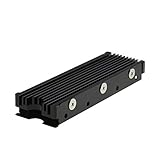
1. Where is the drive installed? A desktop motherboard with a pre-installed M.2 shield, a PS5 expansion slot, and a compact Mini-ITX or laptop are three totally different clearance scenarios. Desktop M.2 slots under a GPU often have only 8 to 12 mm of clearance above the SSD PCB. The PS5 M.2 bay allows a total assembly height of 11.25 mm from the top of the SSD to the top of the heatsink. Laptops may allow less than 3.5 mm. Your location dictates your maximum thickness budget.
2. Single-sided or double-sided SSD? Most 1TB and 2TB NVMe drives in 2026 are single-sided, with all NAND and controller on the top. High-capacity 4TB+ drives and some older PCIe 3.0 models are double-sided with chips on the bottom. Double-sided drives need a bottom thermal pad or a two-piece heatsink, which adds 1.0 to 2.5 mm to total stack height and complicates clearance over motherboard standoffs.
3. Do you need a replacement or an add-on? If your motherboard already has a thick integrated heatsink with a thermal pad, you should measure that first — many OEM shields are 6 to 9 mm thick and perform well enough that an aftermarket cooler is unnecessary or won’t fit underneath. If you have a bare M.2 slot with no shield, you have full control but also full responsibility to get thickness, pad compliance, and mounting pressure right.
Size and Thickness Clearance: The Numbers That Matter
Clearance is a stack-up calculation. Start with the standard.
An M.2 2280 SSD itself is 22 mm wide and 80 mm long. The PCB is about 0.8 to 1.0 mm thick. Components on top (controller, NAND packages, DRAM) add 1.0 to 2.2 mm. Without any heatsink, the top of the tallest chip typically sits 2.0 to 3.0 mm above the motherboard surface when mounted on the 2.3 to 3.5 mm tall M.2 standoff.
An aftermarket heatsink adds its own height. Here is how common designs break down:
- Ultra-low-profile copper/graphene spreader: 1.5 to 2.8 mm total thickness, weight 8 to 15 grams. Designed for laptops and PS5 secondary clearance limits.
- Slim aluminum slab with one flat fin channel: 3.0 to 5.5 mm thick, weight 18 to 32 grams. The most universal fit for desktops under GPUs.
- Standard finned aluminum heatsink: 6.5 to 10 mm thick, weight 35 to 58 grams. Good surface area but often too tall for GPU-adjacent slots.
- High-performance tall fin or heat-pipe tower: 11 to 17 mm thick, weight 60 to 95 grams. Only suitable for open M.2 slots away from the GPU, such as top slots with no card overhang or PCIe add-in cards.
To check your real limit, measure from the top of the bare SSD PCB to the nearest obstruction (GPU backplate, motherboard armor, case panel, or PS5 metal cover) with a ruler or calipers. Subtract 0.5 to 1.0 mm for airflow and mounting tolerance. For PS5, Sony’s specification is absolute: the heatsink assembly from the SSD surface cannot exceed 11.25 mm, and the total width including heatsink must stay under 25 mm. For desktop, if your GPU overhangs the M.2 slot, keep total assembly under 9 mm unless you have confirmed at least 12 mm of gap with the card installed.
Also check length and width interference. Some double-sided heatsinks use a bottom plate that is 24 to 25 mm wide and can collide with adjacent M.2 standoff screws or tall capacitors near the slot. Always confirm your motherboard manual lists 2280 support and not just 2242/2260 for that slot.
Material and Thermal Interface: What Actually Transfers Heat
Material matters, but not as much as marketing suggests. The differences are predictable without lab claims.
Extruded aluminum (6063 alloy) is the standard for every budget to mid-tier heatsink. It is light, inexpensive to machine into fins, and offers thermal conductivity around 200 W/mK. It is sufficient for SSD controllers that typically dissipate 3.5 to 8.5 watts under sustained writes.
Copper or copper-base plates have conductivity near 385 W/mK but weigh roughly 3 times more than aluminum for the same volume. A copper plate can be thinner for the same heat spreading, which helps clearance, but it adds weight (45 to 80 grams) that puts more stress on the M.2 screw and slot. Full copper fin stacks are rarely worth the weight and cost for NVMe, where heat density is localized at the controller.
Thermal pads are the critical interface. Pads are usually silicone-based with conductivity ratings of 3 to 12 W/mK. Thickness options commonly sold are 0.5 mm, 1.0 mm, 1.5 mm, and 2.0 mm. For clearance, thinner is better, but only if contact is complete. A 0.5 mm pad requires a very flat heatsink and low component height variance; a 1.0 mm pad is the most forgiving universal choice because it compresses 20 to 40 percent to fill 0.8 to 1.5 mm gaps around the controller and NAND. Avoid stacking two 1.5 mm pads to make up for a poor fit — that adds 3.0 mm and increases thermal resistance. Single-sided pads with plastic film on one side must have the film removed before installation.
For double-sided cooling, the bottom pad between SSD and motherboard or bottom heatsink plate should be softer (Shore 00 30-50) and 1.0 to 1.5 mm thick to avoid bending the PCB when the M.2 screw is tightened. Over-compression can flex the drive and crack solder joints over time.
Construction and Fin Design: How Thickness Affects Cooling
Construction determines whether thin still cools.
A solid aluminum slab with no fins (2.5 to 4.0 mm thick) relies entirely on thermal mass and surface radiation. It is silent and fits everywhere, but it saturates faster during long 100GB+ file transfers because it has only about 12 to 18 square centimeters of surface area.
A finned design with 4 to 11 fins, each 0.6 to 1.2 mm thick with 1.2 to 2.5 mm spacing, increases surface area to 35 to 75 square centimeters without adding excessive height if the fins are short (3 to 6 mm fin height). Fin height is the main driver of total thickness. A heatsink that is 4.5 mm at the base plus 5 mm fins totals 9.5 mm and will not fit under most GPUs. Look for fin orientation: fins running lengthwise along the 80 mm axis align with typical case airflow from front to rear, while crosswise fins can trap heat if there is no direct airflow.
Two-piece clamp designs (top sink plus bottom plate joined by clips or screws) add rigidity and cool double-sided drives, but they add 2.0 to 3.5 mm below the PCB and require you to remove the motherboard’s factory M.2 standoff collar. Clip retention should be snug but not require excessive force. If you have to press hard to close the clips, your pad stack is too thick.
Mounting matters for thickness stability. Options include an elastic rubber band/ring, a wire clip, or a screw-through design. Rubber rings add almost no height but can slip if pads are oily. Metal clips add 0.5 to 1.0 mm on top and hold pressure more consistently. Avoid adhesives or tape that leaves residue and makes future removal risky.
Compatibility, Performance, and System Clearance
A heatsink can only help if air can move. The performance question is not how cold it gets idle, but how long it delays thermal throttling under sustained load.
Most NVMe controllers begin to throttle between 75 and 82 degrees Celsius, then sharply reduce write speed. A properly fitted low-profile heatsink (3 to 6 mm thick) with a 1.0 mm pad typically keeps throttle onset later during extended writes compared to a bare drive, simply because the extra mass and area spreads the 5 to 8 watt heat pulse. A taller finned sink can extend that further, but only if there is at least 3 to 5 mm of open air above the fins and case airflow of at least 30 to 50 CFM across the motherboard. In a tight sandwich under a hot GPU backplate (which can be 55 to 70 degrees Celsius during gaming), a thick heatsink can actually soak heat from the GPU and perform worse than a slim spreader.
Check these compatibility points with numbers:
- GPU clearance: With GPU installed, slide a 10 mm thick stack of coins or a caliper gauge over the M.2 area. If it touches the GPU, you need sub-6 mm.
- Motherboard integrated shield: If your board ships with a shield, its underside pad is often 0.75 to 1.25 mm. Aftermarket heatsinks cannot be stacked under it; you must choose one or the other.
- PS5: Measure total height with pads installed. If you are at 10.5 to 11.25 mm, you are at the limit. The side walls of the PS5 bay leave only about 1.5 mm per side beyond a standard 22 mm drive.
- Laptop/Steam Deck-style handheld: Only use sub-3.0 mm spreaders and confirm the bottom case still closes without pressure marks.
Weight is also a form of clearance. Heatsinks over 60 grams on a vertically mounted M.2 slot (common on some motherboards) can vibrate during shipping or PC moves. Keep to under 50 grams if your system is moved frequently.
Price Tiers: What You Should Expect to Pay
NVMe heatsinks are inexpensive, but price does correlate with machining quality and included pads.
Budget tier, $4 to $9: Single-piece extruded aluminum slab or basic 4-6 fin design, often sold in 1-pack or 5-packs. Includes one or two gray silicone pads (usually 0.5 mm and 1.0 mm). Thickness typically 3 to 7 mm. Weight 18 to 35 grams. Tolerances are looser, so check flatness — place the heatsink on glass; if it rocks, lap it or choose another unit. This tier is fine for closing the gap on a bare desktop slot when clearance is generous.
Mid tier, $10 to $20: Better anodizing, more consistent base flatness, often includes two pad thicknesses and a proper wire clip or screw mount. Examples include PS5-specific designs that guarantee sub-11.25 mm total height and 22 to 24 mm width. Thickness is precisely documented (for example, 4.2 mm or 7.6 mm total). Weight 25 to 55 grams. This is the sweet spot for most buyers who need guaranteed PS5 or GPU clearance.
Premium tier, $21 to $45: Copper base, machined aluminum fins, or integrated heat pipe for PCIe 5.0 drives that can pull 10 to 12 watts. Often includes premium pads rated 8 to 12 W/mK and separate top/bottom plates for double-sided drives. Thickness often 8 to 14 mm and not intended for tight slots. Buy this only for open desktop slots with PCIe 5.0 x4 drives where sustained write workloads exceed 30 seconds at full speed.
Do not pay extra for RGB or elaborate top covers — they add 1.5 to 3.0 mm and impede airflow for no thermal benefit.
Warranty, Delivery, and Assembly
Warranty on a passive heatsink is simple but worth reading. Most sellers offer 30-day returns and a 12-month defect warranty covering machining flaws (warped base, missing clips). Keep the original pads unused if you think you may return it, as many sellers will not accept installed thermal pads. Heatsinks themselves cannot damage an SSD when properly installed, but over-tightening the M.2 screw with an overly thick pad stack can void the SSD warranty if the PCB is cracked — follow torque by feel: snug, not forced, until the screw stops without bowing the drive.
Delivery is straightforward: these ship as small parcels weighing 0.05 to 0.25 lbs, typically in a padded envelope or small box. No assembly service exists for this part — installation is a 5 to 10 minute DIY job. You need a PH1 or PH0 Phillips screwdriver and isopropyl alcohol to clean the SSD label if you want direct contact (most drives cool fine through the label; removing the label may void the SSD warranty, so leave it on unless the SSD maker explicitly permits removal). Installation steps are: power off and unplug, remove GPU if it blocks access, remove existing M.2 shield, place bottom pad if double-sided, set top pad, seat heatsink, secure with clip or band, and re-torque the M.2 screw without lifting the drive at an angle.
If you order a multi-pack for several workstations, verify every slot’s clearance individually. A heatsink that fits the top M.2_1 slot may not fit M.2_2 directly under the GPU on the same board.
Spec Checklist
| Spec | Budget | Mid | Premium |
|---|---|---|---|
| Total Thickness (with pad compressed) | 3.0 – 7.0 mm | 3.5 – 8.5 mm (PS5-safe options at 5.0 – 11.25 mm) | 8.0 – 14.0 mm |
| Weight | 18 – 35 g | 25 – 55 g | 50 – 95 g |
| Material | 6063 aluminum, extruded | 6063 aluminum, milled/anodized; options with copper base | Copper base + aluminum fins or full copper, optional heat pipe |
| Fin Design | Solid slab or 4-6 short fins, 1.5-3.5 mm fin height | 6-11 fins, 3.0-6.0 mm fin height, lengthwise airflow orientation | 10+ fins or heat pipe, 6-10 mm fin height, high surface area 55-90 sq cm |
| Thermal Pads Included | 1-2 gray silicone pads, 0.5 mm + 1.0 mm, ~3-6 W/mK | 2 pads: 0.5/1.0/1.5 mm options, ~6-8 W/mK, pre-cut to 22×70 mm | 2-3 pads including bottom plate pad, 1.0-1.5 mm, ~8-12 W/mK |
| Width / Length Footprint | 22 x 75 mm | 22 – 24 x 78 – 82 mm (PS5 width capped at 25 mm) | 24 – 25 x 80 – 83 mm, may overhang slot edges |
| Mounting | Rubber band/elastic ring | Wire clip or screw clamp, even pressure | Screw-through with backplate, controlled pressure |
| Ideal Use Case | Bare desktop slot with no GPU overhang | PS5, GPU-adjacent desktop slot, single-sided 2280 drives | PCIe 5.0 workstation drives in open slots with strong case airflow |
| Price Range (2026) | $4 – $9 per unit, $6 – $22 for 5-packs | $10 – $20 per unit | $21 – $45 per unit |
Red Flags
Avoid these warning signs when evaluating thickness and clearance claims:
- No listed total thickness or only lists fin height without base and pad. You need compressed total height, not marketing images.
- Includes two thick 1.5 mm pads to be stacked together. Stacked pads add thermal resistance and often push you over PS5 or GPU limits.
- Claims universal PS5 compatibility but total height with pads exceeds 11.25 mm or width exceeds 25 mm.
- Requires removing the SSD’s factory label with a warning that warranty is unaffected — leaving the label on is almost always safer and has minimal impact.
- Heatsink base is visibly concave or rocks on a flat surface, or the package contains metal shavings from poor machining.
- Weight over 70 grams with only a single M.2 screw mount and no backplate, especially for vertically oriented slots.
- Seller shows the heatsink installed under a motherboard’s integrated shield — you should use one or the other, not both stacked.
FAQ
How do I measure clearance without calipers?
Use a simple stack test. Place the SSD in the slot without a heatsink, then stack coins or business cards over the SSD until you touch the obstruction (GPU, shield, or case cover). A US penny is 1.52 mm thick, a nickel is 1.95 mm, and a standard business card is about 0.3 mm. Add your stack to find the gap, then subtract 1.0 mm for safety. For PS5, if you do not have calipers, assemble the SSD, pads, and heatsink outside the console and measure the total with a ruler against a flat table — the top of the assembly should sit at or below 11.25 mm above the table when the SSD PCB is flat on the table.
Can a heatsink be too thick?
Yes. Too thick can be worse than none. If fins press against a GPU backplate, heat transfers from the hotter GPU into the SSD. If a tall sink blocks all airflow in a cramped bay, hot air recirculates. And if thick pads create excessive pressure, the SSD can bow upward between the M.2 standoff and screw, stressing the connector. For most GPU-adjacent slots, stay under 6 mm total; for open slots with good front-to-back airflow, 8 to 12 mm is usable; for PS5, never exceed 11.25 mm.
Do I need a double-sided heatsink?
Only if your drive is double-sided or your motherboard manual recommends bottom-side cooling. Check the bottom of your SSD — if you see NAND packages on the back, use a two-piece design with a 1.0 to 1.5 mm soft bottom pad. If the bottom is bare PCB with only a label, a single top heatsink with a 0.5 to 1.0 mm pad is sufficient and preserves 2 to 3 mm of clearance under the drive. Bottom plates also help when the M.2 slot is on the back of the motherboard with limited airflow.
Should I remove the motherboard’s built-in M.2 shield to use an aftermarket heatsink?
Use one system at a time. Motherboard integrated shields are engineered for that specific board’s standoff height and usually include a 0.75 to 1.25 mm pad with good coverage. They often cool as well as a $6 slab in real case conditions. If your shield is thin (under 4 mm) and fits poorly, you can replace it with a mid-tier aftermarket heatsink of similar or slightly taller thickness that you have verified will clear the GPU. Do not stack the aftermarket heatsink on top of or under the factory shield — that doubles thickness to 10 to 16 mm and guarantees interference and poor contact.
