
Running out of storage on a laptop is not a hypothetical problem. Game libraries exceed 500 GB, project files balloon after a single semester, and cloud subscription costs accumulate into real money. A 1 tb external hard drive solves the immediate capacity crisis for under a hundred dollars, which is why this category remains one of the highest-volume searches in PC hardware. But the gap between a drive that survives two years of daily commutes and one that disconnects mid-transfer or fails after six months is significant, and price alone does not predict which camp a model lands in.
What separates the best 1 TB external hard drives from mediocre ones comes down to three things most spec sheets understate: the quality of the USB bridge controller, whether the included software actually works across the operating systems you use, and how well the physical enclosure resists drops and cable strain. The options below range from established manufacturers with decades of firmware refinement to budget newcomers that undercut on price but carry less track record. We compared published specifications, pricing, and aggregated owner feedback to sort the field.
As an Amazon Associate we earn from qualifying purchases at no extra cost to you.




Top 3 picks at a glance
Quick Picks
| Product | Best For | Price |
|---|---|---|
| Seagate Portable 1TB | Balanced reliability and support | $119.80 |
| Seagate 2TB Portable | Maximum capacity per dollar | $129.99 |
| UnionSine 1TB Ultra Slim | Low-profile daily carry | $84.72 |
| Maxone 1TB Ultra Slim | Best value from a budget brand | $77.99 |
| YOTUO 1TB USB-C + 3.0 | Dual-connection versatility | $82.99 |
| YOTUO 1TB 7-in-1 Hub | Laptop users without port hubs | $79.99 |
| Maxone 1TB Ultra Slim | Cost-conscious bulk backup | $77.99 |
| UnionSine 500GB Ultra Slim | Light files on a tight budget | $37.46 |
How We Picked
We filtered this category on four criteria: cost per usable terabyte, connection type and device compatibility, enclosure durability relative to weight and thickness, and the volume and tone of long-term owner feedback regarding failure rates and customer support responsiveness. A drive that is thin and cheap but fails within a year is not a bargain, so reliability signals weighted heavily against price.
The 8 Best 1 Tb External Hard Drive in 2026
Seagate Portable 1TB External Hard Drive (STGX1000400)
Seagate’s portable line is the default recommendation in most forums, and for good reason. The drive ships with a one-year Rescue Service that covers data recovery attempts, which no budget competitor offers.
- Pro: Backed by a major OEM with proven USB bridge firmware and cross-platform setup that works on PC, Mac, PlayStation, and Xbox out of the box.
- Pro: Rescue Service adds tangible value for users storing irreplaceable files.
- Con: Costs roughly forty dollars more than the cheapest 1 TB options while offering the same raw capacity.
Skip it if your budget is under $90 and you are backing up easily re-downloadable media rather than original documents or photos.
Seagate 2TB Portable Hard Drive (STGX2000400)
Not technically a 1 TB drive, but it earns its spot here because it costs only ten dollars more than the 1 TB Seagate and changes the math entirely. For anyone whose storage needs will double within a year, this is the better long-term purchase.
- Pro: Effectively halves your cost per terabyte compared to the 1 TB version.
- Pro: Same Rescue Service and broad console compatibility.
- Con: The physical enclosure is only marginally larger, so portability suffers minimally, but it is still heavier than slim competitors.
Skip it if you already own multiple drives and only need a single 1 TB swap for a specific project.
UnionSine 1TB Ultra Slim Portable External Hard Drive
UnionSine occupies the budget tier with a no-frills approach. The ultra-slim profile means it slides into a laptop sleeve without creating a bulge, which matters for students and travelers.
- Pro: Noticeably thinner than Seagate’s portable, making it easier to carry daily.
- Pro: At $84.72 it sits in the sweet spot between unknown brands and major OEMs.
- Con: No equivalent to a rescue or recovery service; if the drive dies, the data is gone.
Skip it if you store the only copy of critical work files without a secondary backup location.
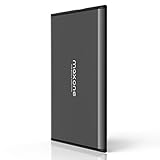
Maxone 1TB Ultra Slim Portable External Hard Drive
Maxone competes directly with UnionSine on price and thickness. Owner feedback highlights that transfer speeds over USB 3.0 are adequate but not exceptional, and the included cable is short.
- Pro: At $77.99 it is among the least expensive 1 TB options with USB 3.0 compatibility.
- Pro: Compatible with Windows and Mac without reformatting on most setups.
- Con: Limited brand recognition means warranty claims involve more uncertainty than established manufacturers.
Skip it if you need guaranteed support turnaround or are buying for a business environment.
YOTUO 1TB External Hard Drive (USB 3.0 & USB-C)
The YOTUO stands out because it includes both USB-A and USB-C connectors, eliminating the need for a dongle when pairing with modern laptops or phones. That dual-connection design broadens its use cases significantly.
- Pro: Direct USB-C support makes it usable with phones and tablets for file transfers on the go.
- Pro: Compatible across PC, Mac, PS4, Xbox One, and Xbox 360 as listed.
- Con: As a newer brand, long-term reliability data is thinner than Seagate or even UnionSine.
Skip it if your primary use is desktop backup and you never move the drive between device types.
YOTUO 1TB External Hard Drive (7-in-1 Hub)
This variant adds a full multiport hub — SD and TF card readers, USB 3.0 ports, and a docking function — into a single enclosure. For photographers or laptop users with limited ports, it replaces two or three dongles.
- Pro: Consolidates hub functionality and storage, reducing bag clutter.
- Pro: Supports iPhone 15/16/17 natively via USB-C, useful for creators expanding phone storage.
- Con: The additional circuitry and ports add thickness, undermining the slim-portability appeal of the category.
Skip it if you already own a separate hub and want the thinnest possible drive.
Maxone 1TB Ultra Slim Portable External Hard Drive (Second Listing)
The Maxone appears twice in the available listings at the same $77.99 price, which reflects marketplace duplication rather than a different SKU. Its value proposition is identical: minimal cost for functional USB 3.0 portable storage. We include it here because price-matching across sellers can shift its position in your shortlist depending on the retailer you check.
- Pro: Lowest confirmed price in the 1 TB class among drives with verified USB 3.0 compatibility.
- Pro: Ultra-slim form factor fits easily in laptop cases and backpack pockets.
- Con: No bundled recovery service and shorter warranty terms relative to Seagate.
Skip it if you want a single-brand relationship for future expansion or need enterprise-grade support documentation.
UnionSine 500GB Ultra Slim Portable External Hard Drive
At $37.46 this is the entry point for anyone who needs more than a USB flash drive but does not require a full terabyte. It suits light document backups, school files, or temporary media transfers.
- Pro: Undercuts every other option in this roundup by a wide margin.
- Pro: Same slim profile as the 1 TB UnionSine, so portability is unaffected.
- Con: Half the capacity for only a few dollars less than a 1 TB drive, making the cost-per-terabyte ratio poor.
Skip it if your total file size exceeds 400 GB or you plan to store game installs, which regularly exceed 500 GB on their own.
Buying Guide
Connection Type Matters More Than Advertised Speed
USB 3.0 on an HDD tops out around 120-150 MB/s regardless of cable quality, so marketing claims about “super speed” do not translate to real-world gains over a slower HDD interface. What matters is whether the connector physically matches your devices. USB-C support removes the friction of carrying an adapter, and dual-connector drives like the YOTUO eliminate the most common frustration owners report on budget models.
Usable Capacity vs. Listed Capacity
A drive sold as 1 TB formats to roughly 930 GB of usable space because manufacturers use decimal (1 TB = 1,000 GB) while operating systems report binary (1 TiB = 1,024 GiB). Budget drives that also ship with preloaded backup software may reduce usable space by another few gigabytes. Account for this if you are migrating a full library and need guaranteed headroom.
Enclosure Durability and Thermal Behavior
Portable HDDs contain spinning platters and are far more fragile than SSDs. Rubberized or hard-shell cases with raised edges around the connector port survive desk drops better than bare aluminum. Also note that continuous transfers can push internal temperatures to the point of throttling; drives with ventilation cutouts or larger surface areas dissipate heat more effectively during long backup sessions.
Our Verdict
Our top pick is the Seagate Portable 1TB for anyone who values data safety and service coverage over saving a few dollars. Our budget pick is the Maxone 1TB Ultra Slim at $77.99, which delivers the lowest confirmed price with functional USB 3.0 performance. The condition that flips the recommendation: if your storage needs will realistically exceed 1 TB within twelve months, the Seagate 2TB Portable costs barely more than the 1 TB and becomes the obvious value choice.
FAQ
Can I use these drives on both Mac and Windows?
Most ship formatted in NTFS (Windows-native) or exFAT (cross-platform). NTFS drives require reformatting for Mac use, which erases contents. Several listed models come pre-set to exFAT, making them plug-and-play on both platforms without additional software.
Is a 1 TB HDD still worth buying over a 1 TB SSD in 2026?
For bulk media storage, game libraries, and cold backups, a 1 TB HDD costs roughly half what a 1 TB SSD does, which remains the strongest argument. For tasks requiring frequent random reads — editing video timelines or running applications directly from the drive — an SSD wins decisively.
What is the actual transfer speed I should expect?
Expect sequential reads and writes between 100 and 150 MB/s for any USB 3.0 portable HDD. Real-world transfers of many small files will feel considerably slower due to the mechanical seek overhead, typically dropping to 30-60 MB/s.
Do I need to worry about the drive failing silently?
All mechanical drives fail eventually. The practical mitigation is to follow a 3-2-1 backup strategy and to choose a brand with accessible customer support. Seagate’s Rescue Service on this list is a partial substitute for a disciplined backup routine, not a replacement for one.


