
Choosing the right M.2 heatsink for a PlayStation 5 is less about finding the largest cooler and more about staying inside Sony’s clearance limits. A heatsink that is too tall can prevent the SSD bay cover from closing, while one that is too wide may interfere with the mounting area or nearby components.
For most PS5 storage upgrades, the safest choice is a low-profile M.2 heatsink designed specifically for the console. Before buying, check the complete dimensions of the SSD and heatsink together—not the heatsink by itself.
As an Amazon Associate we earn from qualifying purchases at no extra cost to you.


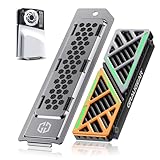

Top 3 picks at a glance
The Short Answer
The maximum recommended overall dimensions for a PS5 M.2 SSD with its heatsink installed are approximately:
- Length: 4.33 inches (110 mm)
- Width: 0.98 inches (25 mm) maximum, although the M.2 drive itself is 0.87 inches (22 mm) wide
- Total height: 0.44 inches (11.25 mm) maximum, including the SSD and heatsink
- Heatsink height above the SSD: ideally no more than 0.31 inches (8 mm)
- Heatsink height below the SSD: no more than about 0.10 inches (2.45 mm)
In practical terms, look for a PS5-compatible heatsink with a total installed height of 11 mm or less. A model measuring about 0.31 inches (8 mm) or less above the M.2 drive gives you a useful safety margin. Slim, flat aluminum covers are generally easier to fit than tall tower-style heatsinks or models with large fins.
The drive must also be an M.2 NVMe PCIe Gen4 SSD in one of the supported lengths. A heatsink cannot make an incompatible SSD fit. For a standard PS5, PS5 Slim, or PS5 Pro, always confirm the cooler is listed for that specific console revision.
Standard Sizes
M.2 SSD sizes are expressed using a four- or five-digit number. The first two digits indicate the width in millimeters, and the remaining digits indicate the length. For example, an M.2 2280 drive is 22 mm wide and 80 mm long.
| M.2 size | SSD dimensions | Dimensions in inches | PS5 suitability |
|---|---|---|---|
| 2230 | 22 × 30 mm | 0.87 × 1.18 in | Fits the length range, but fewer high-capacity Gen4 options are available |
| 2242 | 22 × 42 mm | 0.87 × 1.65 in | Supported if the drive and mounting position are appropriate |
| 2260 | 22 × 60 mm | 0.87 × 2.36 in | Supported |
| 2280 | 22 × 80 mm | 0.87 × 3.15 in | Most common and usually the easiest to cool |
| 22110 | 22 × 110 mm | 0.87 × 4.33 in | Longest supported size; requires careful clearance checking |
The M.2 slot supports drives from 30 mm to 110 mm long, including 2230 through 22110 formats. Most buyers choose an M.2 2280 SSD because it offers the widest selection of capacities and heatsinks. The heatsink should match the drive’s length or be designed as a universal cover that does not obstruct the mounting screw.
Some heatsinks are made from a thin aluminum plate with ventilation holes. Others use a copper heat pipe, aluminum fins, or a replacement bay cover. These designs can work well, but the key measurement remains the installed height. A product advertised as “for PS5” should still provide a dimensional drawing or a stated maximum height.
How to Measure Your Space
- Identify the SSD length. Read the label or product specifications on the drive. An M.2 2280 SSD, for example, is 80 mm long and should use the 80 mm mounting position.
- Measure the SSD width. Standard M.2 drives are 22 mm wide, or about 0.87 inches. Avoid a cooler that extends substantially beyond the drive’s edges unless it is specifically made for the PS5 bay.
- Measure the SSD’s component height. Some drives have memory chips on both sides. A double-sided SSD takes up more vertical space before the heatsink is added.
- Add the heatsink thickness. Combine the SSD height, thermal pads, and heatsink. The complete assembly should remain below approximately 11.25 mm, or 0.44 inches.
- Check the lower side. If the heatsink includes a bottom plate, make sure it does not exceed about 2.45 mm below the circuit board. A bottom plate that is too thick can prevent the drive from sitting correctly.
- Check the cover. The bay cover must close without pressure. Never force it into place, since pressure can bend the cover or stress the SSD and mounting point.
- Confirm the mounting screw position. The standoff must line up with the SSD’s notch and the selected 30, 42, 60, 80, or 110 mm position.
Use the manufacturer’s dimensions when available rather than measuring a product photograph. Thermal pads may compress slightly, but you should not rely on compression to compensate for a heatsink that is already too tall.
By Room or Use Case
Standard PS5 Expansion Bay
For the original PS5, a low-profile aluminum M.2 heatsink is usually the simplest option. A flat cover measuring roughly 22 to 25 mm wide and up to 80 mm long works well with the common 2280 format. A replacement dust cover with ventilation holes can add protection without adding much height.
Look for an overall assembly height of approximately 8 to 11 mm. A basic PS5-specific cover or heatsink generally costs about $10 to $20. One example in this category is a metal heat-dissipation cover priced around $9.95, although exact pricing can change in 2026.
PS5 Slim
The PS5 Slim uses a similar M.2 storage format, but compatibility should still be checked against the product listing. Choose a cooler labeled for the Slim rather than assuming every original-PS5 accessory will have identical clearance.
Thin aluminum covers and compact finned heatsinks are the best choices when space is limited. Products that combine an M.2 heatsink with a replacement dust cover often cost approximately $15 to $25. Avoid oversized fin arrays unless the seller gives a complete installed-height measurement.
PS5 Pro
For the PS5 Pro, use a heatsink specifically identified for the Pro or a model with clearly stated dimensions. Some accessories combine a copper heat pipe with an aluminum fin section. These may offer more surface area than a simple plate, but they also require closer inspection of height and cover clearance.
PS5 Pro-compatible cover sets commonly fall in the $18 to $30 range. A copper heat-pipe and aluminum-fin set may cost about $23.95. The higher price does not automatically mean better compatibility; the fit, thermal pad thickness, and total height matter more.
High-Capacity or Heavy-Use Storage
Large-capacity Gen4 SSDs and drives used for frequent game transfers can benefit from a better heatsink, but the cooler still must fit the bay. Choose a model with a continuous metal contact surface, correctly sized thermal pads, and ventilation around the fins.
For a typical 2280 drive, a slim finned heatsink or cover set priced from $15 to $25 is usually sufficient. Do not remove the PS5’s expansion-bay cover permanently to accommodate a taller cooler; the cover helps protect the installation from dust and accidental contact.
Common Sizing Mistakes
- Measuring only the heatsink: The SSD, thermal pads, and heatsink all count toward the height limit.
- Buying a desktop motherboard cooler: Many PC heatsinks are too tall for the PS5 bay.
- Ignoring double-sided SSDs: Chips on the underside reduce the room available for a bottom plate.
- Confusing 2280 with 22110: Both are 22 mm wide, but the 22110 drive is 30 mm longer.
- Using thick thermal pads: A pad that is too thick may bow the heatsink or put pressure on the SSD.
- Assuming “universal” means PS5-compatible: Check the actual width, length, and height in millimeters.
- Forcing the bay cover closed: Resistance usually indicates a clearance problem, not a tight fit that will resolve itself.
FAQ
What is the maximum heatsink height for a PS5?
The complete SSD-and-heatsink assembly should be no more than about 11.25 mm, or 0.44 inches, tall. Keeping the heatsink itself around 8 mm, or 0.31 inches, above the SSD provides a safer fit, especially with a double-sided drive.
Does every M.2 2280 heatsink fit inside a PS5?
No. M.2 2280 describes the drive’s size, not the cooler’s clearance. A 2280 heatsink can still be too wide or too tall. Choose a low-profile model with stated PS5 compatibility and verify the complete installed dimensions.
Is a copper or aluminum heatsink better?
Copper conducts heat efficiently, while aluminum is lighter and commonly used for fins and covers. Either material can work in a PS5 when properly fitted. Design, thermal-pad contact, ventilation, and height are more important than material alone.
Can I use a PS5 heatsink on a PS5 Slim or PS5 Pro?
Sometimes, but do not assume compatibility. Compare the product’s console listing and measurements with your model. A heatsink labeled for the original PS5 may not account for every cover or clearance difference in the Slim or Pro. A model designed for your exact console revision is the safer purchase.


