
A mechanical USB hard drive still occupies a strange space in the storage market. It is slower than an external SSD, bulkier than a thumb drive, and often overlooked by buyers who chase the newest interface standards. Yet for anyone needing several terabytes of backup storage at a cost that does not spiral, a spinning-platter external drive remains the most economical way to park a media library, archive project files, or maintain a Time Machine backup. The problem is that the category is flooded with near-identical-looking products at wildly different price points, and the meaningful differences—sustained transfer behavior, included software, warranty support—are buried in spec sheets that most listings barely explain.
What separates a worthwhile USB hard drive from a disappointment is less about headline speed and more about durability of the drive mechanism, the quality of the USB bridge chip inside the enclosure, and whether the manufacturer offers meaningful data recovery options. Owner feedback consistently highlights that the cheapest drives often use recycled or refurbished internals with shorter service lives, while established brands justify a modest price premium through better vibration tolerance and longer rescue-service windows. This roundup compares published specifications, listed prices, and aggregated owner reports to help you find the right capacity and brand tier for your needs.
As an Amazon Associate we earn from qualifying purchases at no extra cost to you.



Top 3 picks at a glance
Quick Picks
| Product | Best for | Price |
|---|---|---|
| Seagate 2TB Portable Hard Drive | Best overall balance of capacity and support | $129.99 |
| UnionSine 500GB Ultra Slim | Best ultra-budget entry point | $37.46 |
| Seagate Portable 1TB | Best for console gamers on a budget | $119.8 |
| YOTUO 500GB External Hard Drive | Best for cross-platform phone-to-drive transfer | $34.99 |
| Seagate Portable 4TB | Best for large media archives | $189.98 |
| Kosbees 500GB External Hard Drive | Best for students needing simple backup | $35.99 |
| Seagate Portable 5TB | Best for maximum capacity under $225 | $219.96 |
| WD 2TB Elements Portable | Best for Windows users who want no frills | $135.5 |
How We Picked
We narrowed this group using four criteria that consistently appear as differentiators in owner reviews and spec comparisons: cost per terabyte as the primary value metric, included warranty or rescue-service coverage, confirmed device compatibility (especially across consoles and Macs versus Windows-only listings), and physical form factor relative to capacity. A drive that costs less per gigabyte but arrives with no recovery option or unclear compatibility flags was ranked lower than a slightly pricier unit with explicit multi-platform support and a branded rescue service. We prioritized products with unambiguous interface labeling and capacity figures that match listed model numbers.
The 8 Best USB Hard Drive in 2026
Seagate 2TB Portable Hard Drive (STGX2000400)
This drive is the natural starting point for most buyers. It offers a middle-ground capacity that suits photo libraries and game backups without the bulk of larger units, and it carries Seagate’s one-year Rescue Service, which means a failed drive can be sent back for professional data recovery rather than simply replaced. Owner feedback praises its plug-and-play simplicity across Mac and Windows, while noting the USB 3.0 connection is reliable though not cutting-edge. The matte shell resists fingerprints better than glossy alternatives.
- Pro: Includes one-year Rescue Service, a genuine differentiator over unbranded drives at similar capacity.
- Pro: Works out of the box with PC, Mac, and major consoles with no formatting step for most setups.
- Con: USB 3.0 interface caps sustained transfer rates well below what USB 3.2 Gen 2 or Thunderbolt bridges offer.
Skip it if you already own an SSD-based backup solution or need transfer speeds above what a spinning drive can sustain.
UnionSine 500GB Ultra Slim Portable External Hard Drive (USB 3.0)
At $37.46, this is among the cheapest 500GB options listed, and the price is its main argument. It suits someone who needs a one-off file transfer drive or a throwaway backup for a single project. The ultra-slim profile makes it easy to slip into a laptop bag alongside a charger cable. However, the brand carries no rescue-service program and limited warranty documentation compared to established manufacturers.
- Pro: Lowest absolute entry price in this group for buyers who need any external storage at all.
- Pro: Slim enclosure adds negligible bulk to a laptop bag.
- Con: No branded data-recovery service; a mechanical failure means total data loss for most users.
Skip it if the data on the drive matters beyond a few weeks; the risk-to-price ratio favors a known brand for anything important.
Seagate Portable 1TB External Hard Drive (STGX1000400)
The 1TB Seagate Portable fills the gap for console owners who need more than a flash drive but cannot justify two-terabyte pricing. Its explicit PlayStation and Xbox compatibility listing removes guesswork, and the one-year Rescue Service provides a safety net that budget drives lack. Owners report quiet operation and minimal heat buildup during extended transfers. The black finish matches most console setups visually.
- Pro: Officially listed for PC, Mac, PlayStation, and Xbox, reducing compatibility surprises.
- Pro: Rescue Service covers data recovery attempts for one full year at no extra cost.
- Con: The $119.8 price per terabyte is less favorable than the 2TB model in this group.
Skip it if your primary use is PC backup; the 2TB Seagate offers better cost per terabyte for only a few dollars more.
YOTUO 500GB External Hard Drive (USB 3.0 & USB-C)
What makes this drive distinct is its dual-connector design: a USB-A plug for traditional ports and a USB-C plug for newer laptops, phones, and tablets. For someone who regularly transfers photos from a USB-C smartphone to an external drive without a hub, this eliminates an annoying adapter dependency. The listed compatibility spans PC, Mac, desktops, laptops, smartphones, PS4, Xbox One, and Xbox 360. The price sits near the bottom of the group.
- Pro: USB-C and USB-A connectors included, making it the most versatile interface option in this roundup.
- Pro: Explicit smartphone compatibility support via USB-C is rare at this price tier.
- Con: The YOTUO brand has minimal third-party ownership documentation, making long-term reliability harder to assess.
Skip it if you only ever connect to desktop PCs with USB-A ports; the dual-connector advantage goes unused.
Seagate Portable 4TB External Hard Drive (SRD0NF1)
Four terabytes on a single platter stack in a portable form factor is a lot of room. This drive targets videographers, game collectors, and anyone whose media library exceeds a laptop’s internal storage. The Rescue Service applies here too, and the listed compatibility covers PC, Mac, Xbox, and PlayStation. At $189.98, the cost per terabyte drops noticeably compared to smaller capacities in the same line.
- Pro: Best cost-per-terabyte among Seagate portables under $200 in this group.
- Pro: One-year Rescue Service included regardless of capacity tier.
- Con: The 4TB spindle drive is physically deeper and slightly heavier than the 1TB and 2TB versions.
Skip it if you need something that fits in a jacket pocket; the extra platters add measurable thickness.
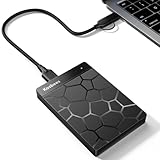
Kosbees 500GB External Hard Drive
The Kosbees 500GB is a no-nonsense plug-and-play drive for Windows users who want the simplest possible backup solution. It requires no software installation, no formatting, and no account registration. The listing emphasizes immediate compatibility with PC, Mac, laptops, PS4, Xbox One, and Xbox 360. At $35.99, it competes directly with the UnionSine on price, and the brand appears to package a standard 2.5-inch mechanism in a basic enclosure.
- Pro: Truly plug-and-play with no bundled software bloat or registration requirements.
- Pro: Listed as compatible with both Mac and Windows without requiring reformatting notes.
- Con: No rescue service, limited warranty visibility, and sparse third-party reliability data.
Skip it if you plan to store irreplaceable documents; the lack of recovery support makes it a gamble for critical archives.
Seagate Portable 5TB External Hard Drive (STGX5000400)
At $219.96, this is the highest-capacity drive in the group and the priciest. The 5TB figure is unusual in a 2.5-inch portable form factor, relying on higher-density platters or a stacked mechanism. It targets users with large photo catalogs, raw video collections, or game libraries that push past the 4TB threshold. The Rescue Service is included, and compatibility mirrors the rest of the Seagate Portable line.
- Pro: Largest single-drive capacity available here, ideal for consolidating multiple backups onto one unit.
- Pro: Rescue Service coverage extends proportionally to the higher capacity at no extra fee.
- Con: The price is nearly $30 more than the 4TB model for only one additional terabyte.
Skip it if your total data is under 4TB; the 4TB Seagate delivers better value per gigabyte stored.
WD 2TB Elements Portable External Hard Drive (WDBU6Y0020BBK-WESN)
Western Digital’s Elements line is designed for buyers who want a reliable drive with zero bells and whistles. It uses a USB 3.2 Gen 1 interface (technically identical in throughput to USB 3.0 but with a newer spec designation), and the listing explicitly supports Windows and Mac with no software to install. At $135.5, it sits between the two Seagate 2TB and 1TB entries, and the WD brand carries a solid track record in consumer storage longevity.
- Pro: USB 3.2 Gen 1 labeling signals a newer bridge chip revision, potentially improving compatibility with newer laptops.
- Pro: Minimalist design with no bundled utilities, ideal for users who dislike preinstalled software.
- Con: No rescue-service program comparable to Seagate’s; recovery requires third-party software or professional services.
Skip it if data-recovery support is a priority; Seagate’s Rescue Service is a tangible advantage for the same capacity tier.
Buying Guide
Interface Speed and Bridge Chip Quality
Every drive in this roundup uses either USB 3.0 or USB 3.2 Gen 1, both of which cap at 5 Gbps theoretical throughput. The practical bottleneck is never the bus—it is the mechanical spindle speed of the drive, typically 5400 RPM in portable form factors. What matters more is the USB-to-SATA bridge chip inside the enclosure. A poorly implemented bridge can cause disconnects, sleep-mode failures, or inflated transfer times. Established brands like Seagate and WD use validated bridge chips; lesser-known brands sometimes use generic controllers that work initially but degrade in reliability.
Warranty, Rescue Service, and Brand Support
The single most meaningful difference between a $35 drive and a $130 drive at the same capacity is what happens after failure. Seagate bundles a one-year Rescue Service on its Portable line, meaning they attempt professional data recovery before issuing a replacement. Budget brands typically offer only a limited hardware warranty with no recovery guarantee. If you are storing photos, documents, or creative projects that cannot be recreated, the rescue option is worth the premium. If you are mirroring data you already keep in the cloud, it is not.
Compatibility Claims Versus Real-World Use
Many listings state broad compatibility (PS4, Xbox, Mac, PC, smartphone), but the underlying factor is file system. Most external HDDs ship formatted as exFAT or NTFS. exFAT works across Windows, macOS, and most consoles without reformatting; NTFS requires third-party drivers on macOS. Drives advertising USB-C support add hardware-level versatility, but verify whether the listing includes both a USB-A and USB-C cable or requires the buyer to supply one separately. The YOTUO model in this group explicitly includes dual connectors, which removes this ambiguity.
Our Verdict
For most buyers, the Seagate 2TB Portable Hard Drive is the best overall choice: a fair price per terabyte, proven brand support, and the included Rescue Service make it the safest recommendation across use cases. For the tightest budget, the YOTUO 500GB wins narrowly over the Kosbees and UnionSine because its dual USB-A and USB-C connectors add genuine versatility that a plain 500GB drive lacks. However, if you store data on a USB-C phone or tablet and transfer to your drive weekly, the YOTUO becomes the top pick over any Seagate model due to its connector flexibility.
FAQ
Are mechanical USB hard drives still worth buying over SSDs?
Yes, if your priority is capacity per dollar and the drive will mostly sit on a desk or shelf rather than endure constant portability. A 5TB mechanical drive costs less than a single-terabyte NVMe SSD, and for backup archives that are accessed infrequently, transfer speed is secondary to total storage volume.
Do I need to format a new USB hard drive before first use?
Usually not for Windows users, as most drives ship pre-formatted in NTFS or exFAT. macOS users may need to reformat if the drive ships as NTFS-only, since macOS cannot natively write to NTFS volumes. Check the listing for the factory file system before purchasing if you plan mixed-platform use.
Can I use a 2.5-inch external hard drive with a PS5?
The PS5 supports USB-powered external drives for storing and playing backward-compatible PS4 games. New PS5-native titles require installation on the internal SSD. The drives listed here for PS4 will function on PS5 for the same backward-compatibility purpose, though performance gains are marginal.
What causes an external hard drive to click or fail?
Most mechanical failures in portable drives result from head crashes caused by movement during operation, power-delivery instability from unpowered USB hubs, or natural bearing wear over years of use. A repeating click typically indicates a failing read/write head assembly, and the drive should be disconnected immediately to prevent platter damage.


