The best music monitors are speakers built to tell the truth. Unlike home speakers that sweeten the sound with boosted bass and sparkling highs, a studio monitor aims for a flat, honest response, so a mix that sounds good on it sounds good everywhere else. That honesty is why producers, musicians, and careful listeners choose monitors: they reveal a muddy low end, a harsh vocal, or a buried guitar part instead of hiding it behind flattering coloration. Whether you are mixing tracks in a bedroom studio, listening to albums critically, or building a small production setup, the right pair of monitors changes how you hear music.

This guide covers powered monitors in the sizes that suit small and medium rooms, from compact nearfields that sit on a desk to larger bookshelf models that fill a living room. Each pick is a complete stereo speaker, not an accessory, and each one earned its place through a combination of driver quality, amplifier design, and a sound character that stays neutral enough to trust. We also explain how to place monitors, how much bass you really need, and which features matter when your room is small and untreated.
How to Choose
Flat Response Over Flattery
A monitor’s job is accuracy. Look for speakers described as neutral or flat, with a smooth frequency response and no obvious emphasis in the bass or treble. If a speaker makes everything sound exciting, it may be hiding problems in your mixes. Listen for clear mids above all, since voices, guitars, and snare drums live there.
Woofer Size and Bass Reach
Woofer size sets how low a monitor reaches. A 3.5-inch woofer suits a desk and nearfield listening; a 5-inch woofer covers most music with usable bass down into the 50 Hz range; a 6.5-inch or larger woofer fills a bigger room and reaches deeper. Bigger is not automatically better — an oversized woofer in a small room can overwhelm the space and blur the low end.
Powered Versus Passive
Most modern monitors are powered, with a matched amplifier built into each cabinet. Powered monitors simplify setup: you connect a source and you are done, with no separate amplifier to choose. Passive monitors need an external amplifier, which adds flexibility but also cost and complexity. For a first setup, powered monitors are the simpler and usually better-sounding choice.
Room Size and Placement
Nearfield monitors are designed to sit close to you, usually on a desk or stands about an arm’s length away, with the tweeters at ear height. Rear ports need space behind the speaker — at least a few inches from the wall — while front-ported designs forgive closer placement. If your desk sits against a wall, a front-ported or sealed monitor will sound cleaner than a rear-ported one jammed into a corner.
Connectivity
Check the inputs before you buy. Balanced XLR and TRS inputs suit audio interfaces and mixers; unbalanced RCA inputs suit computers, turntables, and phones; Bluetooth adds convenience for casual listening but is not a substitute for a wired connection when mixing. A monitor with both balanced and unbalanced inputs covers the most setups.
Volume, Hiss, and Noise Floor
A good monitor stays quiet when nothing plays. Cheap amplifiers can produce an audible hiss at idle, which grows tiring during quiet passages and long sessions. Look for monitors with a clean noise floor, a sensible volume control on the front or back, and a standby mode that powers down when the signal stops.
Build and Long-Term Support
Monitors are long-term tools. Solid cabinets, quality drivers, and a manufacturer with a real service network matter more than a flashy feature list. A pair you can still get parts and advice for in five years beats a bargain pair from a brand that vanishes. Check the warranty length and whether replacement drivers are available.
Top Picks
JBL 305P MkII Matched Pair
View the JBL 305P MkII Matched Pair on Amazon
The JBL 305P MkII is one of the most recommended nearfield monitors in its class, and this matched pair ships as a complete stereo set. Each cabinet holds a 5-inch woofer and a 1-inch tweeter set into JBL’s image-control waveguide, which widens the sweet spot so the stereo image stays stable even when you shift in your chair. The sound is clean and detailed, with a tight low end that reaches low enough for most music without a subwoofer, and a top end that stays smooth rather than harsh.
Who it is for: home studio owners, bedroom producers, and anyone mixing music at a desk. The pair works well in small rooms and pairs naturally with an audio interface over balanced TRS or XLR. Caveats: the rear port wants a little space behind the cabinet, so avoid pushing them flat against a wall; the volume control sits on the back, which is less convenient than a front knob.
Klipsch R-51PM Powered Bluetooth Speaker
View the Klipsch R-51PM Powered Bluetooth Speaker on Amazon
The Klipsch R-51PM is a powered pair of bookshelf speakers that blends monitor-style clarity with everyday convenience. A 5.25-inch woofer and a 1-inch titanium tweeter in a Tractrix horn give it a lively, detailed character with strong dynamics, and the built-in amplifier means no separate amp is needed. Bluetooth, optical, USB, RCA, and a phono input cover nearly every source, from a turntable to a television.
Who it is for: listeners who want one pair of speakers for music, vinyl, and television, and who value easy switching between sources. The horn-loaded tweeter delivers crisp dialogue and cymbal detail. Caveats: the sound leans lively rather than strictly flat, so it suits listening more than critical mixing; the remote is small and easy to misplace.
Edifier R1700BTs Powered Bookshelf Speakers
View the Edifier R1700BTs Powered Bookshelf Speakers on Amazon
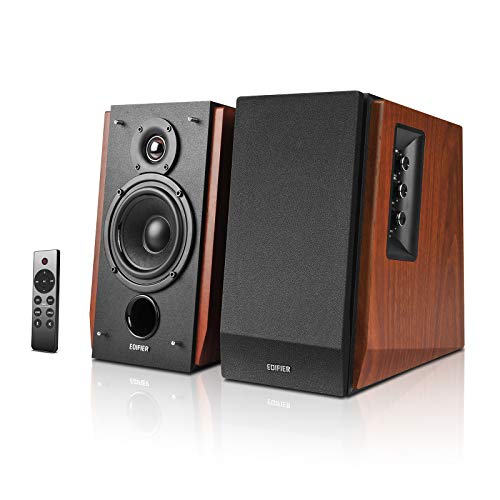
The Edifier R1700BTs is a compact powered pair built for desks and small rooms, with a 4-inch woofer and a silk-dome tweeter in each cabinet. Bluetooth 5.0, dual RCA inputs, and front-panel bass, treble, and volume controls make it simple to use daily, and the sound is warm and easy to listen to for long sessions without fatigue. It is a sensible first pair for someone moving up from computer speakers.
Who it is for: desk listeners, students, and casual music fans who want a clear step up from small desktop speakers without a complicated setup. Caveats: the 4-inch woofers do not reach deep bass, so bass-heavy music loses some weight; the Bluetooth connection is convenient but a wired input sounds cleaner for focused listening.
Klipsch Reference Premiere RP-600M II Ebony Bookshelf Speakers
View the Klipsch Reference Premiere RP-600M II Ebony Bookshelf Speakers on Amazon
The Klipsch RP-600M II is a passive bookshelf speaker with a 6.5-inch Cerametallic woofer and a 1-inch titanium tweeter in a larger Tractrix horn, and it is one of the most dynamic speakers in its size class. The sound is big, punchy, and detailed, with a sense of scale that smaller monitors cannot match, and the Ebony finish looks at home in a living room as well as a studio. Because it is passive, you pair it with an amplifier or receiver of your choice.
Who it is for: listeners with a proper amplifier who want a lively, room-filling pair for music and films, and who enjoy the Klipsch horn sound. Caveats: it needs an external amplifier, which adds cost and a box to the setup; the forward, energetic character suits rock, jazz, and film more than whisper-quiet acoustic music.
KEF Q150 Bookshelf Speakers
View the KEF Q150 Bookshelf Speakers on Amazon
The KEF Q150 uses KEF’s Uni-Q driver, which places the tweeter in the center of the midrange cone so sound comes from a single point. The result is a remarkably coherent stereo image with precise placement of instruments and voices, and a smooth, refined character that suits long listening sessions. A 5.25-inch driver and a rear port give it solid bass for its size, and the compact cabinet fits on a desk, a shelf, or a stand.
Who it is for: careful listeners who value imaging and coherence, and who want a speaker that rewards good recordings without punishing average ones. Caveats: it is a passive speaker, so an amplifier is required; the rear port needs a little breathing room from the wall to keep the bass clean.
Comparison Table
| Monitor | Type | Woofer | Inputs | Best For |
|---|---|---|---|---|
| JBL 305P MkII Pair | Powered | 5-inch | XLR, TRS | Mixing at a desk |
| Klipsch R-51PM | Powered | 5.25-inch | Bluetooth, optical, USB, RCA, phono | Music, vinyl, TV |
| Edifier R1700BTs | Powered | 4-inch | Bluetooth, dual RCA | Small desks, casual listening |
| Klipsch RP-600M II | Passive | 6.5-inch | Speaker terminals | Lively, room-filling sound |
| KEF Q150 | Passive | 5.25-inch | Speaker terminals | Precise imaging |
Which One Is Right for You?
If you are mixing music, the JBL 305P MkII pair is the most direct choice: powered, neutral, and designed for exactly that job. If you want one pair for everything — music, vinyl, television — the Klipsch R-51PM covers the most sources with the least fuss. Small desks and tight budgets suit the Edifier R1700BTs, which sounds warm and pleasant without demanding much space or setup. Listeners with an amplifier who want scale and dynamics should look at the Klipsch RP-600M II, while those who prize a precise, coherent stereo image will appreciate the KEF Q150. Whichever you choose, place the tweeters at ear height, keep the pair symmetrical, and give the room a little treatment — even a rug and a bookshelf — before blaming the speakers.
Frequently Asked Questions
Do I need a subwoofer with music monitors?
Usually not for mixing or listening in a small room. A 5-inch or larger monitor reaches low enough for most music, and a subwoofer in an untreated small room often creates more problems than it solves. Add a subwoofer only after the main pair is placed well and you still miss the lowest octave.
Are powered monitors better than passive ones?
Neither is better in principle. Powered monitors include a matched amplifier, which simplifies setup and guarantees a good pairing. Passive monitors let you choose the amplifier and upgrade it separately, which suits listeners who already own a good amp or want flexibility.
How far apart should music monitors sit?
A good first step is an equilateral triangle: the distance between the two speakers roughly equals the distance from each speaker to your head. Keep them symmetrical, angled slightly inward, with tweeters at ear height and the pair clear of side walls.
Can I use studio monitors for casual listening?
Yes. A good monitor sounds excellent with any music, and many listeners prefer the honest, detailed sound to the boosted bass of lifestyle speakers. The only adjustment is habit: mixes you know well may sound a little different, usually because you are hearing details the old speakers hid.
Disclosure: As an Amazon Associate, we may earn from qualifying purchases.
Related guides
More from Amazon
Programs that pair well with the guide above. Offers and eligibility are set by Amazon and may change.
A free business account with business pricing and bulk-buying tools for work, shop or home office.
Create a business accountFree shipping on eligible items, Prime Video and more. Eligible new members can start with a free trial.
Start a Prime free trialAudiobooks and podcasts to listen to on the go. Eligible new members can start with a free trial.
Try Audible freeAd-free music streaming. Eligible new subscribers can start with a free trial.
Try Music Unlimited freeAs an Amazon Associate we earn from qualifying purchases.