The best 10 inch bass guitar speakers are the drivers that give a bass cabinet its punch, definition, and low-end weight without the size and mass of a larger driver. A 10-inch driver sits in the sweet spot for many players: it responds faster than a 15-inch speaker, moves enough air to fill a rehearsal room, and stacks neatly into compact cabinets that are easy to carry to a gig. Whether you are replacing a blown driver in an existing cabinet or building a custom rig, the driver you choose shapes the tone more than any other single component.

This guide explains how to read the numbers that matter — impedance, power handling, sensitivity, and frequency response — and then covers the drivers with verified Amazon listings. Note that this is a niche category with a small number of verified listings: two impedance variants of one well-established driver are the picks with confirmed ASINs, and we name two further drivers to research once a verified listing can be confirmed. A thin shortlist is better than a long list of guesses. It is also worth knowing that a bass driver is only half the story: the cabinet it sits in shapes the sound as much as the driver itself, so this guide covers cabinet compatibility alongside the driver numbers, and the frequently asked questions at the end cover measuring, wiring, and matching a driver to an amplifier.
How to Choose
Impedance matching. A bass driver is usually 4 or 8 ohms, and your amplifier expects a specific total load. Two 8-ohm drivers in parallel present 4 ohms to the amp, while a single 4-ohm driver presents 4 ohms on its own. Check your amplifier’s minimum impedance before buying, because running below it can damage the amp.
Power handling. The RMS power rating tells you how much continuous power the driver can take. Match it to your amplifier’s output at the same impedance, with some headroom, and remember that the program rating is higher than the RMS rating. A driver rated well below your amp will distort and can fail.
Sensitivity. Sensitivity, measured in decibels, tells you how loud a driver gets from a given amount of power. A higher sensitivity figure means more volume from the same amplifier, which matters on stage and in rehearsal. A difference of a few decibels is clearly audible.
Frequency response and low-end reach. A bass driver should reach down to the low notes of your instrument with authority. The published frequency range and the resonance frequency give a guide, but the cabinet design matters just as much: the same driver sounds different in a sealed box and a ported box.
Cone and voice coil construction. Bass drivers work hard. A rigid cone, a robust surround, and a voice coil built to shed heat will survive years of gigs. Look for a stamped or cast frame and a voice coil diameter suited to the power you plan to run.
Cabinet compatibility. A replacement driver must fit the cutout, mounting depth, and internal volume of your cabinet. Measure the existing driver and the cabinet before ordering, and check the manufacturer’s recommended cabinet volume and tuning for a new build.
Single driver versus multiples. A single 10-inch driver suits practice and small rooms. A cabinet with two or four 10-inch drivers moves far more air, stays cleaner at volume, and spreads the load across the drivers. Plan the cabinet around the number of drivers you intend to use.
Top Picks
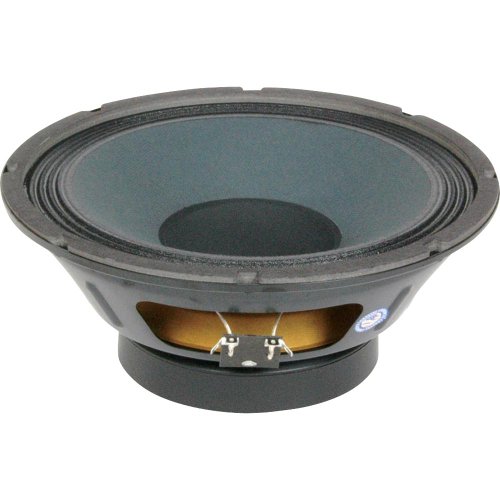
Eminence Legend BP102 10-Inch Bass Guitar Speaker, 8 Ohm, 200 Watts
Eminence Legend BP102 10-Inch Bass Guitar Speaker, 8 Ohm, 200 Watts
The Eminence Legend BP102 is the standard 10-inch bass driver that cabinet builders and repair shops reach for first. It is a 200-watt RMS driver with an 8-ohm impedance, a sensitivity that makes it efficient on modest amplifier power, and a tone that balances low-end weight with the midrange definition a bass guitar needs to sit clearly in a mix. Eminence builds it in the United States with a rigid cone and a frame that survives the rigours of gigging, and it is widely used as a replacement driver in commercial cabinets as well as in custom builds. For a single 8-ohm driver in a practice cabinet, a small gig rig, or a multi-driver cabinet wired in parallel, this is the safe, well-documented choice, and the 8-ohm version is the one to buy when your amplifier or cabinet plan calls for 8-ohm drivers. It is also a forgiving driver to build with: the published cabinet recommendations are widely used, the mounting dimensions are standard for a 10-inch driver, and replacement parts and advice are easy to find because the driver has been in production for years.
Key specifications:
- 10-inch bass guitar driver, 200 watts RMS
- 8-ohm impedance for single or parallel cabinet wiring
- Sensitivity around 91.8 dB for efficient output
- Rigid cone and robust frame built for gig use
- Designed as a replacement driver and for custom cabinets
- Manufacturer lists it for amplifier upgrades, stage, and studio use
Who it is for: a player replacing a blown 8-ohm driver or building a cabinet around 8-ohm drivers.
Watch for: Check your amplifier’s impedance and your cabinet’s cutout and depth before ordering, and confirm the 8-ohm version, not the 4-ohm variant, matches your plan.
Eminence Legend BP102-4 10-Inch Bass Guitar Speaker, 4 Ohm, 200 Watts
Eminence Legend BP102-4 10-Inch Bass Guitar Speaker, 4 Ohm, 200 Watts
The Legend BP102-4 is the 4-ohm version of the same driver, and it exists for one reason: wiring. A single 4-ohm driver presents a 4-ohm load to an amplifier that delivers its full output at 4 ohms, and two 4-ohm drivers in series present 8 ohms. The cone, motor, power handling, and tone are the same family as the 8-ohm BP102, so the sound you get is the same punchy, defined bass, and the choice between the two versions is purely a question of what your amplifier and cabinet wiring need. If your rig is built around a single driver and a 4-ohm amplifier, this is the correct variant. Buying the wrong impedance is the most common mistake in driver replacement, so confirm the number on your existing driver or amplifier before you order.
Key specifications:
- 10-inch bass guitar driver, 200 watts RMS
- 4-ohm impedance for single-driver 4-ohm rigs or series wiring
- 400 watts program power handling
- Same Legend BP102 cone and motor family as the 8-ohm version
- Built for amplifier upgrades and custom cabinets
- Suited to cabinets where a 4-ohm single driver is specified
Who it is for: a player whose amplifier or cabinet plan calls for a single 4-ohm driver.
Watch for: It is the same driver family as the 8-ohm version, so it is not a second distinct tone option — buy it only when 4 ohms is what your rig needs.
Comparison Table
| Driver | Impedance | Power Handling | Best For |
|---|---|---|---|
| Eminence Legend BP102 | 8 ohm | 200 watts RMS | 8-ohm rigs and parallel cabinets |
| Eminence Legend BP102-4 | 4 ohm | 200 watts RMS | Single-driver 4-ohm rigs |
Which One Is Right for You?
This is a deliberately short shortlist. Only two drivers carry verified Amazon listings in this category, and both are impedance variants of the same Eminence Legend BP102, so your decision is really about impedance, not brand. Choose the 8-ohm BP102 if your cabinet or amplifier plan calls for 8-ohm drivers, and choose the 4-ohm BP102-4 if you need a single 4-ohm driver. Two further drivers worth researching are the Celestion BL10-100X and the Eminence Basslite S2010, but neither had a verified Amazon listing at the time of writing, so they are named here without a link rather than listed as picks. If you need four drivers for a large cabinet, buy four of the same impedance variant and wire them to match your amplifier, rather than mixing versions. Building a cabinet around these drivers is straightforward: Eminence publishes recommended cabinet volumes and port tuning for the BP102 family, and following those figures matters more than the wood or the finish. A sealed cabinet gives tighter, more controlled bass, while a ported cabinet tuned to the driver’s resonance gives more low-end extension at the cost of a larger box. Measure twice, wire the drivers to the impedance your amplifier expects, and test the cabinet at rehearsal volume before taking it to a gig, because a cabinet that sounds good at home can behave differently in a room full of people.
Frequently Asked Questions
Can I replace a 10-inch bass speaker with a different impedance?
Only if your amplifier supports the resulting total load. A 4-ohm driver in place of an 8-ohm driver halves the load, and an amplifier with an 8-ohm minimum can be damaged. Always match the impedance your amplifier and cabinet wiring expect, and check the number printed on the old driver.
How many watts does a 10-inch bass driver need?
Match the driver’s RMS rating to your amplifier’s output at the same impedance, with some headroom. A 200-watt RMS driver suits a wide range of bass heads, but a much more powerful amplifier can damage it if you push it into distortion, and a much weaker amplifier can damage it by clipping.
Is one 10-inch speaker enough for a gig?
One 10-inch driver suits practice and small rooms. For a rehearsal with a drummer or a gig, two or four 10-inch drivers in a cabinet move more air, stay cleaner at volume, and give the low end more authority. Cabinet design matters as much as the driver count.
What is the difference between a bass guitar speaker and a regular guitar speaker?
A bass guitar speaker is built to move more air at low frequencies, with a stiffer cone, a larger voice coil, and a suspension designed for long excursion. A regular guitar speaker is voiced for midrange and treble, and it will sound thin and can be damaged by the low frequencies of a bass guitar at volume. The two are not interchangeable, even when the diameter matches, so always buy a driver designed for bass guitar use.
What should I measure before ordering a replacement driver?
Measure the cutout diameter, the mounting depth, the bolt pattern, and the cabinet’s internal volume, and note the impedance and power rating of the old driver. A driver that does not fit the baffle or suit the cabinet volume will sound wrong even if the brand and size match.
Disclosure: As an Amazon Associate, we may earn from qualifying purchases.
Related guides
More from Amazon
Programs that pair well with the guide above. Offers and eligibility are set by Amazon and may change.
A free business account with business pricing and bulk-buying tools for work, shop or home office.
Create a business accountFree shipping on eligible items, Prime Video and more. Eligible new members can start with a free trial.
Start a Prime free trialAudiobooks and podcasts to listen to on the go. Eligible new members can start with a free trial.
Try Audible freeAd-free music streaming. Eligible new subscribers can start with a free trial.
Try Music Unlimited freeAs an Amazon Associate we earn from qualifying purchases.