As an Amazon Associate we earn from qualifying purchases.
The best latency for server hard drives is not a single number on a box: it is the result of the drive type, the interface, the workload, and the way the server is configured. Latency is the delay between a request for data and the moment the data starts to arrive, and in a server that delay decides how fast a database answers, how quickly a virtual machine boots, and how responsive a file share feels. A drive with low latency makes the whole server feel faster, even when the headline transfer speed looks modest.
This guide explains what latency means for server hard drives, which drive types deliver the lowest latency, and how to choose and configure a drive for your workload. It is a pure guide with no product links, because the right choice depends on your server, your interface, and your workload rather than on a single shortlist of drives.
How to Choose
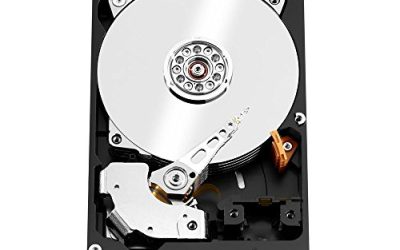
Drive type: HDD, SSD, or NVMe. A mechanical hard drive has moving parts, and its latency is measured in milliseconds — the time for the head to seek and the platter to rotate. A SATA SSD has no moving parts and its latency is measured in fractions of a millisecond. An NVMe SSD connected over PCIe has the lowest latency of all. For latency-sensitive work, the drive type matters more than any other factor.
Seek time and rotational latency. On a mechanical drive, latency comes from two sources: the time the actuator takes to move the head to the right track, and the time the platter takes to rotate the right sector under the head. A faster spindle speed shortens the rotational part, and a shorter seek shortens the rest. These figures are published for enterprise drives and are worth comparing.
Interface: SATA, SAS, or NVMe. SATA is the simplest interface and the slowest. SAS adds dual-port redundancy and better queueing for enterprise use. NVMe over PCIe removes the storage interface bottleneck almost entirely and delivers the lowest latency. The interface sets a floor on latency that no drive can beat.
Queue depth and IOPS. A server rarely asks for one thing at a time. Queue depth is the number of requests waiting, and IOPS is how many the drive completes each second. A drive that handles a deep queue well keeps latency low under load, while a drive that stalls under a queue will show rising latency exactly when the server is busiest.
Workload: random versus sequential. Random reads and writes — the pattern of a database or a virtual machine — punish a mechanical drive, because every request needs a new seek. Sequential reads and writes — the pattern of a backup or a media stream — suit a mechanical drive, because the head stays in one place. Match the drive to the workload, not to the headline speed.
Cache and write behaviour. A drive with a large cache absorbs bursts of writes and serves repeated reads quickly, which lowers the latency you actually feel. But a cache that fills under sustained writes stops helping, and a write cache without power protection can lose data in an outage. Check the cache size and the power-loss behaviour before relying on it.
RAID and redundancy. RAID changes latency as well as capacity. A mirrored array can serve reads from either disk and keep latency low, while a parity array adds a calculation to every write and raises write latency. Choose the RAID level for the workload: mirrors for latency-sensitive reads, parity for capacity with acceptable write latency.
How Latency Works in a Server Drive
Latency is the time between a request and the start of the response. On a mechanical hard drive, that time is dominated by physics: the actuator must move the read head to the correct track, and the platter must rotate the correct sector under the head. A 7200 RPM drive rotates once every 8.3 milliseconds, so the average rotational delay alone is a little over 4 milliseconds, and the seek adds several more. A 10000 RPM or 15000 RPM enterprise drive shortens both parts, which is why enterprise drives spin faster than desktop drives, and why they cost more and use more power.
A solid-state drive has no head and no platter, so it has no seek and no rotation. Its latency comes from the controller, the flash memory, and the interface, and it is typically measured in tens of microseconds rather than milliseconds — roughly a hundred times lower than a mechanical drive. That difference is why a database on SSDs feels dramatically faster than the same database on hard drives, even when the sequential transfer speeds look close. The latency gap, not the headline speed, is what the user notices.
Choosing a Drive by Latency
For the lowest latency, an NVMe SSD is the right choice. It connects directly over PCIe, it handles deep queues well, and its latency stays low under load. It suits databases, virtualisation, and any workload with many small random requests. The trade is capacity and cost: NVMe drives hold less for the same outlay than mechanical drives, and they need a server with NVMe slots and cooling.
For a balance of latency and capacity, a SATA or SAS SSD is the practical middle ground. Its latency is far lower than any mechanical drive, it fits the standard drive bays and interfaces a server already has, and it holds enough for most virtual machines and databases. It suits a server that is being upgraded from mechanical drives without a full rebuild.
For bulk storage where latency matters less, an enterprise mechanical drive is still the right tool. A 7200 RPM enterprise drive with a large cache serves sequential reads and writes well, and its latency is acceptable for backups, archives, and media storage. It does not suit a database or a virtual machine host, where random access dominates, but it is the economical choice for data that is read in large, sequential chunks.
Measuring Latency Before You Commit
Do not trust a single headline figure. Measure latency under your own workload, with the queue depth and the read-write mix your server actually sees. A drive that looks fast in a sequential test can be slow under random load, and a drive that looks slow on paper can be fast enough for your workload. Test with the tools your operating system provides, run the test for long enough to fill the cache, and record both the average latency and the worst-case latency, because a server that is usually fast but occasionally very slow feels worse than one that is consistently moderate.
When Latency Does Not Matter
Not every server workload cares about latency. A backup job reads and writes large files in sequence, so its bottleneck is transfer speed, not the delay before the first byte. A media server streams large files in order, so the same applies. An archive that is written once and rarely read cares even less. For these workloads, a mechanical drive is the economical choice, and spending on low-latency storage would buy speed nobody notices. The mistake is to apply one rule to the whole server: put low-latency drives where the workload is random and interactive, and put high-capacity mechanical drives where the workload is sequential and patient. A server with both kinds of storage, each matched to its workload, is faster and cheaper than a server with only one kind.
Configuration That Protects Low Latency
Configuration matters as much as the drive. Keep the drive firmware current, because firmware updates often improve queue handling and latency. Use the right RAID level for the workload: a mirror for latency-sensitive reads, and avoid parity RAID for write-heavy workloads. Leave free space on an SSD, because a nearly full SSD has less room to manage writes and its latency rises. Separate the operating system, the database, and the logs onto different drives or arrays where you can, so one workload does not starve another. And monitor latency continuously after deployment, because a drive that starts fast and degrades over months is a drive that needs attention before it becomes a problem.
Comparison Table
| Drive Type | Typical Latency | Best For |
|---|---|---|
| NVMe SSD | Lowest, microseconds | Databases, virtualisation, random workloads |
| SATA or SAS SSD | Low, fractions of a millisecond | General server use, VM hosts, upgrades |
| Enterprise HDD 7200 RPM | Milliseconds | Bulk storage, backups, sequential reads |
| Enterprise HDD 10000 or 15000 RPM | Lower milliseconds | Legacy latency-sensitive mechanical workloads |
Which One Is Right for You?
Choose by workload, not by brand. If your server runs databases or virtual machines, buy NVMe or SATA SSDs and measure latency under your own load before committing. If your server stores backups, archives, or media, buy enterprise mechanical drives and spend the saving on a second copy of the data. If you are upgrading an existing server, start with the drives that serve the most latency-sensitive workload, and move the mechanical drives to bulk storage where their latency does not matter. And whatever you buy, monitor latency after deployment: a server’s latency is a living number, and the drive that is fast today may not be fast in a year without attention.
Frequently Asked Questions
What is a good latency for a server hard drive?
It depends on the drive type. A mechanical hard drive typically answers in several milliseconds, while an SSD answers in a fraction of a millisecond and an NVMe drive in tens of microseconds. The right target is set by your workload: a database needs far lower latency than a backup job.
Does a faster spindle speed lower latency?
Yes, on a mechanical drive. A higher RPM shortens the rotational delay, which is a large part of total latency. A 10000 RPM or 15000 RPM enterprise drive answers faster than a 7200 RPM drive, but it costs more, uses more power, and still cannot match an SSD.
Is an SSD always better than a hard drive for a server?
For latency, yes. For capacity and cost, no. An SSD is the right choice for databases, virtual machines, and any workload with many small random requests. A mechanical drive is the right choice for bulk storage, backups, and archives, where capacity matters more than latency.
Does RAID improve or worsen latency?
It depends on the RAID level and the workload. A mirrored array can serve reads from either disk, which keeps read latency low, while a parity array adds a calculation to every write, which raises write latency. For latency-sensitive reads, a mirror is the safer choice; for capacity with acceptable write latency, parity is a reasonable trade.
How do I measure server drive latency?
Use the benchmarking tools your operating system provides, and test with the queue depth and the read-write mix your server actually sees. Run the test long enough to fill the cache, and record both the average latency and the worst-case latency, because occasional slow responses matter as much as the average.
Related guides
- Best 10 Inch Bass Guitar Speakers: Drivers for Punch, Definition, and Low End (2026)
- Best Monitors for PS5 Under $300: 5 Fast, Sharp Picks for Console Gaming
- Best Monitors for Drafting: 5 Sharp, Colour-Accurate Picks for CAD Work
- Best Internal Hard Drives for Your PS4: 2TB Upgrades That Fit and Last (2026)
More from Amazon
Programs that pair well with the guide above. Offers and eligibility are set by Amazon and may change.
A free business account with business pricing and bulk-buying tools for work, shop or home office.
Create a business accountFree shipping on eligible items, Prime Video and more. Eligible new members can start with a free trial.
Start a Prime free trialAudiobooks and podcasts to listen to on the go. Eligible new members can start with a free trial.
Try Audible freeAd-free music streaming. Eligible new subscribers can start with a free trial.
Try Music Unlimited freeAs an Amazon Associate we earn from qualifying purchases.