Our Short List of 3
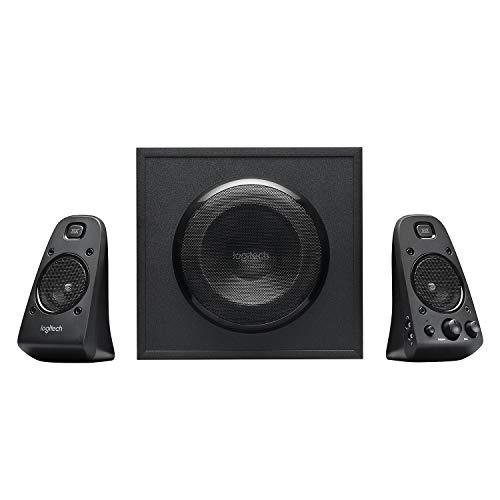
- Best for: A desk or TV corner that needs strong, simple wired bass.
- 2.1 channel system with two satellite speakers and a subwoofer
- 400 watts peak power, 200 watts RMS
- Subwoofer rated at 130 watts, satellites at 35 watts each
- THX Certified

- Best for: Living-room listening where music quality matters as much as movie bass.
- 2.1 system with bookshelf satellites and a separate subwoofer
- 8-inch subwoofer driver
- Titanium dome tweeters
- 150 watts RMS total output

- Best for: Smaller rooms and desks where the subwoofer must stay out of sight.
- 2.1 channel system, THX Certified
- Two satellites with a ported subwoofer
- Wired control pod with volume and subwoofer level controls
- Headphone output on the control pod
All 4 Picks at a Glance
| Product | Specs | Action |
|---|---|---|
| Logitech Z623 |
| Check price on Amazon |
| Edifier S350DB |
| Check price on Amazon |
| Klipsch ProMedia 2.1 THX |
| Check price on Amazon |
 Logitech Z906 |
| Check price on Amazon |
Buying bass for a living room is really a decision about where the low end comes from. Small bookshelf boxes can sound clean and still leave film scores and kick drums feeling thin, because a compact woofer runs out of travel long before it runs out of amplifier. A separate subwoofer with its own driver and its own share of the power budget solves that physics problem, which is why every system below is built around one.
This roundup is for home listeners who watch films, stream music and play games in the same room and want the floor of the sound filled in. Each pick was chosen from the driver sizes, power figures and input lists printed on its Amazon listing, not from brand reputation, so the numbers quoted here are the numbers a buyer can check before ordering.
Our Top Picks
Top 3 picks at a glance
Quick Picks
As an Amazon Associate we earn from qualifying purchases.
| Product | Best for | Key spec from title |
|---|---|---|
| Logitech Z623 | A single desk-or-TV setup that needs simple, strong bass | 400 Watt Home Speaker System, 2.1 |
| Edifier S350DB | Listeners who want a subwoofer plus proper source switching | Bookshelf Speaker and Subwoofer 2.1 System, Bluetooth aptX |
| Klipsch ProMedia 2.1 THX | Compact rooms where the sub has to hide under a desk | THX Certified Computer Speaker System |
| Logitech Z906 | A full surround rig for films and console gaming | 5.1 Surround Sound Speaker System, THX Certified |
How to Choose
Judge the subwoofer driver, not the headline wattage
Peak wattage is the number printed largest, yet it describes a momentary burst rather than what the system sustains during a film scene. RMS power and the subwoofer’s driver diameter tell you far more: an 8-inch or larger cone moves enough air to be felt at normal listening levels, while a small passive radiator setup usually cannot. Compare the subwoofer’s own RMS figure and driver size first, then treat the total system wattage as supporting information rather than the deciding stat.
Decide between 2.1 simplicity and 5.1 surround
A 2.1 system puts two satellites and one subwoofer in the room, which keeps wiring short and placement easy, and the sub still supplies the bass weight most listeners are missing. A 5.1 system adds a center channel and rear satellites, so dialogue anchors to the screen and effects travel around you, at the cost of running cable across the room. Pick 2.1 for a desk or a small lounge, and 5.1 when the seating position is fixed and films are the main use.
Match the inputs to your actual sources
A television, a PC and a turntable all connect differently, and a speaker system with only a 3.5mm jack forces adapters or a separate DAC into the chain. Optical input is the cleanest route from most TVs, coaxial suits some disc players and streamers, and Bluetooth removes the cable for phone listening entirely. List every device you plan to connect before buying, then confirm each one has a matching socket on the subwoofer or control unit of the system you choose.
Plan subwoofer placement before you buy
Bass builds up in corners and can turn boomy against a wall, so the subwoofer needs a few placement options rather than one fixed spot. Check the cable length between the sub and the satellites, because that distance decides whether the sub can sit beside the sofa instead of under the desk. A system with a separate bass level control also matters here: rooms differ, and being able to trim the sub down at night keeps the low end present without carrying through the whole house.
The 4 Best Options
Logitech Z623
- Best for: A desk or TV corner that needs strong, simple wired bass.
- 2.1 channel system with two satellite speakers and a subwoofer
- 400 watts peak power, 200 watts RMS
- Subwoofer rated at 130 watts, satellites at 35 watts each
- THX Certified
A desk or TV corner that needs strong, simple wired bass.
There is no optical input or Bluetooth, so a modern TV may need an adapter or an analog output.
The Z623 is the straightforward answer for a room that currently relies on television speakers or a basic desktop pair. Its subwoofer carries the largest share of the system’s 200 watts RMS, so film effects and bass lines arrive with physical weight instead of a hint, while the two satellites stay small enough for a desk or a media unit. Controls sit on the right satellite, including a dedicated bass dial, which makes late-night adjustment easy without hunting for a remote. It suits buyers who want one wired system for a PC and a TV and no interest in surround channels.
Edifier S350DB
- Best for: Living-room listening where music quality matters as much as movie bass.
- 2.1 system with bookshelf satellites and a separate subwoofer
- 8-inch subwoofer driver
- Titanium dome tweeters
- 150 watts RMS total output
Living-room listening where music quality matters as much as movie bass.
The wooden cabinets and subwoofer need real shelf and floor space, so measure before ordering.
Edifier builds this system like a small hi-fi rather than a PC accessory: two proper bookshelf satellites with titanium dome tweeters, and a separate subwoofer with an 8-inch driver handling everything below the midrange. The result is bass that stays distinct from the voices and instruments above it, which matters in film dialogue and acoustic music. It is also the most flexible connector here, taking optical and coaxial feeds from a TV or streamer, RCA from a turntable setup, and Bluetooth with aptX from a phone. A wireless remote and side-panel bass and treble knobs round out the home-first design.
Klipsch ProMedia 2.1 THX
- Best for: Smaller rooms and desks where the subwoofer must stay out of sight.
- 2.1 channel system, THX Certified
- Two satellites with a ported subwoofer
- Wired control pod with volume and subwoofer level controls
- Headphone output on the control pod
Smaller rooms and desks where the subwoofer must stay out of sight.
The single analog input means several sources need swapping cables or an external switcher.
The ProMedia 2.1 has been sold in this form for years because the formula works: two horn-loaded satellites that play loud without strain, and a ported subwoofer that gives the system its low-end punch. THX certification means the system met a defined performance standard rather than a marketing claim, and the wired control pod puts volume and subwoofer level within arm’s reach on the desk. It is the most compact route here to bass that registers in action scenes, and it asks for nothing more than a 3.5mm connection from the source.
Logitech Z906
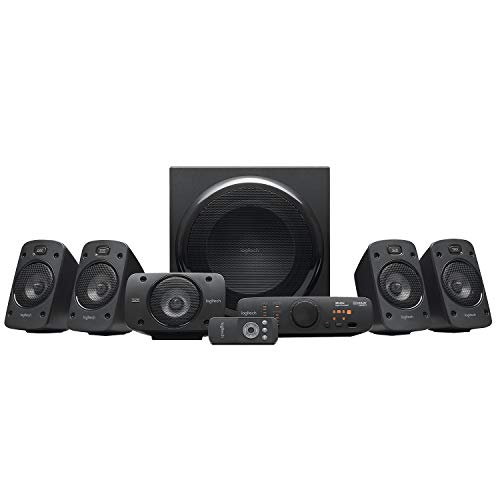
- Best for: A fixed home-theater seat that wants real surround and the strongest bass here.
- 5.1 channel surround system with five satellites and a subwoofer
- 500 watts RMS, 1000 watts peak power
- Subwoofer rated at 165 watts
- THX Certified, with Dolby Digital and DTS decoding
A fixed home-theater seat that wants real surround and the strongest bass here.
Running rear-speaker cable across the room is part of the deal, and the subwoofer is a large cabinet.
The Z906 is the step up to genuine surround sound: five satellites and a 165-watt subwoofer, fed by a control console that decodes Dolby Digital and DTS bitstreams directly. That decoding matters for film and console use, because the system builds the soundstage from the actual surround track instead of upmixing stereo. With 500 watts RMS on tap, the subwoofer holds together in larger rooms where the smaller 2.1 systems start to thin out. Multiple digital and analog inputs let a TV, console and PC stay connected at once, and the wireless remote handles volume from the sofa.
Which One Fits Your Situation
You watch films on a TV with weak built-in speakers
Start with the Z623 if the TV has an analog or headphone output, since its bass dial and simple wiring fix the thin sound in one step. If the TV only offers optical output, the S350DB or the Z906 connects directly without adapters. Any of the three replaces the hollow television sound with a subwoofer doing the low work.
You mostly listen to music in the living room
The S350DB fits best here. Its bookshelf satellites and titanium tweeters keep vocals and instruments clear while the 8-inch subwoofer fills in the bottom end, and Bluetooth with aptX makes phone listening painless. The separate bass and treble controls also help tune the system to a room that doubles as a workspace.
Your space is a bedroom or a small apartment
The ProMedia 2.1 keeps the footprint smallest while still delivering certified, punchy bass, and its control pod makes low-volume listening easy to manage. Corner placement will add free low-end reinforcement in a small room, so start with the subwoofer level low and raise it gradually rather than running it hot from day one.
You are building a proper movie and gaming corner
Choose the Z906. The decoded 5.1 soundstage, the strongest subwoofer in this group and the spread of digital inputs make it the only system here designed for a TV, a console and a PC living together. Budget the time to route the rear cables neatly, because that one chore is the difference between surround that impresses and wires that annoy.
Common Mistakes
- Comparing systems by peak watts alone, when RMS power and subwoofer driver size predict real bass far better.
- Buying a 2.1 system with no optical input for a TV that only outputs digital audio, then blaming the speakers for silence.
- Placing the subwoofer in a corner and turning it up, which produces boom rather than depth.
- Expecting a small satellite system to fill a large open-plan room at film volume.
- Forgetting to measure shelf and floor space for the subwoofer cabinet before the box arrives.
Frequently Asked Questions
Does a bigger subwoofer driver always mean better bass?
Not automatically, but driver size sets the ceiling for how much air the system can move at low frequencies. An 8-inch subwoofer generally produces deeper, calmer bass at home listening levels than a compact unit working harder. Amplifier power, cabinet design and placement still shape the final result, so treat driver size as the first filter rather than the only one.
Can these systems connect to a TV without a receiver?
Yes, that is the point of powered systems like these. The amplifier lives inside the subwoofer or control unit, so a TV connects straight to the speaker system through optical, coaxial, RCA or 3.5mm, depending on the model. Check which outputs your television actually has, because newer sets often drop analog audio entirely.
Is 2.1 enough, or do I need 5.1 for films?
For bass alone, 2.1 is enough, since the subwoofer supplies the low end in both formats. The 5.1 advantage is placement of sound: a center channel locks dialogue to the screen and rear speakers carry effects behind you. If your seating is fixed and films are the priority, 5.1 earns its extra wiring; otherwise 2.1 covers most rooms well.
Where should the subwoofer go in the room?
Start beside the TV or front speakers, a short distance from the wall, then adjust by ear from your seat. Corners add output but often add boom, while a spot along the front wall usually sounds tighter. Because every system here includes a bass level control, small placement changes plus a small level change usually solve most problems.
Related guides
More from Amazon
Programs that pair well with the guide above. Offers and eligibility are set by Amazon and may change.
A free business account with business pricing and bulk-buying tools for work, shop or home office.
Create a business accountFree shipping on eligible items, Prime Video and more. Eligible new members can start with a free trial.
Start a Prime free trialAudiobooks and podcasts to listen to on the go. Eligible new members can start with a free trial.
Try Audible freeAd-free music streaming. Eligible new subscribers can start with a free trial.
Try Music Unlimited freeAs an Amazon Associate we earn from qualifying purchases.