Our Short List of 3

- Best for: Households with large arms where two people share one monitor.
- Easy-Wrap ComFit cuff fits arms 9 to 17 inches in circumference
- Bluetooth connection to the Omron Connect app
- TruRead averaging mode takes three readings and averages them
- Dual display shows current and previous readings side by side

- Best for: Buyers who want AFib screening and clear app trends from one monitor.
- D-ring cuff fits arms 22 to 42 centimetres in circumference
- Advanced AFib screening on every reading
- High-contrast backlit display
- Bluetooth connection to the Omron Connect app
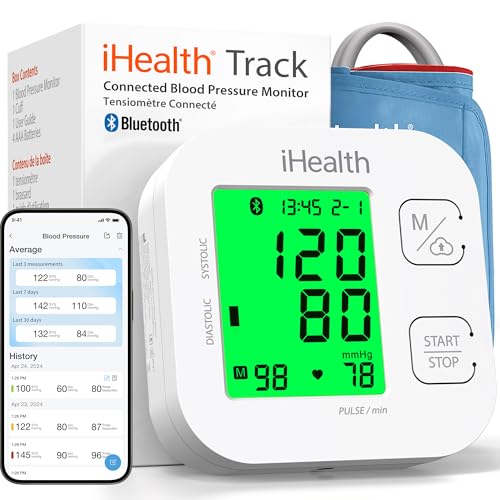
- Best for: Buyers who want simple Bluetooth tracking and a large, clear display.
- Wide-range cuff fits standard to large adult arms
- Bluetooth connection to the iHealth MyVitals app
- Large display with big, easy-to-read digits
- Irregular heartbeat detection shown on screen
All 4 Picks at a Glance
| Product | Specs | Action |
|---|---|---|
| Omron 10 Series BP7450 |
| Check price on Amazon |
| Omron Platinum BP5450 |
| Check price on Amazon |
| iHealth Track KN-550BT |
| Check price on Amazon |
 Omron Evolv BP7000 |
| Check price on Amazon |
A blood pressure cuff that is too small squeezes the arm, pinches during inflation, and gives readings that cannot be trusted, so the first decision is not the brand or the screen but the cuff itself. Large arms need a cuff with a stated range that covers the arm, a shape that wraps evenly without gaps, and a monitor that inflates smoothly without repeated pumping. The four monitors below all ship with wide-range cuffs that fit arms from 9 to 17 inches, and each one adds a different strength, from app tracking to a tubeless design that packs flat for travel.
This guide is for people with larger arms who want a cuff that fits the first time, for households where two people share one monitor, and for anyone who tracks readings to show a clinician. Each monitor was chosen from the names and specs on its Amazon page, with cuff range, memory, and display checked against the listing before it earned a place here.
Our Top Picks
- iHealth Track Smart Upper Arm Blood Pressure Monitor1 Count (Pack of 1)3.9 x 3.9 x 1.6 inches1 poundsCheck on Amazon
Top 3 picks at a glance
Quick Picks
As an Amazon Associate we earn from qualifying purchases
| Product | Best for | Key spec from title |
|---|---|---|
| Omron 10 Series BP7450 | Largest arms and two-user homes | Easy-Wrap ComFit cuff fits 9 to 17 inch arms |
| Omron Platinum BP5450 | Rhythm screening and app trends | AFib screening with Bluetooth and 200-reading memory |
| iHealth Track KN-550BT | Simple Bluetooth tracking | Wide-range cuff fits standard to large adult arms |
| Omron Evolv BP7000 | Travel and tubeless use | All-in-one design with cuff that fits 9 to 17 inch arms |
How to Choose
Cuff fit and size range
Start by measuring the upper arm at its midpoint, then compare the number with the cuff range on the listing, not with the monitor name. A cuff that is too small reads high and hurts, while a cuff that is too loose slips and reads low, so the range matters more than any other feature. Look for a range that covers the arm with room on both ends, such as 9 to 17 inches, and check whether the cuff is pre-formed, which holds its shape around the arm, or a flat D-ring style that wraps and fastens by hand. If two people share the monitor, confirm the range covers both arms before buying.
Reading storage and sharing
A monitor is only useful if the readings survive after the cuff comes off, so check how many readings it stores and whether it separates them by user. Two-user memory with 100 readings each keeps a shared household from mixing up results, while Bluetooth sync sends each reading to a phone app where trends over weeks are easier to see than a single number. Look for an app that exports a report or a chart you can show a clinician, and check whether the app needs an account or works without one. Unlimited app storage beats a small on-device memory when you track readings for months.
Display and ease of use
A large, backlit display with big digits matters when you read the numbers without glasses or in a dim room, and a dual display that shows the current reading beside the last one helps you spot changes at a glance. One-touch start keeps the routine simple: wrap the cuff, press start, and wait for the reading without menus or settings. Look for a monitor that flags an irregular heartbeat symbol on the screen, and check that the buttons are large enough to press without looking. An AC adapter in the box saves batteries for daily use at home.
Power and portability
Most upper-arm monitors run on four AA batteries, and some include an AC adapter for the bedside table, so check what ships in the box before you buy spares. Battery life matters less at home than on the road, where a tubeless all-in-one design that folds flat takes up far less space in a bag than a separate monitor, cuff, and adapter. If you travel, look for a monitor with a carrying case and a cuff that keeps its shape after being packed. A monitor that stores readings in the app also means you never lose a result when the batteries run out.
The 4 Best Options
Omron 10 Series BP7450
- Best for: Households with large arms where two people share one monitor.
- Easy-Wrap ComFit cuff fits arms 9 to 17 inches in circumference
- Bluetooth connection to the Omron Connect app
- TruRead averaging mode takes three readings and averages them
- Dual display shows current and previous readings side by side
Households with large arms where two people share one monitor.
The cuff is wide and pre-formed, so check that it fits inside your storage spot when folded.
The 10 Series is the pick for the largest arms in a shared home, because its pre-formed Easy-Wrap ComFit cuff fits arms from 9 to 17 inches and holds its shape so one person can wrap it alone without help. Bluetooth sends every reading to the Omron Connect app, TruRead averaging takes three readings and shows the average, and the dual display puts the latest result beside the previous one. Two-user memory stores 200 readings, and the AC adapter in the box means daily use never depends on batteries.
Watch out for: The cuff is wide and pre-formed, so check that it fits inside your storage spot when folded.
Omron Platinum BP5450
- Best for: Buyers who want AFib screening and clear app trends from one monitor.
- D-ring cuff fits arms 22 to 42 centimetres in circumference
- Advanced AFib screening on every reading
- High-contrast backlit display
- Bluetooth connection to the Omron Connect app
Buyers who want AFib screening and clear app trends from one monitor.
The D-ring cuff wraps by hand, so take a moment to seat it evenly before each reading.
The Platinum suits buyers who want rhythm information alongside each reading, because it screens for possible AFib on every measurement and pairs the result with a high-contrast backlit display that stays readable in low light. Its D-ring cuff fits arms from 22 to 42 centimetres, Bluetooth syncs readings to the Omron Connect app, and two-user memory holds 200 readings. The monitor is sold as an Amazon exclusive model, and the kit includes an AC adapter and a storage case.
Watch out for: The D-ring cuff wraps by hand, so take a moment to seat it evenly before each reading.
iHealth Track KN-550BT
- Best for: Buyers who want simple Bluetooth tracking and a large, clear display.
- Wide-range cuff fits standard to large adult arms
- Bluetooth connection to the iHealth MyVitals app
- Large display with big, easy-to-read digits
- Irregular heartbeat detection shown on screen
Buyers who want simple Bluetooth tracking and a large, clear display.
The monitor uses AAA batteries, so keep spares on hand if you measure daily.
The iHealth Track is the straightforward choice for buyers who want Bluetooth tracking without a complicated setup, because its wide-range cuff fits standard to large adult arms and the monitor pairs with the iHealth MyVitals app in a few taps. The large display shows the reading in big digits, irregular heartbeat detection flags unusual rhythms on screen, and the app stores unlimited readings with history by day, week, and month. Four AAA batteries power the monitor, and the cuff stores flat in its case.
Watch out for: The monitor uses AAA batteries, so keep spares on hand if you measure daily.
Omron Evolv BP7000
- Best for: Travellers who want a large-arm cuff that packs flat in a bag.
- All-in-one tubeless design with the monitor built into the cuff
- Cuff fits arms 9 to 17 inches in circumference
- Bluetooth connection to the Omron Connect app
- Unlimited readings stored in the app
Travellers who want a large-arm cuff that packs flat in a bag.
The one-piece shape means the whole unit goes on the arm, so check the fit feels steady before the first reading.
The Evolv is the travel pick, because it folds the monitor into the cuff itself, with no tubes and no separate unit to pack, and the cuff still fits arms from 9 to 17 inches. Bluetooth sends readings to the Omron Connect app with unlimited storage, and the compact shape slips into a bag beside a laptop. One-touch start keeps the routine simple on the road, and the monitor runs on batteries so no outlet is needed. It is the lightest way to keep the same cuff fit away from home.
Watch out for: The one-piece shape means the whole unit goes on the arm, so check the fit feels steady before the first reading.
Which One Fits Your Situation
Largest arms in a shared home
Choose the Omron 10 Series BP7450 when two people with larger arms share one monitor. Its pre-formed cuff holds its shape for solo wrapping, the range covers 9 to 17 inch arms, and two-user memory keeps 100 readings each without mixing them up. TruRead averaging and the dual display make it easy to compare today with yesterday at a glance.
Rhythm screening and app trends
Choose the Omron Platinum BP5450 when you want AFib screening on every reading and a clear record to show a clinician. The backlit display stays readable in dim rooms, Bluetooth syncs each reading to the app, and the 200-reading memory covers two users. The included case keeps the cuff and adapter together between uses.
Simple Bluetooth tracking
Choose the iHealth Track KN-550BT when you want the simplest route to phone tracking. The wide-range cuff fits standard to large arms, the large display shows big digits, and the app stores unlimited readings with history by day, week, and month. It is a good fit for buyers who check readings daily and want the history without extra steps.
Travel with a large-arm cuff
Choose the Omron Evolv BP7000 when the monitor needs to travel. The tubeless all-in-one design packs flat, the cuff still fits 9 to 17 inch arms, and Bluetooth storage in the app means no reading is lost when the batteries run low. It suits hotel rooms, family visits, and any trip where a separate monitor and cuff would take too much space.
Common Mistakes
- Buying a monitor without checking the cuff range against a measured arm size first.
- Measuring over a sleeve, which bunches the fabric and changes the reading.
- Talking, moving, or crossing legs during the reading instead of sitting still with feet flat.
- Trusting a single reading instead of taking two or three and looking at the pattern over days.
- Sharing one monitor between two people without checking that the memory separates users.
Frequently Asked Questions
How do I measure my arm for a cuff?
Wrap a soft tape around the midpoint of the upper arm, halfway between shoulder and elbow, with the arm relaxed at your side. Write down the number, then compare it with the cuff range on the listing. Pick a cuff whose range covers your measurement, and re-measure if your arm size changes over time.
Can one monitor work for two people with different arm sizes?
Yes, if the cuff range covers both arms and the monitor stores readings by user. Two-user memory with 100 readings each keeps results separate, and a pre-formed cuff that holds its shape is easier to wrap alone. Measure both arms first, then confirm the stated range fits the larger one before buying.
Do Bluetooth blood pressure monitors need a subscription?
No. The monitors in this guide sync readings to a free companion app, and the app stores the history without a monthly fee. Some apps offer extra features behind a paid tier, but basic syncing, history, and sharing work without one. Check the app listing before buying if a specific feature matters to you.
When should I talk to a clinician about my readings?
Share your readings with a clinician when the numbers stay high over several days, when readings jump around a lot, or when the monitor flags an irregular heartbeat more than once. Bring the app history or a written log so the clinician sees the pattern, not just one number. A home monitor tracks trends; it does not replace medical advice.
Related guides
More from Amazon
Programs that pair well with the guide above. Offers and eligibility are set by Amazon and may change.
A free business account with business pricing and bulk-buying tools for work, shop or home office.
Create a business accountFree shipping on eligible items, Prime Video and more. Eligible new members can start with a free trial.
Start a Prime free trialAudiobooks and podcasts to listen to on the go. Eligible new members can start with a free trial.
Try Audible freeAd-free music streaming. Eligible new subscribers can start with a free trial.
Try Music Unlimited freeAs an Amazon Associate we earn from qualifying purchases.