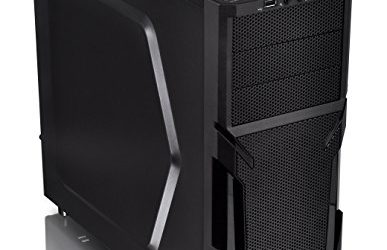
The best portable PC cases in 2026 are small-form-factor Mini-ITX cases with a built-in carry handle or a compact footprint: the Cooler Master NR200P is the best overall, the Fractal Design Terra is the best for style and portability, the NZXT H1 V2 is the best all-in-one with a bundled power supply and liquid cooler, and the Lian Li A4-H2O is the best for ultra-small builds. Choose by the length of the graphics card you plan to use and the cooling you need.
Portable does not only mean small. A case you carry to LANs needs a rigid frame, protective panels, a handle or compact shape, and enough airflow that a high-power graphics card does not overheat in a tight space. This guide gives picks, then a clearance and power calculation so you can check compatibility before buying.
Quick comparison of the best portable PC cases
| Pick | Best for | Key specs | Typical price range |
|---|---|---|---|
| Cooler Master NR200P | Best overall | About 18 L, Mini-ITX, GPU up to about 330 mm, 280 mm radiator support, tool-free panels | Usually $90-$120 |
| Fractal Design Terra | Best for style and carrying | About 10 L, Mini-ITX, aluminum and wood-style design, GPU up to about 322 mm, SFX power supply | Usually $160-$200 |
| NZXT H1 V2 | Best all-in-one | About 13 L, Mini-ITX, bundled 750 W SFX 80+ Gold power supply and 140 mm AIO, GPU up to about 305 mm | Usually $300-$400 |
| Lian Li A4-H2O | Best ultra-compact | About 11 L, Mini-ITX, GPU up to about 322 mm of two-slot width, 240 mm radiator option | Usually $130-$170 |
| Sliger / SSUPD Meshlicious class | Best for airflow | About 15 L, mesh panels, handle-friendly shape, SFX or SFX-L power supply | Usually $120-$180 |
Specifications vary by revision, so check the manufacturer’s current spec sheet for exact graphics card length, cooler height and power supply compatibility.
Best overall: Cooler Master NR200P
The NR200P is a popular Mini-ITX starting point. It offers vented steel panels, a roomy interior for an 18 liter case, and options for radiators or fans on several sides. It fits graphics cards up to about 330 mm, so most two-fan and some three-fan cards fit. Tool-free panels make building straightforward.
Trade-off: it is not the smallest option, and it lacks a built-in handle, so carrying it by the panel edges feels less secure than a dedicated handle.
Best for style and carrying: Fractal Design Terra
The Terra uses a vertical, compact layout with a metal frame and a distinctive design, and it is among the easiest cases to carry thanks to its shape. It supports SFX power supplies and a good range of coolers. The trade-off is price and limited graphics card width; confirm that the card you want is two slots and within the length limit.
Best all-in-one: NZXT H1 V2
The H1 V2 is sold as a near-complete shell: it includes a power supply and a liquid cooler, plus a riser cable for the graphics card. Because the PSU and cooler are included, assembly is simpler and compatibility is known in advance. The trade-off is flexibility: you must use its included parts, and the cooling headroom is limited with very high-power graphics cards.
Best ultra-compact: Lian Li A4-H2O
The A4-H2O is around 11 liters and designed to take a full-size graphics card by putting it in a sandwiched layout with a riser. It fits in a backpack and suits LAN travel. The trade-offs are tight clearance, a smaller CPU cooler height limit and a demand for an SFX power supply with short cables. Builders need patience.
Best for airflow: mesh small-form-factor cases
Cases built around mesh panels, such as the Meshlicious class, have large open surfaces that keep temperatures down. They suit builders who want a powerful graphics card in a small shell without thermal throttling, and they often include a top handle or are easy to carry in a bag.
Worked example: will your parts fit and cool?
Suppose you want a Mini-ITX build with a graphics card that draws up to 285 W and a CPU that draws up to 125 W. Typical other components add about 50 W (motherboard, memory, drives, fans). Total peak is about 285 + 125 + 50 = 460 W. Power supplies are most efficient at 50 to 80 percent load, so a 750 W SFX unit gives comfortable headroom (460 / 750 = 61 percent) and handles transient spikes from the graphics card.
| Check | Typical limit in a 10-18 L case | What to measure |
|---|---|---|
| Graphics card length | 300-335 mm | Card length from the spec sheet, plus 5 mm clearance for cables |
| Graphics card thickness | 2 to 3 slots (about 40-60 mm) | Slot width from the spec sheet |
| CPU cooler height | 48-67 mm for low-profile; up to 130 mm in larger cases | Cooler height from the maker |
| Power supply form factor | SFX or SFX-L | Wattage 600-850 W |
| Radiator size | 120-280 mm | Thickness plus fan stack |
If a card is 320 mm long and the case allows 322 mm, you have 2 mm to spare: technically fits, but cable plugs may not. Aim for at least 5 mm of free space. A rule of thumb for airflow: small cases need at least two intake and one exhaust fan, and the graphics card should have its fans facing a ventilated panel rather than a solid one.
How to choose a portable PC case
- Start with the graphics card. Its length and thickness set the minimum case size. Compact two-slot cards give the most freedom.
- Choose volume by how you carry. Under 12 liters fits a backpack; 15 to 20 liters needs a dedicated bag or a handle.
- Check CPU cooling. Small cases limit air coolers. Decide between a low-profile air cooler or a 240 mm liquid cooler.
- Plan the power supply. SFX units are pricier and have short cables; confirm connector length for the graphics card.
- Look at panel design. Mesh gives better airflow; solid glass looks nicer but runs hotter.
- Check build difficulty. Smaller cases are harder to wire. Choose a larger one for your first build.
Tips for transporting a PC
- Remove or support heavy graphics cards using a bracket or foam during travel to avoid stress on the slot.
- Secure the CPU cooler; large air coolers can loosen over bumpy trips.
- Pack the PC upright and cushion it in a padded bag; never check it as luggage.
- Let a cold machine reach room temperature before powering on to avoid condensation.
Frequently Asked Questions
What is the best portable PC case?
The Cooler Master NR200P is the best overall for most people because it balances size, airflow and price. The Fractal Design Terra and Lian Li A4-H2O are better if you value a smaller footprint and are happy to pay more.
Can a small case fit a high-end graphics card?
Yes, many Mini-ITX cases take cards up to about 330 mm long and two to three slots wide. Check the card’s exact length and the case’s spec sheet, and confirm that airflow is good enough to avoid throttling.
Do small cases run hotter?
They can, because there is less air volume. Cases with mesh panels and correctly placed fans can keep temperatures reasonable. Using a slightly lower power limit on the graphics card can also reduce heat with only a small performance loss.
Is a portable case good for LAN parties?
Yes. A small case with a handle or a compact shape is easy to carry and fits in a backpack. A mesh design keeps temperatures low during long sessions.
What power supply do portable cases need?
Most use SFX or SFX-L power supplies, which are smaller than standard ATX units. A 650 to 850 W unit covers most gaming builds, but verify that the case supports the form factor you choose.
Related guides
More from Amazon
Programs that pair well with the guide above. Offers and eligibility are set by Amazon and may change.
A free business account with business pricing and bulk-buying tools for work, shop or home office.
Create a business accountFree shipping on eligible items, Prime Video and more. Eligible new members can start with a free trial.
Start a Prime free trialAudiobooks and podcasts to listen to on the go. Eligible new members can start with a free trial.
Try Audible freeAd-free music streaming. Eligible new subscribers can start with a free trial.
Try Music Unlimited freeAs an Amazon Associate we earn from qualifying purchases.