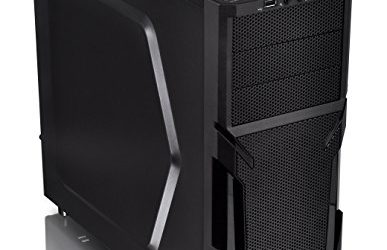
The best small form factor PC case for most builders in 2026 is the Cooler Master NR200P (or its V2 revision), because it balances a roughly 18-liter body, support for long triple-fan-class graphics cards and easy building. If you want the smallest footprint, look at the Fractal Design Terra, Fractal Design Ridge or Lian Li A4-H2O class, which sit near 10-12 liters but demand careful part selection.
Quick comparison of SFF case picks
| Pick | Best for | Approx. volume and key specs | Price range |
|---|---|---|---|
| Cooler Master NR200P / V2 | Best overall | About 18 L, mini-ITX, SFX or SFX-L PSU, roughly 330 mm GPU length, mesh panels | Usually $90-$130 |
| Fractal Design Terra | Best looking and compact | About 10 L, mini-ITX, SFX PSU, aluminum and wood-look build | Usually $180-$220 |
| Fractal Design Ridge | Living-room console style | About 10 L, horizontal or vertical, PCIe riser included | Usually $120-$160 |
| Lian Li A4-H2O | Smallest high-end build | About 11 L, mini-ITX, 240 mm AIO option, SFX PSU, riser included | Usually $150-$190 |
| Lian Li Q58 | Easiest SFF with an ATX PSU | Roughly 15 L, mini-ITX, ATX power supply support, glass sides | Usually $100-$140 |
| NCASE M1 class (spec class) | Enthusiast, tiny footprint | About 12-13 L, SFX PSU, very small, limited availability | Usually $200-$300 |
What makes a small case “best”
An SFF case succeeds or fails on three numbers: internal volume, graphics card clearance (length and thickness) and CPU cooler or radiator support. A case that looks tiny but forces you into a low-power graphics card and a loud cooler is a bad trade for a gaming build. Match the case to the parts you want, not the other way around.
Best overall: Cooler Master NR200P
The NR200P and its newer V2 refresh are the case most builders recommend first. At around 18 liters, they have enough room for a roughly 330 mm graphics card, a 280 mm radiator or a tall air cooler up to about 155 mm, per the manufacturer’s spec sheet. The side panels pop off without tools, and the cooling layout works with both air and liquid.
Who it suits: first-time SFF builders and anyone planning to use a high-end graphics card.
Trade-off: it is larger than the true ultra-compact cases, and you still need an SFX or SFX-L power supply, which costs more than a standard ATX unit.
Best for the smallest premium build: Lian Li A4-H2O and Fractal Design Terra
The A4-H2O and the Terra target people who want a console-sized PC, around 10-12 liters. Both include or support a PCIe riser, which lets the graphics card sit at the side of the motherboard. The A4-H2O supports a 240 mm radiator in some configurations; the Terra relies on air cooling with a low-profile cooler. Per manufacturer specs, both limit graphics cards to two or fewer slots in thickness, so large flagship cards will not fit.
Trade-off: parts compatibility is narrow. Check GPU length, thickness and cooler height before buying anything.
Best for a standard ATX power supply: Lian Li Q58
If you already own a regular ATX power supply or want to avoid the price premium of SFX units, the Q58 is one of the few SFF cases that accepts one. It sits around 15 liters, so you trade a bit of size for savings and easier cable routing.
Best for a living room: Fractal Design Ridge
The Ridge can sit horizontally like a console or stand vertically, and it ships with a riser cable. It has a smaller maximum GPU length than larger cases, so measure first.
Worked calculation: will your parts fit?
Use this quick method before ordering anything.
- Compute case volume. Multiply length x width x height in centimeters and divide by 1,000. A case measuring 37 x 18.5 x 26 cm is about 17.8 liters.
- Check the graphics card length. Add 5 mm of safety margin to the card’s listed length. A 320 mm card needs at least a 325 mm limit.
- Check the card thickness. A card marketed as 2.5-slot is about 50 mm thick. Many 10-12 liter cases cap at about 2-2.5 slots, or roughly 45-55 mm.
- Check the power supply. A mid-range gaming build with a 200 W graphics card and a 105 W CPU peaks near 350 W under load. Adding 50% headroom suggests a 550-650 W SFX unit.
- Check CPU cooler height. Many SFF cases cap air coolers at 48-67 mm for the smallest models and about 155 mm for mid-size ones.
| Component | Typical SFF limit (check each spec sheet) | Example choice |
|---|---|---|
| Graphics card length | Roughly 280-340 mm | Two-fan mid-range cards at 240-290 mm |
| Graphics card thickness | 2 to 3 slots | 2-slot cards for 10-12 L cases |
| CPU cooler height | 48-155 mm | Low-profile air cooler or 240 mm AIO |
| Power supply | SFX 450-850 W, some SFX-L or ATX | 650 W SFX Gold |
| Storage | 1-3 M.2 plus a couple of 2.5-inch bays | 2 TB NVMe SSD |
Thermals: how to avoid a hot, loud small build
Small cases have less air volume, so heat builds up faster. These choices matter most:
- Choose efficient parts. A graphics card and CPU that draw less power need less cooling. Pairing a 65 W CPU with a card around 200 W keeps total heat under about 300 W.
- Prioritize mesh panels. A mesh side panel gives the graphics card direct access to fresh air, which can lower temperatures by several degrees compared with a solid panel, depending on the case.
- Set a custom fan curve. Small fans spin faster and sound sharper. Setting a curve that ramps gradually from 30% at 50 C to 70% at 80 C keeps idle noise low.
- Undervolt the graphics card. Reducing voltage by 50-100 mV with a matching clock limit often lowers power by 10-20% with minimal performance loss, though results vary by card and silicon.
Decision matrix by situation
| Your priority | Choose |
|---|---|
| High-end GPU, easy build | NR200P or V2 |
| Smallest possible desk or TV-stand PC | Terra, Ridge or A4-H2O |
| Use an old ATX power supply | Lian Li Q58 |
| Quiet office-gaming hybrid | A larger SFF case with mesh and a low-power GPU |
| Tightest budget | NR200P class with a standard mini-ITX board |
Build order tips for tight cases
Install parts in the order that keeps cables accessible. Mount the CPU, memory and M.2 drive on the motherboard outside the case first, because the board often becomes unreachable once the graphics card and cooler are in place. Fit the power supply and route its cables before installing the graphics card, and use short, custom or flat cables where possible; a bundle of standard cables can block airflow and stop a side panel from closing. Finally, run a stress test for 20-30 minutes and watch temperatures, since a hot spot is easier to fix before you cable-tie everything in place.
Frequently Asked Questions
What is considered a small form factor PC case?
SFF cases are usually under about 20 liters in volume and take mini-ITX motherboards, though a few accept micro-ATX. There is no single official definition, but communities generally label cases under 20 liters as SFF and under 10 liters as ultra-compact.
Can I fit a high-end graphics card in an SFF case?
Yes, in mid-size SFF cases around 15-18 liters. Cases near 10-12 liters often limit you to cards two to 2.5 slots thick and under about 300 mm. Always compare the card’s dimensions with the case spec sheet.
Are SFF PCs harder to build?
They are less forgiving. Cable routing, tight clearances and SFX power supplies add time, but modern cases such as the NR200P are designed to be beginner friendly. Plan the build order before starting.
Do small cases run hotter?
They can, especially with high-wattage parts and solid panels. With mesh panels, efficient components and a decent fan curve, many SFF builds hold normal gaming temperatures. Results depend on the case, the parts and room temperature.
Is an SFX power supply worse than ATX?
Not in quality; good SFX units from reputable makers offer Gold efficiency and long warranties. They cost more per watt and usually top out around 850-1000 W, which is plenty for most gaming systems.
Related guides
More from Amazon
Programs that pair well with the guide above. Offers and eligibility are set by Amazon and may change.
A free business account with business pricing and bulk-buying tools for work, shop or home office.
Create a business accountFree shipping on eligible items, Prime Video and more. Eligible new members can start with a free trial.
Start a Prime free trialAudiobooks and podcasts to listen to on the go. Eligible new members can start with a free trial.
Try Audible freeAd-free music streaming. Eligible new subscribers can start with a free trial.
Try Music Unlimited freeAs an Amazon Associate we earn from qualifying purchases.