A SATA SSD is the simplest storage upgrade a desktop or laptop can receive. It plugs into the same 2.5-inch bay and SATA cable as an old hard drive, yet it removes the mechanical delay that makes a system feel slow. Boot times shorten, programs open sooner, and large files copy without the long waits that come with spinning disks. For machines that lack an M.2 slot, or for anyone adding a second drive for games and media, a SATA SSD is still the practical choice.
This guide compares four 2.5-inch SATA III drives using only the specifications shown on their Amazon product pages: capacity, sequential read and write speeds, NAND type and model number. Every drive below is a 2.5-inch SATA SSD sold on Amazon US. Use the Quick Picks table to narrow the field, then read the How to Choose section to work out which capacity and endurance profile fits your machine.
Our Top Picks
 Kingston 480GB A400 SATA 3 2.5" Internal SSD480 GB3.94 x 0.28 x 2.75 inches0.09 poundsCheck on Amazon
Quick Picks
| Product | Best for | Key spec |
|---|---|---|
| Samsung 870 EVO 1TB SATA III 2.5-inch Internal SSD (MZ-77E1T0B/AM) | Everyday upgrades and mixed workloads | Up to 560 MB/s read, 1TB |
| Crucial MX500 1TB 3D NAND SATA 2.5-inch Internal SSD (CT1000MX500SSD1Z) | Balanced capacity and reliability | Up to 560 MB/s read, 1TB |
| WD Blue SA510 1TB SATA III 2.5-inch/7mm Internal SSD (WDS100T3B0A) | Slim laptops and compact builds | 7mm 2.5-inch form, 1TB |
| Kingston A400 480GB SATA 3 2.5-inch Internal SSD (SA400S37/480G) | Low-cost boot drive upgrades | 480GB, up to 500 MB/s read |
How to Choose
Capacity: match the drive to what it will hold
Capacity decides how useful the drive will be a year from now. A 480GB drive holds an operating system, everyday programs and a modest game library, but it fills up fast once large games and video files arrive. A 1TB drive gives the same system far more room to breathe, and it is the capacity most buyers should aim for when the drive will hold games as well as the operating system. Check how much space your current drive uses before you choose, and leave room for the drive to stay well below full.
Speed: SATA III has a firm ceiling
Every SATA III drive tops out near the interface limit of 6Gb/s, so the fastest drives in this guide read at up to 560 MB/s and the slowest at up to 500 MB/s. That gap is small in everyday use. What matters more is that any of these drives is far faster than a hard drive at random access, which is the pattern behind booting, launching programs and loading game levels. Do not buy a SATA drive expecting NVMe speeds; buy it for the upgrade it actually delivers over a hard drive.
NAND type and endurance
NAND type shapes how a drive handles sustained writes. The Samsung 870 EVO uses Samsung V-NAND 3D NAND, and the Crucial MX500 uses 3D NAND, both of which are established designs for consumer SATA drives. For a boot drive or a games drive, either is a sound choice. Endurance ratings matter most when a drive will see heavy, repeated writing, such as video scratch disks or constant large file transfers. For ordinary desktop use, capacity and form factor will affect your experience more than small differences in NAND.
Form factor: check the bay and the cable
All four drives here are 2.5-inch SATA drives, but thickness still matters. The Samsung 870 EVO and WD Blue SA510 are 7mm drives, which fit slim laptop bays that cannot take a 9.5mm drive. The Crucial MX500 and Kingston A400 are listed as standard 2.5-inch drives, so check your laptop or enclosure for a thickness limit before ordering. Desktops with a 2.5-inch bay or a mounting bracket take any of them. You will also need a free SATA data cable and a SATA power connector from your power supply.
The 4 Best SATA SSDs
Samsung 870 EVO 1TB SATA III 2.5-inch Internal SSD (MZ-77E1T0B/AM)
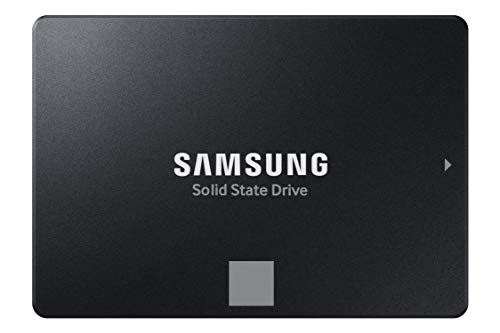
The Samsung 870 EVO is the best-known drive in this guide, and its specification sheet explains why it earns that position. It reads at up to 560 MB/s and writes at up to 530 MB/s, which is effectively the top of what the SATA III interface allows. The 1TB capacity suits a boot drive that also holds a game library, and the Samsung V-NAND 3D NAND is a mature design that has been used across several generations of Samsung drives.
As a general-purpose upgrade, the 870 EVO is the easiest drive in this list to recommend. It fits 7mm laptop bays, works in any desktop with a SATA port, and its 1TB capacity is large enough that most buyers will not need to think about storage again for a long time. The model number MZ-77E1T0B/AM identifies the 1TB version, so check that number on the listing if you are comparing capacities.
- Specs: Brand: Samsung; Model Number: MZ-77E1T0B/AM; Capacity: 1TB; Form Factor: 2.5-inch, 7mm; Interface: SATA III 6Gb/s; NAND: Samsung V-NAND 3D NAND; Sequential Read: Up to 560 MB/s; Sequential Write: Up to 530 MB/s
- Best for: Everyday upgrades, boot drives and mixed workloads where reliability matters.
- Watch out for: It is a SATA drive, so it cannot match NVMe speeds; buy it for a SATA bay, not as a substitute for an M.2 slot.
Crucial MX500 1TB 3D NAND SATA 2.5-inch Internal SSD (CT1000MX500SSD1Z)
The Crucial MX500 is the long-running alternative to Samsung in the 1TB SATA class, and its numbers are close to the 870 EVO in every measure that matters. It reads at up to 560 MB/s and writes at up to 510 MB/s over SATA 6Gb/s, using 3D NAND. For booting, launching programs and loading games, the difference between this drive and the fastest SATA drive is not something most users will notice.
The MX500 suits buyers who want a proven 1TB drive and are comparing on value rather than brand. Its model number CT1000MX500SSD1Z marks the 1TB version of the line. It is a standard 2.5-inch drive, so desktop owners can fit it in any 2.5-inch bay, while laptop owners should confirm the bay accepts its thickness before ordering.
- Specs: Brand: Crucial; Model Number: CT1000MX500SSD1Z; Capacity: 1TB; Form Factor: 2.5-inch; Interface: SATA 6Gb/s; NAND: 3D NAND; Sequential Read: Up to 560 MB/s; Sequential Write: Up to 510 MB/s
- Best for: Balanced 1TB upgrades where a proven design and straightforward specs matter.
- Watch out for: Check bay thickness on slim laptops, since this listing does not state a 7mm profile.
WD Blue SA510 1TB SATA III 2.5-inch/7mm Internal SSD (WDS100T3B0A)
The WD Blue SA510 is the slim drive in this guide. At 7mm thick, it fits the narrow bays found in many laptops and small-form-factor builds, while still offering 1TB of capacity and sequential reads up to 560 MB/s over SATA III 6Gb/s. That combination makes it a strong pick when the machine itself limits what will fit.
For a laptop upgrade, the SA510 solves the two problems that matter most: space and thickness. A 1TB capacity is enough for the operating system, programs and a reasonable media collection, and the 7mm profile removes the fit question that stops some buyers from upgrading older slim laptops. The model number WDS100T3B0A identifies the 1TB version on the listing.
- Specs: Brand: Western Digital; Model Number: WDS100T3B0A; Capacity: 1TB; Form Factor: 2.5-inch, 7mm; Interface: SATA III 6Gb/s; Sequential Read: Up to 560 MB/s
- Best for: Slim laptops and compact builds where a 7mm drive is required.
- Watch out for: The listing does not state a sequential write speed, so compare it on read speed and capacity rather than write performance.
Kingston A400 480GB SATA 3 2.5-inch Internal SSD (SA400S37/480G)
The Kingston A400 is the low-cost entry in this guide, and its role is narrower than the 1TB drives above. At 480GB it holds an operating system and everyday programs comfortably, and its sequential read speed of up to 500 MB/s and write speed of up to 450 MB/s are enough to transform an old hard-drive machine. It is the drive to pick when the budget is tight and the job is a boot-drive rescue rather than a full storage overhaul.
This drive makes the most sense in an older desktop or laptop that still runs on a hard drive. Swapping in the A400 as the boot drive gives the machine a second life for ordinary work, web browsing and light programs. The model number SA400S37/480G marks the 480GB version, so confirm the capacity on the listing before ordering.
- Specs: Brand: Kingston; Model Number: SA400S37/480G; Capacity: 480GB; Form Factor: 2.5-inch; Interface: SATA Rev. 3.0 (6Gb/s); Sequential Read: Up to 500 MB/s; Sequential Write: Up to 450 MB/s
- Best for: Low-cost boot drive upgrades in older machines still running on hard drives.
- Watch out for: 480GB fills up quickly if it must also hold games or large media, so plan for a second drive if storage needs are large.
Which One Fits Your Situation
If you are upgrading a laptop, start with thickness. The Samsung 870 EVO and WD Blue SA510 are both 7mm drives, so either fits a slim bay, and the 1TB capacity covers the operating system plus programs and media. If you are upgrading a desktop, any of the four fits, so choose on capacity and value instead.
If the drive will hold games as well as the operating system, pick a 1TB drive. The Samsung 870 EVO leads on write speed, the Crucial MX500 matches it on read speed, and the WD Blue SA510 adds the slim profile. If the job is only to rescue an old machine as a boot drive, the Kingston A400 at 480GB does that job for less, and its lower speeds still feel far faster than a hard drive.
Common Mistakes
- Buying a SATA SSD for a machine that has a free M.2 NVMe slot and expecting NVMe performance from it.
- Choosing 480GB for a gaming machine and running out of room after installing a few large games.
- Forgetting to check whether a slim laptop bay needs a 7mm drive before ordering a standard-thickness model.
- Cloning a failing hard drive onto the new SSD without checking the old drive for errors first.
- Leaving the old hard drive connected as the boot drive in BIOS after installing the SSD, so the system still boots slowly.
- Filling the SSD to near full, which leaves little free space for the drive to manage writes efficiently.
Frequently Asked Questions
Will a SATA SSD work in my laptop?
If your laptop has a 2.5-inch SATA bay, yes. Check whether the bay needs a 7mm drive; the Samsung 870 EVO and WD Blue SA510 in this guide are 7mm, while the Crucial MX500 and Kingston A400 are listed as standard 2.5-inch drives.
Is a SATA SSD much faster than a hard drive?
Yes, in the ways that matter day to day. Sequential reads up to 560 MB/s are several times faster than a hard drive, and random access is far quicker, which is what makes booting and launching programs feel faster.
Do I need 1TB or is 480GB enough?
480GB is enough for an operating system and everyday programs. Choose 1TB if the drive will also hold games, video or large media files, since those fill a smaller drive quickly.
Can I use a SATA SSD as a second drive for games?
Yes. Any of the 1TB drives in this guide works well as a games drive in a desktop with a free SATA port and a spare SATA power connector.
Related guides
- Best SSDs for NAS
- Best portable hard drives for Mac
- Best software for cloning hard drives
As an Amazon Associate, we earn from qualifying purchases.
Related guides
More from Amazon
Programs that pair well with the guide above. Offers and eligibility are set by Amazon and may change.
A free business account with business pricing and bulk-buying tools for work, shop or home office.
Create a business accountFree shipping on eligible items, Prime Video and more. Eligible new members can start with a free trial.
Start a Prime free trialAudiobooks and podcasts to listen to on the go. Eligible new members can start with a free trial.
Try Audible freeAd-free music streaming. Eligible new subscribers can start with a free trial.
Try Music Unlimited freeAs an Amazon Associate we earn from qualifying purchases.