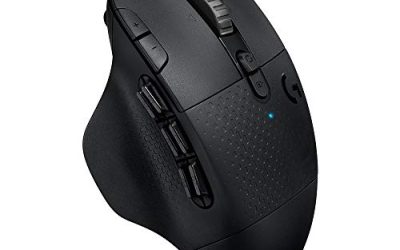
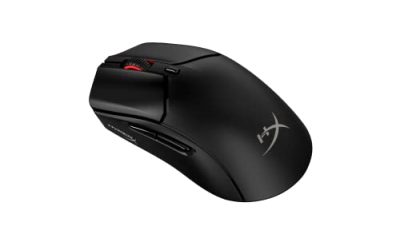
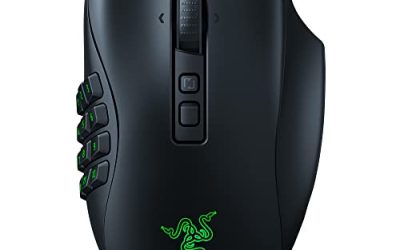
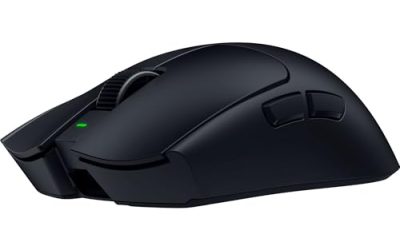
The best accurate gaming mouse for most players in 2026 is the Logitech G Pro X Superlight 2, because its sensor tracks cleanly, its 60 g shell is easy to stop precisely, and it runs for a long time per charge. If you want the highest polling rates, the Razer Viper V3 Pro is the closest alternative. If you want a plug-and-play mouse with no software, look at the Zowie EC2-CW. Beyond a certain point, accuracy depends more on shape, weight, and your sensitivity settings than on a bigger DPI number.
As an Amazon Associate we earn from qualifying purchases at no extra cost to you.


Top 3 picks at a glance
What “accurate” actually means in a gaming mouse
Accuracy is a bundle of behaviors, not one spec. Modern flagship sensors from Logitech, Razer, and others all report tracking speeds above 400 IPS and acceleration above 40 G according to the manufacturers’ spec sheets. Differences between sensors are small at that level. These are the traits that separate mice in real use:
- Tracking consistency: no spin-outs, jitter, or unwanted smoothing at your normal DPI (400–1600).
- Low lift-off distance (LOD): the sensor stops reading soon after you lift the mouse, so repositioning does not drag the crosshair. Adjustable LOD helps here.
- Polling rate and wireless stability: 1000 Hz is enough for most players. 4000–8000 Hz gives finer cursor updates but costs CPU time and battery.
- Weight and glide: a mouse that is easy to stop lets you land flicks without overshoot. This is shape and feet, not sensor quality.
- Shape fit: if the mouse does not match your hand and grip, no sensor will make your aim consistent.
Quick comparison of the picks
| Pick | Best for | Key specs (per manufacturer) | Price range |
|---|---|---|---|
| Logitech G Pro X Superlight 2 | Best overall | Wireless, about 60 g, HERO 2 sensor up to 32,000 DPI, low-profile symmetrical shape | Usually $140–$160 |
| Razer Viper V3 Pro | Best for high polling and esports | Wireless, about 54 g, Focus Pro 35K optical sensor, up to 8000 Hz with the supported dongle | Usually $150–$170 |
| Zowie EC2-CW | Best no-software, shape-first pick | Wireless, ergonomic right-hand shape, fixed DPI steps, driverless operation | Usually $120–$160 |
| Razer Viper V3 HyperSpeed | Best budget accurate mouse | Wireless, about 82 g, 30K-class optical sensor, symmetrical shape | Usually $60–$80 |
| Logitech G305 Lightspeed | Best value on a tight budget | Wireless, HERO 12K sensor, runs on one AA battery, about 99 g with battery | Usually $30–$50 |
Best overall: Logitech G Pro X Superlight 2
The Superlight 2 suits players who want a mouse that works without tuning. The HERO 2 sensor is consistent across mousepad surfaces, the 60 g body stops easily, and the shape is a safe fit for claw and fingertip grips on medium hands. Logitech’s spec sheet lists about 95 hours of battery life, so charging is rarely a concern.
Trade-off: the shape is low and fairly flat, so large-handed palm grippers may find it cramped. It also costs more than mice with similar real-world tracking.
Best for high polling and esports: Razer Viper V3 Pro
The Viper V3 Pro is the pick if you play fast shooters on a 240Hz or faster monitor and want to experiment with 4000 or 8000 Hz polling. At about 54 g it is one of the lightest mainstream wireless mice, and the optical sensor is accurate at low DPI. The symmetrical shape works for most grips on small to medium hands.
Trade-off: high polling rates drain the battery much faster, and they can raise CPU load in demanding games. Razer’s own guidance is that the benefit shows mainly at very high refresh rates. Most players will be fine at 1000 Hz.
Best no-software, shape-first pick: Zowie EC2-CW
Zowie mice use fixed DPI steps and a driverless setup, so there are no profiles to corrupt and no software running in the background. The EC2 shape is a well-known ergonomic design that suits palm and relaxed claw grips on medium hands. If your aim is inconsistent because other mice feel awkward, a shape that fits your hand can do more for accuracy than a faster sensor.
Trade-off: it is heavier than the ultralights, and the button feel and scroll wheel are functional rather than premium. There is no fine-grained DPI or LOD tuning.
Best budget: Razer Viper V3 HyperSpeed
This mouse brings a modern optical sensor and a symmetrical shape down to roughly $60–$80. For competitive play at 800–1600 DPI, tracking is not the limiting factor. The main compromise is weight: at about 82 g it is noticeably heavier than the flagships, and the polling and battery specs are more modest.
Trade-off: it takes more effort to stop precisely on small flicks, and its shell and clicks are a step below the Pro-tier mice.
Best value on a tight budget: Logitech G305 Lightspeed
The G305 is older, but its HERO 12K sensor is still accurate at normal gaming DPI. It runs on a single AA battery and remains one of the cheapest ways to get a wireless mouse with dependable tracking. It suits casual and mid-level players who want accuracy without paying for weight savings.
Trade-off: about 99 g with the battery, a small shell, and no modern extras such as USB-C charging or high polling rates.
Worked example: how DPI and sensitivity set your real accuracy
Accuracy in-game depends on how many sensor counts it takes to turn your view by one degree, and how far your hand moves for a full turn (cm/360). Here is the math for Valorant, which uses a yaw of 0.07 degrees per count at 1.0 sensitivity:
- At 800 DPI and 0.40 in-game sensitivity, each count turns the view 0.07 × 0.40 = 0.028°.
- A full 360° takes 360 / 0.028 = 12,857 counts.
- Divide by 800 counts per inch: 16.07 inches, or about 40.8 cm per 360°.
Now compare other DPI values with the same hand distance of about 41 cm per 360°:
| Mouse DPI | Valorant sensitivity needed | Degrees per count | Counts per degree |
|---|---|---|---|
| 400 | 0.80 | 0.056° | about 17.9 |
| 800 | 0.40 | 0.028° | about 35.7 |
| 1600 | 0.20 | 0.014° | about 71.4 |
The same hand movement gives the same aim in all three rows, but 400 DPI has the coarsest steps. At 800 DPI the view moves in steps smaller than a pixel on a 1440p screen at typical field of view, so there is no visible stepping. That is why 800 DPI is the usual sweet spot. Going past 1600 DPI adds noise sensitivity without a visible gain, according to most published sensor analyses.
For CS2 (0.022 degrees per count), 800 DPI at 1.0 in-game sensitivity works out to 360 / 0.022 / 800 = 20.45 inches, about 52 cm per 360°. Many players aim for 30–50 cm for tactical shooters and 20–35 cm for fast-paced ones, depending on mousepad size.
Polling rate and frame timing
At 1000 Hz the mouse reports every 1 ms. A 240 Hz monitor draws a new frame every 4.17 ms, so roughly four mouse reports arrive per frame. At 8000 Hz reports arrive every 0.125 ms, about 33 per frame. That makes cursor movement smoother and trims the average wait before your input is read, but it only helps if your game runs at a high, stable frame rate. If you are at 100–150 FPS, 1000 Hz is practically the same.
How to choose: decision matrix
| Your situation | Choose | Why |
|---|---|---|
| Medium hand, claw or fingertip, wants a safe pick | Logitech G Pro X Superlight 2 | Light, consistent sensor, long battery |
| 240Hz+ monitor, fast flick aim, willing to tune | Razer Viper V3 Pro | Lightest option with 4000–8000 Hz support |
| Palm grip, medium or large hand, dislikes software | Zowie EC2-CW | Ergonomic shape, driverless |
| Budget up to about $80, wants modern sensor | Razer Viper V3 HyperSpeed | Accurate tracking, symmetrical shape |
| Budget up to about $50, casual to mid-level play | Logitech G305 Lightspeed | Reliable tracking for the price |
Settings that protect accuracy
- Use 800 DPI as a starting point. Adjust sensitivity in-game rather than raising DPI.
- Turn off pointer acceleration in Windows (Enhance pointer precision) so movement is 1:1.
- Start with polling at 1000 Hz. Move to 2000–4000 Hz only if your frame rate stays stable.
- Set lift-off distance to the lowest setting that still tracks reliably on your pad.
- Use a clean, consistent cloth pad. Dust or a worn surface causes more tracking errors than sensor differences do.
Frequently Asked Questions
Does a higher DPI mean a more accurate mouse?
No. DPI is a scaling setting, not an accuracy score. A mouse at 800 DPI with a good sensor is as accurate as the same mouse at 3200 DPI. Very high settings can add jitter and make small movements harder to control.
Is wireless as accurate as wired in 2026?
For major brands’ current gaming wireless systems, yes in practice. Latency and tracking are comparable to wired when you use the included dongle, and many esports pros use wireless mice. Bluetooth modes are typically less responsive, so use the dongle for gaming.
Is 8000 Hz polling worth it?
It is worth it only for players with a 240Hz or faster monitor and a CPU that can hold high frame rates. The gains are small, and battery life falls significantly. For most players 1000 Hz is the practical choice.
How much does mouse weight affect accuracy?
Weight affects how easily you start and stop movement. Lighter mice, in the 50–65 g range, are easier to flick and stop, while heavier ones, around 80–100 g, can feel steadier for slow tracking. Neither is better in absolute terms, so pick whichever suits your aiming style.
Should I buy an optical or laser sensor?
Choose optical. Current gaming mice use optical sensors, and laser sensors have mostly disappeared from the gaming market because of surface-dependent tracking quirks. Any recent optical flagship from Logitech, Razer, or Zowie is accurate enough that shape and weight are the better deciding factors.
Related guides
More from Amazon
Programs that pair well with the guide above. Offers and eligibility are set by Amazon and may change.
A free business account with business pricing and bulk-buying tools for work, shop or home office.
Create a business accountFree shipping on eligible items, Prime Video and more. Eligible new members can start with a free trial.
Start a Prime free trialAudiobooks and podcasts to listen to on the go. Eligible new members can start with a free trial.
Try Audible freeAd-free music streaming. Eligible new subscribers can start with a free trial.
Try Music Unlimited freeAs an Amazon Associate we earn from qualifying purchases.