A turntable needs speakers that respect what vinyl does well: a wide, open midrange, clean treble, and bass that stays tight instead of boomy. The simplest path from a record player to sound is a pair of powered speakers, because the amplifier lives inside the cabinet and no separate receiver is needed. The catch is the phono signal. A turntable cartridge puts out a very quiet signal that needs a phono preamp before it can drive a normal line input, and only some powered speakers include one. This guide covers four powered pairs that fit a turntable setup, with the phono question answered honestly for each one, so you can see at a glance which pair connects straight to your deck and which one needs a turntable with a built-in preamp or a separate phono stage.
Top 3 picks at a glance

What to look for
The first thing to check is the phono input. A powered speaker with a built-in phono preamp takes a turntable directly: connect the RCA cables, attach the ground wire to the ground screw, flip the input switch to phono, and the record plays. Without that stage, a bare turntable sounds faint and thin through a line input, because the signal never gets the boost and equalization it needs. If your turntable already has a built-in preamp, any powered speaker with an RCA input works, and the phono stage inside the speaker becomes a bonus rather than a requirement. Know which kind of deck you own before you choose, because it decides how many boxes your setup needs.
Driver size shapes the sound more than any other single figure. A 4-inch woofer suits a desk or a small room and keeps the cabinet compact, while a 5.25-inch woofer moves more air and reaches deeper into the low end, which suits a living room and larger records with real bass content. The tweeter matters just as much: a silk dome tweeter tends to sound smooth and forgiving on older pressings, while a horn-loaded tweeter throws treble further into the room and sounds livelier at low volume. Neither approach is better in every room, so match the driver layout to the space where the speakers will live.
Power figures tell you how loud a pair can play before distortion creeps in, not how good it sounds at normal volume. A pair with 40 watts per channel fills a bedroom or office with ease, while 60 watts per channel gives a living room more headroom for dynamic passages. Look at continuous power rather than peak figures, because continuous power describes what the amplifier sustains, while peak power describes a brief burst. A rear bass port adds low-end weight but needs space behind the cabinet, so leave a few inches between the speaker back and the wall if the listing shows a rear port.
Inputs decide how the pair fits the rest of your system. RCA covers the turntable, optical covers a television, USB covers a computer, and Bluetooth covers a phone. A subwoofer output is worth having if you may add a subwoofer later, because it lets the low end grow without replacing the pair. A remote control is a small thing that becomes a big thing in daily use, since it puts volume, input switching, and mute within reach from the listening chair. Auto standby saves power by putting the speakers to sleep after a period of silence, though some listeners prefer a pair that stays awake, so check whether the listing says the feature can be switched off.
Placement deserves a thought before the speakers arrive. Bookshelf speakers sound best with the tweeters near ear height and the pair angled slightly toward the listening spot, forming a triangle with the chair. Keep the turntable on a separate surface from the speakers when you can, because bass energy from a speaker cabinet can travel through a shared shelf and reach the stylus. A solid stand or a heavy shelf keeps the deck isolated and the sound clean.
Klipsch R-50PM
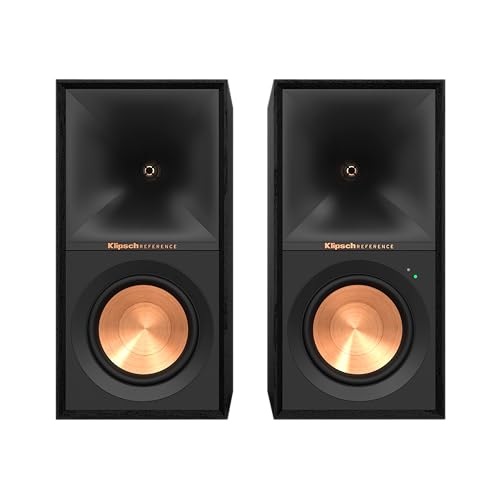
Klipsch R-50PM Powered Bookshelf Speakers
The Klipsch R-50PM is the most complete turntable-ready pair in this guide, and the reason is the input panel on the back of the active speaker. Klipsch lists the analog input as phono/line with a switch and a ground screw terminal, so a turntable with no preamp of its own connects straight to it, and the ground wire has a proper post to land on. The manual even carries a page headed for turntable connections, which is a detail most powered speakers leave out. With that stage built in, the R-50PM needs no extra box between the deck and the sound, and a turntable that does have its own preamp simply uses the line setting instead.
The drivers are a 1-inch aluminum LTS tweeter on a Tractrix horn and a 5.25-inch spun-copper TCP woofer, a combination Klipsch has used across its Reference line for years. The horn controls where treble goes, which makes the sound feel lively and present even at modest volume, and the larger woofer reaches down to 55 Hz, the deepest low end of any pair here. Total system power is 120 watts, with 60 watts per channel continuous, and the listing gives a maximum output of 104 dB, so a living room is well within reach.
Inputs cover Bluetooth, phono/line RCA, 3.5 mm, USB digital, and optical digital, plus a subwoofer output for later expansion. The cabinet is 14 inches tall, so measure the shelf before ordering, because these are the largest speakers in this guide and need sturdy stands or a deep shelf. Black is the only finish on this listing, which suits a dark setup and disappears against a media console.
One honest note: the R-50PM replaced the older R-51PM in the Klipsch line, so buyers searching for the older model may find used or renewed stock instead of new pairs. This listing is the current model, and the phono stage, horn tweeter, and input set are the reasons it leads this guide for a deck with no preamp of its own.
Kanto YU4
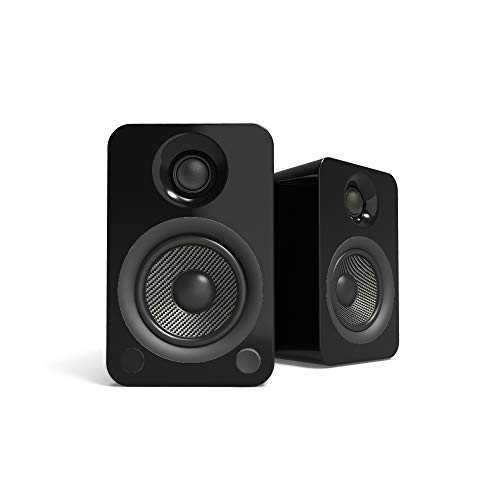
Kanto YU4 Powered Bookshelf Speakers
The Kanto YU4 is the compact pick for a desk or a small room, and it carries the same key feature as the Klipsch: a built-in phono preamp. The listing states that the YU4 connects easily to any vintage or modern turntable through its integrated phono stage, and the rear panel carries a switchable RCA input with a phono setting. That makes it a true one-box partner for a bare deck, with no extra stage to buy and no cable clutter beyond the pair itself.
The drivers are 4-inch Kevlar woofers and 1-inch silk dome tweeters, driven by a 140-watt peak Class D amplifier. Kevlar keeps the woofer cone stiff and light, which helps midrange clarity on vocals and acoustic instruments, while the silk dome tweeter stays smooth on bright or worn pressings. The cabinet is small enough for a desk, and the pair includes a remote control for volume, input, tone, and balance, plus Bluetooth with aptX for streaming from a phone when the turntable rests.
Connectivity runs beyond the phono input: two optical inputs, a 3.5 mm auxiliary input, and a subwoofer output round out the panel, so the pair can serve a television and a computer alongside the deck. Auto standby puts the speakers to sleep after a period of silence and wakes them when a signal returns, which saves power in daily use. The gloss black finish on this listing suits a modern desk, and Kanto also makes the same pair in matte and walnut finishes for buyers who want a warmer look.
The YU4 suits a listener who wants the shortest path from a turntable to sound in a small space. Its 4-inch woofers will not move as much air as the 5.25-inch pairs here, so a large room or bass-heavy records may call for the subwoofer output, but for a desk or bedroom the balance of size, phono input, and wireless streaming is hard to fault.
Audioengine A5+ Wireless
Audioengine A5+ Wireless Powered Bookshelf Speakers
The Audioengine A5+ Wireless is the analog purist of this guide, built around a Class AB amplifier and a pair of 5-inch aramid fiber woofers with 0.75-inch silk dome tweeters. Total peak power is 150 watts, with 50 watts RMS per channel, and the listing gives a frequency response of 50 Hz to 22 kHz. The sound leans warm and natural rather than bright, which suits long listening sessions and vocal-heavy records, and the handcrafted wood cabinets with a gloss finish look at home in a living room.
This is the wireless version of the A5+, so Bluetooth 5.0 with aptX HD and a 24-bit DAC join the wired inputs. The wired panel carries RCA and 3.5 mm auxiliary inputs, plus a variable RCA output for a subwoofer, and the pair ships with a remote control, speaker wire, and cables in the box. The 3-year warranty from the maker is the longest coverage among the pairs here.
The honest caveat is the phono question: the A5+ has no built-in phono preamp. It pairs beautifully with a turntable that has its own preamp built in, or with a separate phono stage between the deck and the RCA input, but a bare turntable connected straight to these speakers will sound faint and thin. If your deck already has a preamp, or you own a phono stage, the A5+ rewards you with the most refined analog sound in this guide. If your deck has no preamp and you want no extra box, the Klipsch or the Kanto above is the better fit.
Readers should also confirm they are on the wireless listing when ordering, because Audioengine sells a wired version of the same speaker without Bluetooth. The wireless listing is the one linked here, and the Bluetooth receiver and DAC are part of what you are buying.
Edifier R1280T
Edifier R1280T Powered Bookshelf Speakers

The Edifier R1280T is the classic entry point into powered bookshelf speakers, and it has held that spot for years because it does the basics well. Two 13 mm silk dome tweeters and two 4-inch woofers sit in wood enclosures with a retro look, driven by 42 watts RMS in total, and the listing gives a frequency response of 75 Hz to 18 kHz with a signal-to-noise figure of 85 dBA or better. Bass and treble controls sit on the side of the active speaker for quick adjustment, and a small remote handles volume and mute from the chair.
Inputs are simple: dual RCA and dual 3.5 mm auxiliary connections, with no Bluetooth and no digital input. That simplicity is part of the appeal for a turntable setup, because the signal path stays short and analog from the deck to the drivers. The pair suits a desk, a shelf, or a bedroom, and the wood finish blends with furniture in a way black plastic cabinets do not.
The same phono caveat as the Audioengine applies here: the R1280T has no built-in phono preamp. It needs a turntable with a preamp built in, or a separate phono stage, to sound right. With that one condition met, it is a warm, forgiving pair that flatters older records and costs far less in spirit than the larger pairs here. Readers should confirm the exact listing and finish before ordering, because Edifier sells several lookalike models in this family with different inputs, and the R1280T is the analog-only member of the group.
Comparison
| Speaker | Power | Drivers | Phono preamp | Inputs | Best for |
|---|---|---|---|---|---|
| Klipsch R-50PM | 120 W total, 60 W per channel | 1 in horn tweeter, 5.25 in woofer | Yes, switchable with ground screw | Bluetooth, RCA, 3.5 mm, USB, optical, sub out | Any turntable, living room |
| Kanto YU4 | 140 W peak | 1 in silk dome, 4 in Kevlar woofer | Yes, switchable | Bluetooth aptX, RCA, optical, 3.5 mm, sub out | Desk or small room |
| Audioengine A5+ Wireless | 150 W peak, 50 W RMS per channel | 0.75 in silk dome, 5 in aramid woofer | No | Bluetooth aptX HD, RCA, 3.5 mm, sub out | Turntable with built-in preamp |
| Edifier R1280T | 42 W RMS total | 13 mm silk dome, 4 in woofer | No | Dual RCA, dual 3.5 mm | Analog-only desk setup |
Frequently asked questions
Do I need a phono preamp for my turntable?
It depends on the deck. A turntable cartridge puts out a quiet signal that needs a phono preamp before a normal line input can use it. If your turntable has a built-in preamp, often marked with a phono/line switch on the back, any powered speaker with an RCA input works. If it has no preamp, choose a speaker with a phono stage built in, such as the Klipsch R-50PM or the Kanto YU4 in this guide, or add a separate phono stage between the deck and the speakers. A bare deck connected straight to a line input will sound faint and thin, which is the most common mistake in a first vinyl setup.
Can I connect a turntable to powered speakers without a receiver?
Yes, and that is the point of a powered pair. The amplifier lives inside the speaker cabinet, so the chain is turntable, then cable, then speakers, with no receiver in the middle. If the speakers have a phono preamp built in, the turntable connects directly. If they do not, the turntable needs its own preamp or a separate phono stage, but still no receiver. Keep the cable run short, attach the ground wire when the speaker has a ground screw, and place the turntable on a separate surface from the speakers so bass energy does not reach the stylus through a shared shelf.
Will these speakers work with a turntable that already has a built-in preamp?
Yes. A turntable with a built-in preamp sends a line-level signal, which any RCA input accepts. Set the turntable switch to line, and if the speaker also has a phono/line switch, set it to line as well, because running the signal through two phono stages makes the sound loud and distorted. All four pairs in this guide accept a line-level turntable through their RCA inputs, so the choice comes down to size, sound, and whether you want Bluetooth or a subwoofer output for later.
How to choose
Begin with the phono question, because it decides the shape of your setup. If your turntable has no preamp of its own, the Klipsch R-50PM is the natural pick: its switchable phono input with a ground screw takes any deck, its 5.25-inch woofers fill a living room, and its input panel covers a television and a computer as well. If your space is a desk or a bedroom, the Kanto YU4 gives you the same direct phono connection in a smaller cabinet, with Bluetooth and a remote for daily use.
If your turntable already has a preamp built in, the field opens up. The Audioengine A5+ Wireless suits a listener who values warm analog sound and wireless streaming in one pair, with the longest warranty coverage here, while the Edifier R1280T suits a listener who wants a simple analog-only pair with tone controls on the cabinet and a classic wood look. Measure the shelf, check the inputs on the back of your deck, and pick the pair whose phono answer matches your turntable. The right match is the one that lets you drop the needle and hear the record, with no extra box and no guesswork.
Disclosure: As an Amazon Associate, we may earn a commission from qualifying purchases made through links in this article, at no additional cost to you.
Related guides
More from Amazon
Programs that pair well with the guide above. Offers and eligibility are set by Amazon and may change.
A free business account with business pricing and bulk-buying tools for work, shop or home office.
Create a business accountFree shipping on eligible items, Prime Video and more. Eligible new members can start with a free trial.
Start a Prime free trialAudiobooks and podcasts to listen to on the go. Eligible new members can start with a free trial.
Try Audible freeAd-free music streaming. Eligible new subscribers can start with a free trial.
Try Music Unlimited freeAs an Amazon Associate we earn from qualifying purchases.