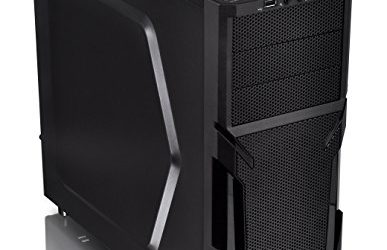
The best PC case for a small space is a mini-ITX or small-form-factor (SFF) case in the 10 to 20 litre range, and the Cooler Master NR200P V2 is the easiest all-round pick because it fits a full-length graphics card, a 240 mm or 280 mm radiator and still builds without drama. If your desk is tighter than that, the Fractal Design Terra and Ridge or the Lian Li A4-H2O trade a little GPU and cooling headroom for a footprint closer to a game console.
A “small space” can mean three different things: a cramped desk, a dorm shelf, or a living-room cabinet. Each one changes which case is right, so this guide starts with the picks, then shows how to work out whether your parts actually fit.
Quick comparison of the best small-space PC cases
| Pick | Best for | Key specs (per manufacturer spec sheets) | Typical price range |
|---|---|---|---|
| Cooler Master NR200P V2 | Best overall | Mini-ITX, about 18 L, up to 336 mm GPU, 2.5-slot cards, up to 280 mm radiator, SFX/SFX-L PSU | $100-$140 |
| Fractal Design Terra | Best for the living room | Mini-ITX, about 10 L, aluminium and wood-style trim, vertical layout, SFX PSU, GPU up to roughly 322 mm | $150-$200 |
| Lian Li A4-H2O | Smallest high-performance build | Mini-ITX, about 11 L, 240 mm cooler or 2-slot GPU up to about 322 mm, SFX PSU | $120-$160 |
| Fractal Design Ridge | Best low-profile console style | Mini-ITX, about 10 L, can lie flat or stand, PCIe riser included, SFX PSU | $120-$160 |
| Compact micro-ATX tower (spec class) | Best budget and easiest build | Micro-ATX, about 25-35 L, standard ATX PSU, 330 mm+ GPU, tower coolers | $60-$100 |
Clearance numbers vary slightly by revision and by how you mount fans, so confirm the exact figures on the maker’s spec page before you buy parts.
Best overall: Cooler Master NR200P V2
The NR200P V2 is the case most small-build guides keep returning to for a good reason: it is genuinely compact at about 18 litres, but it does not force you into exotic parts. It accepts a standard-length graphics card, either a 280 mm radiator or a tower cooler up to roughly 155 mm, and both SFX and SFX-L power supplies. The V2 revision added a better front panel with USB-C and a mesh-focused airflow design.
Who it suits: anyone building a first small PC who wants a flagship-class GPU. Main trade-off: at 18 litres it is not “tiny”; it will not vanish on a shelf the way an 11-litre case does, and cable management in the lower chamber takes patience.
Best for the living room: Fractal Design Terra
The Terra looks more like a piece of audio equipment than a computer, thanks to its aluminium shell and wood-style accent. It is a vertical, roughly 10-litre mini-ITX case that uses a riser to place the graphics card behind a ventilated side panel. It supports SFX power supplies and slim-to-mid-size coolers.
Who it suits: a home theatre or TV-console PC that has to look at home beside other gear. Main trade-off: you are limited to compact coolers and 2- to 2.5-slot cards, and the premium finish costs more than airflow-first alternatives.
Best for the smallest high-performance build: Lian Li A4-H2O
The A4-H2O is an aluminium sandwich-layout case of about 11 litres. It supports a two-slot graphics card of roughly 320 mm and a 240 mm radiator when the GPU is slim. Its sandwich design gives the card its own airflow chamber, so temperatures can be better than you would expect for the volume.
Who it suits: people who want maximum performance per litre and already know SFF building. Main trade-off: strict component height limits, an SFX PSU requirement, and almost no tolerance for chunky three-slot cards.
Best low-profile console style: Fractal Design Ridge
The Ridge sits flat like a console or stands upright, and it ships with the riser cable needed for its card orientation. Its internal volume is about 10 litres, so it is among the smallest cases that still take a real discrete graphics card. It also draws air through a large perforated panel.
Who it suits: shelf and cabinet builders who want a quiet, simple, clean look. Main trade-off: tight cooling clearances and a preference for efficient components, so a 350 W GPU is a poor match.
Best budget: a compact micro-ATX tower
If you do not need to hide the PC, a good micro-ATX tower often costs less than any SFF case and lets you use a cheaper standard ATX power supply. Cases in this class have 25 to 35 litres of volume, which is less than half the footprint of a classic mid tower, and they leave room for a normal cooler and a full-length GPU. You give up some of the “small space” bragging rights, but you also gain lower prices, easier assembly and quieter fans.
Main trade-off: not all micro-ATX cases are slim in height, so measure the shelf or desk gap before buying.
How to choose: three numbers that decide fit
1. Case volume versus your available space
Measure the width, depth and height of the spot, convert to centimetres and multiply. A cabinet cavity of 40 x 35 x 25 cm is 35,000 cubic centimetres, or 35 litres. Leave at least 3 cm free on the exhaust side and 5 cm in front of intake panels, so the real usable space is smaller than the raw figure. In this example a 10-18 litre SFF case fits comfortably; a 35-litre micro-ATX tower does not.
2. Power budget for an SFX supply
SFF cases generally use SFX power supplies in the 600 W to 850 W range. Here is a worked example for a typical high-end small build:
- Graphics card: about 220 W board power (a mainstream 12 GB card)
- CPU under gaming load: about 90 W to 120 W for an efficient gaming chip
- Motherboard, RAM, SSD, fans: about 60 W
- Total sustained load: roughly 370 W to 400 W
- Add 40 percent headroom for transient spikes: about 520 W to 560 W
An 650 W SFX unit covers that comfortably. If you want a 320 W flagship card, the same calculation lands near 700 W, and an 750 W or 850 W SFX unit becomes the safer choice.
3. Cooler height and GPU thickness
| Your situation | Recommended case class | Cooler limit | GPU limit |
|---|---|---|---|
| Cramped desk, wants a console-sized PC | 10-12 L SFF (Ridge, A4-H2O, Terra) | Low-profile or 240 mm AIO | 2 to 2.5 slots, under about 325 mm |
| Dorm room, wants strong GPU and easy build | 15-20 L SFF (NR200P V2) | Up to about 155 mm tower or 280 mm AIO | Up to about 336 mm |
| Budget build, space is a shelf | Compact micro-ATX tower | Up to about 160-170 mm | 330 mm+ |
| TV cabinet, quiet operation matters | Vertical 10 L (Terra) | Compact tower | Slim 2-slot cards |
Cooling and noise in small cases
Small cases concentrate heat. A few practical settings help. Cap the GPU power limit to 80 to 90 percent in the graphics driver or a tuning utility; most cards lose only a few percent of performance while shedding 30 to 40 watts. Set case fans to ramp from about 35 percent at 50 degrees Celsius to 70 percent at 75 degrees Celsius in your motherboard fan curve rather than running them flat out. Keep the intake side clear of dust-catching fabric or curtains, and plan to clean filters every two to three months.
Common mistakes when building small
- Buying the case last. Choose the case, then the GPU, cooler and PSU against its clearance list.
- Ignoring the motherboard. Mini-ITX boards have fewer M.2 slots and fan headers, so check the board’s feature list.
- Assuming any SFX supply works. SFX-L supplies are longer and only fit some cases.
- Forgetting cable length. Short-cable SFX supplies are easier to route in 10-litre cases.
Frequently Asked Questions
What is the smallest PC case that can still hold a gaming graphics card?
Cases of about 10 to 11 litres, such as the Fractal Design Ridge, Terra and Lian Li A4-H2O, are the smallest mainstream options that take a full discrete card. They need a two-slot card of about 320 mm or less and an SFX power supply.
Do small form factor PCs run hotter?
Often yes, because there is less air volume and fewer fan positions. Good airflow design, undervolting and a power-limited GPU close most of the gap, and many mini-ITX builds run at ordinary gaming temperatures.
Is a mini-ITX case harder to build in?
It is more fiddly than a mid tower. Cables are shorter in space, components must be installed in a set order, and some cases require removing panels to reach ports. A first-time builder can manage it by following the case manual and planning cable routing before installing parts.
Can I use a normal ATX power supply in a small case?
Not in most mini-ITX cases, which are built around SFX or SFX-L supplies. Micro-ATX towers usually accept standard ATX units, which is one reason they are cheaper to build.
Is a small case more expensive overall?
Typically yes. SFX power supplies, low-profile coolers and mini-ITX boards carry a premium over full-size equivalents, so a small build often costs $100 to $300 more than a similarly powered mid-tower system.
Related guides
More from Amazon
Programs that pair well with the guide above. Offers and eligibility are set by Amazon and may change.
A free business account with business pricing and bulk-buying tools for work, shop or home office.
Create a business accountFree shipping on eligible items, Prime Video and more. Eligible new members can start with a free trial.
Start a Prime free trialAudiobooks and podcasts to listen to on the go. Eligible new members can start with a free trial.
Try Audible freeAd-free music streaming. Eligible new subscribers can start with a free trial.
Try Music Unlimited freeAs an Amazon Associate we earn from qualifying purchases.