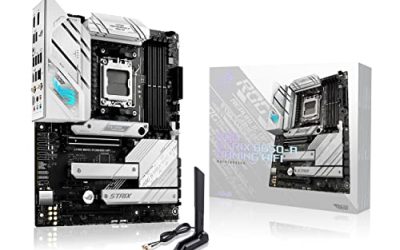
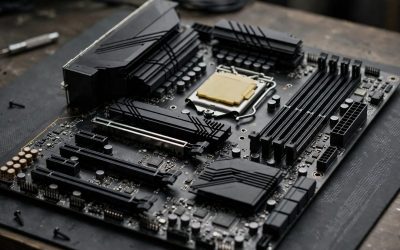
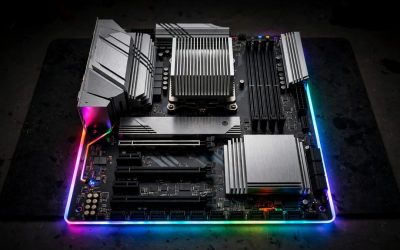
For $50-$100, the best motherboard is a micro-ATX board on a budget chipset that matches a CPU you can actually afford: an A620 board for new AMD Ryzen 7000/8000/9000 builds, a B550 or B450 board if you are keeping an AM4 chip, or an H610 board for Intel 12th-14th Gen CPUs. In this price band you give up overclocking, extra M.2 slots, and fast networking, but you can still get a stable base for a solid gaming PC.
The motherboard decision is really a CPU decision. The socket, the memory type, and the chipset all follow from the processor, so pick the platform first and the board second.
Quick comparison of budget motherboard picks
| Pick | Best for | Key specs | Typical price range |
|---|---|---|---|
| Best overall: A620M micro-ATX (AM5) | New Ryzen builds with an upgrade path | AM5 socket, DDR5, 1-2 M.2 slots, PCIe 4.0 x16, micro-ATX | Usually $80-$110 |
| Best budget AMD: B550M or B450M (AM4) | Reusing or buying a cheap Ryzen 5000 chip | AM4 socket, DDR4, PCIe 3.0 or 4.0, 1-2 M.2 slots | Usually $55-$100 new or used |
| Best budget Intel: H610M (LGA1700) | Core i3 and i5 builds without overclocking | LGA1700, DDR4 or DDR5 depending on model, 1 M.2 slot, no CPU overclocking | Usually $60-$95 |
| Best for storage: board with two M.2 slots | Builders who want a second NVMe drive | Dual M.2, 4 SATA ports, USB 3.2 Gen 1 front header | Usually $85-$110 |
Best overall: A620M micro-ATX for AM5
An A620M board is the most future-proof choice at this price. AM5 supports DDR5 memory and, per AMD’s platform documentation, multiple CPU generations on the same socket, so you can start with a modest Ryzen 5 and upgrade later without replacing the board. The trade-offs are that A620 does not support CPU overclocking, usually has weaker VRM cooling than B650 boards, and often limits you to one PCIe 4.0 M.2 slot plus a slower second one. Pair it with a CPU in the 65 W class to avoid stressing a thin VRM heatsink.
Remember the DDR5 cost: a 16 GB DDR5-5600 kit adds to the platform price, so a complete AM5 budget build costs more than the board alone suggests.
Best budget AMD: B550M or B450M on AM4
AM4 is the cheapest route to a capable gaming PC, especially if you buy a Ryzen 5 5600 or Ryzen 5 5500-class processor. B550M boards support PCIe 4.0 for the GPU and the main M.2 slot and handle Ryzen 5000 chips out of the box. B450M boards are cheaper, but older ones may need a BIOS update before they will boot a Ryzen 5000 CPU, so confirm the BIOS version or the seller’s “Ryzen 5000 ready” label. The trade-off is that AM4 is a dead-end platform with DDR4 only.
Best budget Intel: H610M for LGA1700
H610 is the cheapest chipset for Intel 12th-14th Gen CPUs. You can pair it with a Core i3-12100F or a Core i5 non-K chip and get strong 1080p gaming performance. The main limitations are no CPU overclocking, fewer USB ports and PCIe lanes, and usually a single M.2 slot. Some H610 boards use DDR4 and others DDR5, and you cannot mix them, so decide on memory before buying. Check the manufacturer’s CPU support list: very high-power K-series chips can throttle on the weakest H610 VRMs.
Best for storage: two M.2 slots
If you plan to use a fast NVMe drive for the OS and a second drive for games, make sure the board has two M.2 slots. Some budget boards disable SATA ports when the second M.2 slot is used, so read the manual. At $85-$110 you can usually find a board with dual M.2, four SATA ports, and at least one front-panel USB 3.2 header.
Worked example: compatibility and total cost
Suppose your budget for CPU, board, and memory is $350. Here are two plausible allocations using general market ranges:
| Platform | CPU | Board | 16 GB memory | Approx. total |
|---|---|---|---|---|
| AM4 (DDR4) | Ryzen 5 5600 class, $120-$140 | B550M, $70-$90 | DDR4-3200, $35-$50 | about $225-$280 |
| AM5 (DDR5) | Ryzen 5 7600 class, $180-$220 | A620M, $85-$105 | DDR5-5600, $55-$80 | about $320-$405 |
| LGA1700 (DDR4) | Core i5-12400F class, $120-$160 | H610M DDR4, $65-$90 | DDR4-3200, $35-$50 | about $220-$300 |
The AM4 and Intel DDR4 options leave $50-$125 in the budget for a better graphics card or SSD. AM5 costs more up front but buys a longer upgrade path.
How to choose a motherboard under $100
- Start with the CPU. Match the socket (AM4, AM5, LGA1700) and check the manufacturer’s CPU support list, including the minimum BIOS version.
- Match memory type. AM5 is DDR5 only, AM4 is DDR4 only, and LGA1700 boards are one or the other.
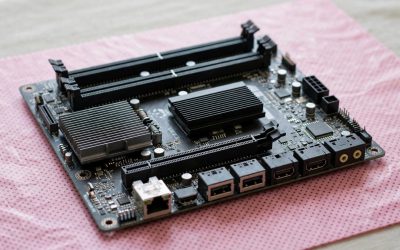
- Check the form factor. Micro-ATX fits most cases and saves money. Mini-ITX boards usually cost more than $100 in this class.
- Count the slots you need. At least one M.2 slot, two or four DIMM slots, and enough SATA ports for your drives.
- Look at the VRM. A visible heatsink over the power stages matters if you pair the board with a CPU above 100 W.
- Check rear I/O. Budget boards often skip Wi-Fi, so add a USB or PCIe Wi-Fi card if you need wireless.
What you give up at this price
- CPU overclocking (A620, H610, and B450 limit or lock it, while B550 allows it).
- Built-in Wi-Fi and Bluetooth on most models.
- More than one PCIe 4.0 M.2 slot on many boards.
- Heavy-duty VRM cooling and premium audio codecs.
- Fast USB 3.2 Gen 2×2 and 2.5 GbE networking on the cheapest models.
None of these matter much for a 65 W CPU, a single graphics card, and a single SSD, which describes most budget gaming PCs.
Pairing the board with the right graphics card and cooler
A budget board does not limit your graphics card, because the main PCIe x16 slot connects straight to the CPU. A mid-range GPU in an A620M or B550M board performs the same as in a $250 board. What the board does limit is power delivery to the CPU. A good rule is to keep the CPU at or below 105 W on a sub-$100 board, and to use the cooler that comes with the processor or a modest tower cooler. If you later move to a power-hungry chip, check reviews of the exact board’s VRM temperatures first, since the heatsink size varies a lot between models in the same price band.
It also pays to check the case. Micro-ATX boards are about 244 x 244 mm, so they fit almost every ATX case, but they leave fewer expansion slots. If you plan a capture card, a sound card, and a Wi-Fi card, count the slots first.
Frequently Asked Questions
Can I get a good gaming motherboard for under $100?
Yes. A micro-ATX A620, B550, or H610 board gives you everything a gaming PC needs: a PCIe x16 slot for the graphics card, at least one M.2 slot, and DIMM slots for dual-channel memory. You mainly give up overclocking, extra storage slots, and Wi-Fi.
Is a cheap motherboard bad for performance?
Not directly. Games run at the same frame rate on a $70 board and a $300 board when the CPU and graphics card are the same. The difference shows up in VRM cooling for high-power CPUs, extra ports, and overclocking support.
Do I need a BIOS update for my CPU?
Sometimes. Older AM4 B450 boards and some early LGA1700 boards need a BIOS update to recognize newer processors. Check the manufacturer’s CPU support list for the minimum BIOS version, and look for a BIOS flashback button or a “ready for new CPUs” label.
Should I choose DDR4 or DDR5 on a budget?
DDR4 platforms usually cost less overall and perform nearly the same in many 1080p games. DDR5 platforms cost more now but are the base for newer CPUs and will see longer manufacturer support, so choose DDR5 if you want an upgrade path.
What size motherboard should I buy?
Micro-ATX is the best value for most builds. It fits standard ATX and mid-tower cases, offers four DIMM slots on many models, and costs less than full ATX boards with similar features.
Related guides
More from Amazon
Programs that pair well with the guide above. Offers and eligibility are set by Amazon and may change.
A free business account with business pricing and bulk-buying tools for work, shop or home office.
Create a business accountFree shipping on eligible items, Prime Video and more. Eligible new members can start with a free trial.
Start a Prime free trialAudiobooks and podcasts to listen to on the go. Eligible new members can start with a free trial.
Try Audible freeAd-free music streaming. Eligible new subscribers can start with a free trial.
Try Music Unlimited freeAs an Amazon Associate we earn from qualifying purchases.