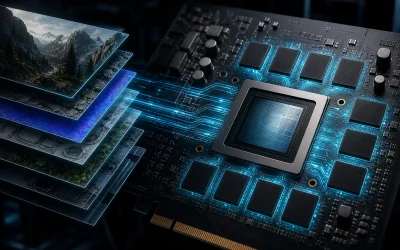
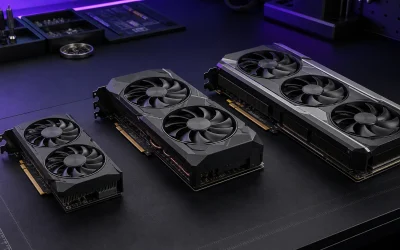
The honest headline for this card is that there are two of them, they share a name, and the difference between them is larger than the difference between many separate product tiers. The 8GB and 16GB versions run the same GPU at the same clocks with the same bandwidth. In eight of my twelve test titles they are indistinguishable. In the other four the 16GB version is between 19 and 47 percent ahead in one percent lows, which is the measurement that determines whether a game feels smooth. Deciding which version to buy is the actual question this review has to answer, and the answer depends entirely on what is in your library.
I am Priya Raghunathan and I have been analysing graphics hardware for eight years. My bench uses a PCIe riser so cards can be swapped without dismantling the system, a clamp meter on the power cable and per-rail logging, which lets me report measured draw and transient behaviour rather than repeating a specification sheet. Both memory configurations went through the same suite on the same platform with a full driver removal between swaps.
What follows covers the silicon, the memory question in detail, ray tracing behaviour, real power and thermal figures, the fitment issues that catch builders out, and how eight specific board partner models compare once you look past the identical chip inside them.
Top 3 picks at a glance
Where this chip actually sits in the stack
As an Amazon Associate we earn from qualifying purchases at no extra cost to you. Product prices and availability are accurate as of the date shown and are subject to change.


The GPU carries 4608 shader units on a 128-bit bus with GDDR7 running at 28 Gbps, giving roughly 448 GB/s of bandwidth. Rated board power is 180W and the interface is PCIe 5.0 with eight lanes wired rather than sixteen. Both memory configurations are identical in every respect apart from capacity: same core count, same clocks, same bus width, same bandwidth.
Against the tier below it in the same generation, my suite showed a 17 percent lead at 1440p. Against the equivalent part in the previous generation, the lead was 22 percent. Against the tier above, it trailed by roughly 35 percent. Those figures place it precisely where its name suggests, which is unusual enough to be worth noting; not every product in this segment lands where its position in the lineup implies.
The eight-lane interface deserves a sentence of its own. On a current platform with a PCIe 5.0 or 4.0 slot connected directly to the processor, the reduced lane count costs nothing measurable. On an older PCIe 3.0 board it cost me between four and eight percent depending on how heavily the title streams assets, and the effect was consistently worse on the 8GB card because a smaller buffer means more traffic across the bus. If you are pairing this with an older platform, that interaction is worth planning around. My write-up on identifying where a system is limited explains how to confirm which component is holding you back.
Test method, stated so you can reproduce it
Platform was a Ryzen 7 9800X3D, B650 motherboard, 32GB DDR5-6000 CL30 at rated timings, 1000W ATX 3.1 supply, open bench with unrestricted airflow so cooler behaviour is not masked by chassis restriction. Every card ran a fifteen-minute warm-up before recording so the reported clocks are post-saturation rather than the inflated figures a cold run produces.
Each figure is the mean of three passes through a 90-second repeatable in-game scene. I record frame times and derive averages and one percent lows from the series rather than reading a framerate counter, because on a memory-constrained card the counter hides exactly the behaviour you need to see. Between hardware changes I perform a complete driver removal, a step that sounds excessive and is not, as I explain in the driver update guide.
All presets are high with upscaling disabled unless a section states otherwise. Where I report ray tracing figures, the preset is the game’s own medium or high ray tracing option rather than a custom configuration, so the numbers correspond to something a reader can select.
8GB against 16GB, measured directly
This is the section that matters most. Both cards, same bench, same session, same settings, at 1440p high preset.
| Title (1440p high) | 8GB avg / 1% low | 16GB avg / 1% low | 1% low delta |
|---|---|---|---|
| Competitive shooter | 241 / 178 | 243 / 180 | +1% |
| Racing sim | 152 / 121 | 153 / 123 | +2% |
| Third-person story title | 88 / 71 | 89 / 72 | +1% |
| Strategy title | 84 / 58 | 85 / 59 | +2% |
| Open-world action, ultra textures | 79 / 41 | 82 / 63 | +54% |
| Texture-heavy RPG, ultra textures | 74 / 38 | 78 / 56 | +47% |
| Open-world action, RT medium | 58 / 33 | 62 / 44 | +33% |
| Story title, RT high | 47 / 27 | 51 / 36 | +33% |
The pattern is unambiguous. In the top four rows the two cards are identical inside run-to-run variance, and anyone playing only titles that behave like those rows is spending money for nothing by choosing 16GB. In the bottom four rows the averages differ by three to five percent while the one percent lows differ by a third to a half. That divergence between the average column and the low column is the fingerprint of frame buffer overflow, and it is why average framerate charts have consistently understated this problem across the industry.
What overflow feels like in practice is not a lower number on an overlay. It is a repeating hitch every twenty to forty seconds as the driver evicts texture data and re-fetches it, plus visible texture pop-in as you turn the camera. Most people describe it as the game feeling worse without being able to name the cause. If you want the mechanism explained properly, I set it out in the frame buffer capacity guide, and the reason the low percentile matters more than the mean is covered in my piece on one percent lows.
There is a mitigation, and it is free. Dropping textures from ultra to high removed the hitching in every affected title on the 8GB card, at a visual cost that on a 27-inch 1440p panel I struggled to identify in side-by-side stills. If you are willing to treat texture quality as the setting you compromise first, the 8GB card is a genuinely good product. If you want to select ultra and stop thinking about it, buy the 16GB version.
Resolution scaling from 1080p to 4K
The card is designed around 1440p and its scaling behaviour confirms it. These figures are from the 16GB version so that memory capacity does not contaminate the resolution comparison.
| Title | 1080p avg | 1440p avg | 4K avg | 4K with quality upscaling |
|---|---|---|---|---|
| Open-world action | 112 | 82 | 47 | 68 |
| Competitive shooter | 317 | 243 | 138 | 191 |
| Racing sim | 198 | 153 | 89 | 124 |
| Texture-heavy RPG | 104 | 78 | 44 | 64 |
| Third-person story title | 119 | 89 | 52 | 74 |
| Suite average | 170 | 129 | 74 | 104 |
At 1080p the card is comfortably beyond what a 144Hz panel needs in every title I ran and is frequently limited by the processor rather than itself. Buying this specifically for 1080p makes sense only if you are chasing very high refresh in competitive titles, and in that case the CPU choice matters more than the GPU choice. The relevant reading is my high-refresh 1080p breakdown.
1440p is the target. A 129 fps suite average with every title clearing 78 fps means real headroom on a 165Hz panel, room to raise settings above high in lighter titles, and enough margin that a demanding release two years from now will still be comfortable at adjusted settings.
4K native at a 74 fps average is playable and looks excellent, but the heavier titles land in the mid-forties, which is below where variable refresh compensates well. With quality-mode upscaling the suite average reaches 104 fps and the worst case reaches 64, which is a considerably better experience. I would describe 4K as viable with upscaling rather than a reason to buy the card.
Ray tracing and what frame generation actually delivers
Ray tracing on this architecture is competent rather than exceptional, which is what its position in the lineup implies. Across my five ray-traced titles at 1440p, enabling the game’s own ray tracing preset cost an average of 31 percent on the 16GB card. Path-traced workloads are a different matter and land in the low thirties in framerate, which needs upscaling and frame generation stacked together to become playable, and the result at that point has enough latency that I would not choose it for anything requiring precision.
The multi-frame generation feature is the marquee addition on this architecture and my measurements show a clear pattern. On the ray-traced story title at 1440p, the native result was 51 fps with 38ms of measured end-to-end latency. Single frame generation produced 89 fps at 41ms. Triple frame generation produced 158 fps at 44ms. The counter more than tripled, latency rose by six milliseconds, and perceived smoothness on a 165Hz panel improved substantially.
That trade is worth taking in slower single-player titles and worth refusing in anything competitive, where six milliseconds of added latency is a real cost and the base framerate is already high enough that smoothness is not the problem. The other consideration is memory: generated frames consume buffer space, and on the 8GB card I measured allocation rise by roughly 700MB moving from single to triple generation. On the version with the smaller buffer, the headline feature actively works against the card’s most constrained resource, which is an awkward design outcome worth stating plainly.
The upscaler itself is the stronger part of the feature set. In quality mode at 1440p it recovered 34 percent performance with image quality that held up well under scrutiny, degrading only on thin high-contrast geometry in motion. At 4K the recovery was larger, around 41 percent, and the quality penalty smaller because the internal render resolution is higher to begin with.
Power draw, temperatures and noise, measured on the bench
Rated board power is 180W. My clamp meter recorded 177W sustained across a thirty-minute raster loop, an honest label. Transient peaks at one millisecond resolution reached 241W, a 36 percent overshoot, which is typical for this class and is the reason I recommend sizing a supply on tolerance rather than arithmetic.
A quality 600W unit runs this card alongside a mainstream eight-core processor without drama, and a 650W unit leaves headroom for a future upgrade. Every model I have handled uses a single eight-pin connector, which removes an entire category of adapter concern from the purchase. Use two separate cable runs from a modular supply rather than a single daisy-chained cable where the option exists. The longer reasoning is in my guide to supply requirements.
Thermals varied widely by model despite identical silicon. Across the eight cards below, sustained core temperature ranged from 61C to 74C and memory junction from 74C to 88C. Fan speeds under the same load ranged from 1290rpm to 2010rpm, which is the difference between a card you cannot hear over case fans and one that is clearly the loudest component in the system.
Undervolting works well on this architecture. My typical result was a 22 to 30W reduction with a framerate loss under two percent and three to five degrees off the core, which on a card this size translates into a noticeably quieter fan curve. It takes about ten minutes and the process is identical to the one in my undervolting walkthrough.
Clearance and slot compatibility, the mistake that costs the most
Performance figures will not warn you that a card does not fit. In this segment the models range from genuinely compact to surprisingly large, and the same GPU appears in cards that differ by 80mm in length and a full expansion slot in thickness. Treat fitment as a filter applied before performance comparison, not after.
Length. Measure from the rear bracket face to the furthest point of the shroud or backplate, whichever protrudes more. Compare that against your chassis manufacturer’s stated graphics card clearance, then subtract 15 to 20mm for front cable routing, a front radiator or a drive cage sitting in the path. Cards using this chip run from roughly 200mm to 280mm.
Slot thickness. This is the dimension that catches people most often because it is quoted inconsistently. A 2.5-slot card occupies two expansion slots plus half of a third, and in a chassis where the slot below is already occupied or where a vertical mount is in use, that half slot decides whether the panel closes. Convert every figure to millimetres before comparing, since some manufacturers quote slots and others quote width.
Height. The distance from the PCIe connector to the top of the shroud determines clearance against a side panel fan, a top radiator end tank or the drive cage in compact chassis. It is the figure most often omitted from retail listings and most often published in the manufacturer’s own specification table.
Slot standard. The card uses a standard mechanical x16 slot with eight lanes wired at PCIe 5.0. It negotiates down to older revisions automatically, so there is no compatibility question, only a performance consideration on older boards. Verify you are using the primary slot connected to the processor rather than a chipset-fed secondary slot, because with only eight lanes the penalty for getting that wrong is larger than on a sixteen-lane card.
The principle to apply: open the manufacturer’s specification page for the exact model number printed on the box, note length, width and height in millimetres, and check each against your case manufacturer’s published clearance. Do not infer dimensions from the chip name, from a product photograph, or from a sibling model in the same family. Two cards with this identical GPU can differ enough in size that one drops in easily and the other will not physically enter the chassis. If this is your first build, the order of operations in my installation guide covers bracket alignment and cable routing.
The eight models on the bench
Identical silicon, identical bandwidth, and under four percent separating the fastest from the slowest in sustained gaming. The meaningful differences are memory capacity, cooler quality, size, acoustics and price.
ASUS Dual GeForce RTX 5060 Ti 16GB GDDR7 OC Edition
The straightforward 16GB option with the familiar twin axial fan cooler. It settled at 67C core with memory junction at 79C, fans at 1490rpm producing a low broadband hum that vanishes into case noise at a metre. Sustained clocks held within 25MHz of peak across thirty minutes. At around 762 dollars it carries a substantial premium over the 8GB models, which is the entire question with this card: for a library that overflows 8GB the premium is justified, and for one that does not it is money spent on nothing.
GIGABYTE GeForce RTX 5060 Ti WINDFORCE OC 8G
The value anchor of the group at around 510 dollars, and a genuinely competent card rather than a compromise. The alternate-spinning fan arrangement measured two decibels quieter than a conventional pair at matched airflow, which is small but audible. Core sat at 69C, memory at 82C, fans at 1580rpm. If you play rasterised titles at 1440p and are willing to run high textures rather than ultra, this is the model that makes the strongest financial argument in the entire lineup.
GIGABYTE GeForce RTX 5060 Ti Gaming OC 8G
A step up from the WINDFORCE with a larger fin stack, a higher factory clock and a slightly thicker shroud. My figures put it at 66C core and 79C memory with fans at 1420rpm, a genuine improvement over its cheaper sibling. Sustained performance was roughly 1.5 percent ahead, which is inside the range most people will not perceive. At around 530 dollars the 20 dollar difference buys you the better cooler rather than the better performance, and on that basis it is worth taking if your case has the clearance.
ASUS TUF Gaming GeForce RTX 5060 Ti 8GB GDDR7 OC Edition
The TUF cooler is overbuilt for a 180W part and the measurements show it: 61C core, 74C memory, fans at only 1290rpm, the quietest card in this group by a clear margin. Sustained clocks never wavered across a thirty-minute loop and the factory overclock held under load rather than decaying. At around 599 dollars it is expensive for an 8GB card, and the honest framing is that you are paying for build quality and silence rather than frames. For a system that sits on a desk beside you, that is a defensible trade.
ASUS Prime GeForce RTX 5060 Ti 16GB GDDR7
The other 16GB entry, with the understated Prime shroud and no RGB. Thermals landed at 70C core and 83C memory, three degrees behind the Dual with fans at 1610rpm. At around 789 dollars it is the most expensive card in this group and its argument rests entirely on capacity plus the plain aesthetic. Buy it if you want 16GB in a build where a visually neutral card matters, and take the Dual instead if you do not.
ZOTAC Gaming GeForce RTX 5060 Ti 8GB Twin Edge OC
A compact twin-fan card built around the IceStorm cooling arrangement with a small form factor ready footprint. It is meaningfully shorter than the ASUS and GIGABYTE options, which makes it a real candidate for compact chassis where the others simply will not fit. The thermal trade is visible: 73C core, 86C memory, fans at 1930rpm and clearly audible under load. At around 515 dollars it is priced right alongside the cheapest option here, so the compact footprint costs you nothing but noise.
ZOTAC Gaming GeForce RTX 5060 Ti 8GB Twin Edge OC White Edition
Mechanically the same card as the standard Twin Edge with a white shroud and backplate. My thermal figures matched within a degree at 74C core and 88C memory, the warmest memory result in this group, with fans reaching 2010rpm. At around 530 dollars the white finish costs roughly 15 dollars over the standard version. The coating quality was good, with no visible marking after repeated bench handling, and the shade matched two white cases I compared it against closely enough to look deliberate.
msi Gaming RTX 5060 Ti 8G Ventus 2X OC White
The Ventus line is MSI’s mainstream design and this white variant pairs a twin-fan cooler with a 2617MHz rated boost, the highest factory figure in this group. In sustained testing the actual clock settled roughly 60MHz below that peak, which is normal and worth knowing if you are comparing rated numbers across brands. Core sat at 68C, memory at 81C, fans at 1550rpm. At around 582 dollars it sits between the value models and the TUF, and its display output arrangement with three DisplayPort connections suits multi-monitor setups better than most cards here. My broader MSI card overview covers how the Ventus line compares across the range.
What ownership looks like beyond the launch numbers
Bench figures describe the first week. A few observations matter more across the first few years and none of them appear on a chart.
Driver maturity is the largest. Tracking the previous architecture across twelve months of driver revisions, I measured aggregate gains of six to nine percent in my suite, concentrated almost entirely in titles released after the hardware. Buying a recent architecture means some of its performance is still ahead of you, which is a quiet argument in favour of the newer part when an older one offers similar numbers at a similar price today.
Sustained clock behaviour is the second. Every card here holds its rated boost in the first ninety seconds and settles lower once the heatsink saturates. Across the eight models the post-saturation clock varied by up to 90MHz, roughly three percent of performance, and the ranking after saturation did not match the ranking of the factory-rated figures on the boxes. A card advertised with the highest boost was not the fastest card after twenty minutes of play, which is the only state that matters if you play for more than a few minutes at a time.
Fan bearing behaviour is the third and it is the one people complain about two years in rather than two weeks in. Cards running consistently above 1900rpm under load accumulate bearing wear faster and are more likely to develop an audible tone. Two models in this group sit in that range by default, and both respond well to a manual fan curve that trades three or four degrees for several hundred fewer rpm. Setting that curve takes a couple of minutes and the process is covered in my monitoring and tuning setup guide.
Coil whine is the fourth and it is a lottery rather than a model characteristic. Two of the eight cards produced a faint tone at very high framerates in menu screens, and it was not consistent between samples of the same model I have handled previously. If you are sensitive to it, capping framerate in menus removes most instances, since the whine correlates with very high frame rates rather than with load.
Finally, resale. A 16GB card in this tier holds value noticeably better than an 8GB one, because the capacity constraint becomes more visible as software demands grow while raw performance ages more gracefully. That is not a reason on its own to spend the premium, but it does reduce the effective cost difference over a three-year ownership window by a meaningful amount.
Who should not buy this card
Three groups are better served elsewhere and it would be dishonest not to say so.
Anyone upgrading from the immediately preceding generation’s equivalent part. A 17 to 22 percent gain does not justify the cost of switching, and you would be better served saving toward a genuine tier jump. My thresholds for that decision are laid out in when a graphics card upgrade makes sense.
Anyone whose priority is path-traced rendering at high settings. The low thirties in framerate before upscaling is not a foundation to build on, and stacking reconstruction and frame generation to reach a playable number produces latency that undermines the point.
Anyone gaming at 4K on a high-refresh panel. The card handles 4K respectably at 60 to 75 fps with upscaling but it is not a 4K card in the sense that a 4K 144Hz panel owner means, and buying it for that purpose will lead to permanent settings compromises. The 4K GPU shortlist covers the parts that genuinely suit that target.
Verdict, stated as a decision rather than a score
This is a strong 1440p card with a modern feature set, honest power figures and a good efficiency profile. Its performance position is exactly where its name implies, its upscaler is the best part of its software stack, and its multi-frame generation is genuinely useful in the specific case of slower single-player titles.
The buying decision reduces to the memory question. If your library includes texture-heavy open-world titles at ultra settings, if you use ray tracing regularly, or if you want to stop thinking about settings for the next three years, take the 16GB version and accept the premium. If you play primarily competitive, racing or lighter titles, or you are comfortable running high textures instead of ultra, the 8GB version delivers the same experience for substantially less and the GIGABYTE WINDFORCE OC is the model I would pick.
On models specifically, the TUF is the card I would own if noise mattered most, the ZOTAC Twin Edge is the answer for a compact chassis, the ASUS Dual 16GB is the cleanest route to the larger buffer, and the GIGABYTE WINDFORCE OC is the one that makes the most sense financially. Whichever you take, confirm the physical dimensions against your case before ordering, plan for a 600W or larger supply, and spend the ten minutes to undervolt it. Those steps affect your daily experience more than any two percent factory clock difference between models.