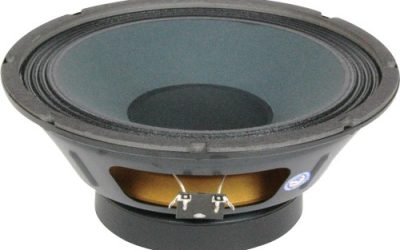
The best subwoofer speakers for car audio are the ones that add depth and weight to your music without drowning it out. A subwoofer handles only the lowest frequencies, the deep notes that a door speaker cannot reproduce, and it does that job in a dedicated enclosure with its own amplifier. When it is chosen and installed well, you do not hear the subwoofer as a separate source; you hear the music as fuller, richer, and more complete, with bass notes that have body and impact rather than a vague rumble from the rear.
All four subwoofers in this guide are 12-inch component drivers, which means they are the speaker alone, without an enclosure or an amplifier. That is deliberate. A component subwoofer lets you choose the enclosure that suits your car and your taste, and it lets you match the amplifier to the subwoofer rather than accepting a bundled combination. A sealed enclosure gives you tight, accurate bass that suits most music, while a ported enclosure gives you louder, deeper bass that suits bass-heavy genres. The right enclosure matters as much as the subwoofer itself, so plan for both.
Before you buy, understand the three numbers that decide whether a subwoofer will work in your car. Power handling, quoted as a nominal figure, describes the continuous power the subwoofer is built to handle, and it should match your amplifier. Impedance, quoted in ohms, describes the electrical load the subwoofer presents to the amplifier, and it decides how much power the amplifier can deliver. Voice coil configuration, single or dual, decides how you wire the subwoofer to the amplifier and what impedance the amplifier sees. Getting these three numbers right is the difference between a system that sounds great and a system that damages a speaker or an amplifier.
Enclosure volume is the other number that matters. Every subwoofer has a recommended sealed and ported box volume, measured in cubic feet, and building a box outside that range will make the subwoofer sound boomy, thin, or distorted. The manufacturers publish these figures, and a reputable box builder or a pre-made enclosure matched to your subwoofer will follow them. If you build your own box, follow the recommended volume and port tuning exactly, and use solid material with proper bracing and sealing.
How to Choose
1. Choose the size for your car and your taste. A 12-inch subwoofer is the sweet spot for most cars, because it moves enough air for deep, powerful bass while still fitting in a reasonably sized enclosure. A 10-inch subwoofer is tighter and faster, and it suits smaller cars and listeners who value accuracy over impact. A 15-inch subwoofer is louder and deeper, but it needs a much larger box and a stronger amplifier. For most drivers, a single 12-inch subwoofer in a well-built box is the right answer.
2. Match the nominal power to your amplifier. The nominal power figure, sometimes called RMS power, is the continuous power the subwoofer can handle all day. Your amplifier should deliver close to that figure at the impedance you wire the subwoofer to, with a little headroom rather than a large excess. An amplifier that delivers far less power than the subwoofer’s nominal rating will leave the subwoofer sounding weak, while an amplifier that delivers far more risks damaging the speaker if the gain is set too high. Match the numbers, then set the gain carefully.
3. Understand impedance and voice coils. A subwoofer with a dual voice coil gives you wiring options: wire the two coils in parallel to halve the impedance, or in series to double it. A dual 4-ohm subwoofer can be wired to 2 ohms or 8 ohms, while a dual 2-ohm subwoofer can be wired to 1 ohm or 4 ohms. Your amplifier will deliver different power at different impedances, and it may not be stable at 1 ohm, so check the amplifier’s specifications before you choose. If you are unsure, a single 4-ohm subwoofer is the simplest choice, because it wires directly to most amplifiers.
4. Pick the enclosure type for your music. A sealed enclosure gives you tight, accurate bass with a smooth response, and it suits most music, from rock to jazz to electronic. A ported enclosure gives you louder, deeper bass with more impact, and it suits bass-heavy genres, but it is larger and its response is less even. A sealed box is smaller, easier to build, and more forgiving of mistakes, while a ported box needs precise volume and port tuning. If you are unsure, start with a sealed box, because it is the safer choice and it sounds good on the widest range of music.
5. Check the mounting depth and the box volume. A 12-inch subwoofer needs a box with enough depth for its magnet and enough internal volume for its cone to move freely. Check the manufacturer’s recommended sealed and ported volumes, and confirm the box you plan to use matches them. Check the mounting depth too, because a deep subwoofer needs a deep box, and a shallow box will not fit it. If your trunk is small, a shallow-mount subwoofer or a smaller enclosure may be necessary, but the four picks here are standard-depth drivers for a conventional box.
6. Plan the amplifier and the wiring. A subwoofer needs a dedicated amplifier, usually a mono Class D amplifier, with enough power for the subwoofer’s nominal rating. You will also need a wiring kit with a power cable, a ground cable, a remote turn-on wire, and RCA cables, plus a fuse near the battery. Run the power cable away from the signal cables to avoid noise, ground the amplifier to clean bare metal, and set the gain with a careful ear rather than turning it to maximum. A properly installed amplifier will sound clean and powerful; a poorly installed one will buzz, hum, or clip.
Top Picks
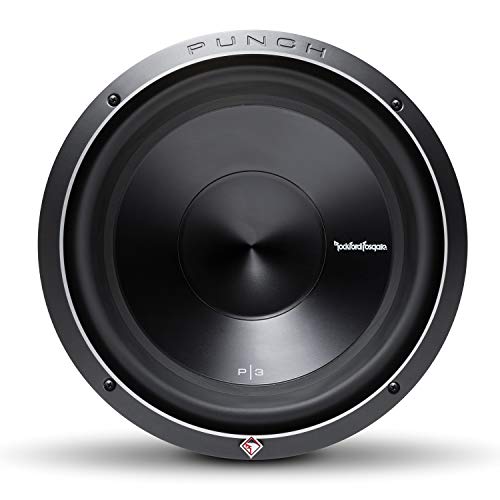
Rockford Fosgate P3D4-12 Punch P3 12-Inch Subwoofer
The Rockford Fosgate P3D4-12 Punch P3 is the benchmark pick in this guide, and it is the one to buy when you want a proven 12-inch subwoofer that sounds great in a sealed or a ported box. It is a 12-inch driver with a dual 4-ohm voice coil, a nominal power handling of 600 watts, and a peak rating of 1200 watts. The cone is an anodised aluminium design with Rockford’s VAST surround, which increases the cone area and lets it move more air than a standard 12-inch driver.
Sound is tight, punchy, and controlled, with bass that hits hard without blurring into the midrange. The P3 works well in a sealed box for accurate bass, and it works well in a ported box for louder, deeper bass, which makes it flexible enough to suit most listeners. The dual 4-ohm voice coils let you wire it to 2 ohms or 8 ohms, so it matches a wide range of amplifiers. Rockford’s Punch range has been a staple of car audio for years, and the P3 is the model most installers recommend when a customer wants a single subwoofer that does everything well.
Who it is for: drivers who want a proven, versatile 12-inch subwoofer for a single-sub setup, and anyone building their first proper car audio system.
Caveats: one retailer listing notes a question about the manufacturer’s status for this model, so confirm the listing is current and the subwoofer is in new condition before ordering. The P3 needs a proper enclosure built to the recommended volume, so do not mount it in a random box and expect it to sound its best.
JL Audio 12W0v3-4 12-Inch Subwoofer
The JL Audio 12W0v3-4 is the accuracy pick in this guide, and it is the one to buy when you want clean, musical bass that blends with your door speakers rather than overpowering them. It is a 12-inch driver with a single 4-ohm voice coil and a nominal power handling of 300 watts, which makes it the easiest subwoofer here to power, because a modest mono amplifier is enough to drive it properly. The cone is a mineral-filled polypropylene design with a nitrile butadiene rubber surround, built for long, controlled excursion.
Sound is smooth and musical, with bass that is deep and full without being boomy, and a response that stays even across the low frequencies. JL Audio’s W0 range is designed for listeners who want the bass to support the music rather than dominate it, and the 12W0v3-4 delivers exactly that. The single 4-ohm voice coil wires directly to most mono amplifiers with no impedance maths to worry about, which makes it the simplest install in this guide. It works well in a sealed box, and JL publishes recommended volumes for both sealed and ported enclosures.
Who it is for: listeners who value accuracy and musicality over sheer volume, and anyone who wants a subwoofer that is easy to power and easy to install.
Caveats: the 300-watt nominal rating means it will not play as loud as the higher-power picks here, so if you want maximum impact for bass-heavy music, choose a higher-power model. The single voice coil gives you no wiring flexibility, though for a single-sub setup that is rarely a problem.
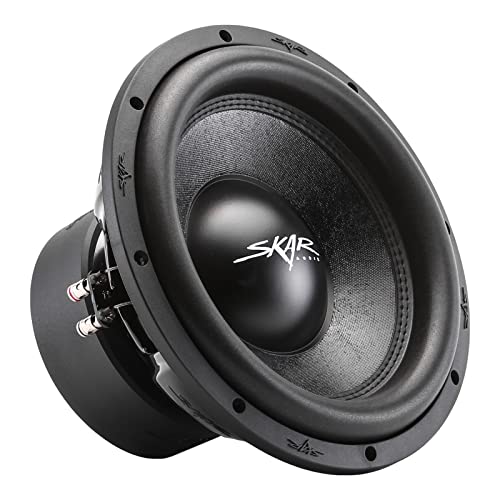
Skar Audio SDR-12 D2 12-Inch Subwoofer
The Skar Audio SDR-12 D2 is the value pick in this guide, and it is the one to buy when you want strong, deep bass for a modest outlay. It is a 12-inch driver with a dual 2-ohm voice coil, a nominal power handling of 600 watts, and a peak rating of 1200 watts. The cone is a pressed paper design with a high-roll foam surround, and the motor uses a large ferrite magnet with a 2.5-inch voice coil for heat handling.
Sound is deep and powerful, with bass that hits hard and fills the car, and a response that suits bass-heavy music well. The dual 2-ohm voice coils let you wire it to 1 ohm or 4 ohms, so it matches a wide range of amplifiers, though you should confirm your amplifier is stable at 1 ohm before wiring it that way. Skar’s SDR range is popular with drivers who want a lot of bass for the money, and the SDR-12 D2 is the model most of them start with. It works well in a ported box for maximum output, and it is also available as a loaded enclosure if you prefer a ready-built solution.
Who it is for: drivers who want deep, powerful bass on a modest outlay, and anyone building a bass-heavy system for electronic, hip-hop, or rap music.
Caveats: the pressed paper cone and foam surround are less durable than the aluminium and rubber designs above, so keep the subwoofer dry and avoid over-driving it. Confirm your amplifier is stable at the impedance you plan to wire it to, because a dual 2-ohm subwoofer wired to 1 ohm will damage an amplifier that is not rated for it.
Skar Audio SVR-12 D2 12-Inch Subwoofer
The Skar Audio SVR-12 D2 is the step-up pick in this guide, and it is the one to buy when you want more power handling and a stronger motor than the SDR model above. It is a 12-inch driver with a dual 2-ohm voice coil, a nominal power handling of 800 watts, and a peak rating of 1600 watts. The motor is larger and stronger than the SDR’s, with better cooling and a stiffer suspension, which lets it handle more power and play louder without distortion.
Sound is deep and forceful, with bass that stays controlled even at high volume, and a response that suits both sealed and ported enclosures. The higher power handling means it needs a stronger amplifier than the SDR, so plan for a mono amplifier rated near 800 watts at the impedance you wire it to. The dual 2-ohm voice coils give you the same wiring flexibility as the SDR, with the same caution about amplifier stability at 1 ohm. It is the right choice if you want the Skar sound with more headroom and more output.
Who it is for: drivers who want the most output from a Skar subwoofer, and anyone with a strong amplifier who needs a subwoofer that can use it.
Caveats: the 800-watt nominal rating means it needs a substantial amplifier and a proper wiring kit with a suitable fuse, so budget for the amplifier as well as the subwoofer. As with the SDR, confirm your amplifier is stable at the impedance you wire it to before you connect it.
Comparison Table
| Subwoofer | Size | Voice Coil | Nominal Power | Peak Power | Best For |
|---|---|---|---|---|---|
| Rockford Fosgate P3D4-12 | 12-inch | Dual 4-ohm | 600 W | 1200 W | Versatile all-rounder |
| JL Audio 12W0v3-4 | 12-inch | Single 4-ohm | 300 W | 600 W | Accurate, musical bass |
| Skar Audio SDR-12 D2 | 12-inch | Dual 2-ohm | 600 W | 1200 W | Deep bass on a modest outlay |
| Skar Audio SVR-12 D2 | 12-inch | Dual 2-ohm | 800 W | 1600 W | Maximum output |
Which One Is Right for You?
If you want the safest, most versatile choice, buy the Rockford Fosgate P3D4-12. It sounds great in a sealed or a ported box, it matches a wide range of amplifiers, and it is the subwoofer most installers recommend for a single-sub setup. If you value accuracy and musicality over sheer volume, buy the JL Audio 12W0v3-4, which is the easiest to power and the simplest to install, and which blends with your door speakers better than any other pick here.
If you want deep, powerful bass on a modest outlay, buy the Skar Audio SDR-12 D2, which delivers strong output for the money and works well in a ported box. If you have a strong amplifier and want the most output, buy the Skar Audio SVR-12 D2, which has the power handling and the motor to use it. Whichever you choose, build or buy an enclosure matched to the manufacturer’s recommended volume, match the amplifier to the subwoofer’s nominal power and impedance, and set the gain carefully.
Frequently Asked Questions
Do I need an amplifier for a car subwoofer?
Yes. All four subwoofers in this guide are component drivers, which means they need a separate amplifier to power them. A mono Class D amplifier is the usual choice, rated near the subwoofer’s nominal power at the impedance you wire it to. Your head unit alone cannot drive a subwoofer, because it does not produce enough power or the right frequency range.
Should I choose a sealed or a ported enclosure?
A sealed enclosure gives you tight, accurate bass with a smooth response, and it suits most music. A ported enclosure gives you louder, deeper bass with more impact, and it suits bass-heavy genres, but it is larger and needs precise volume and port tuning. If you are unsure, start with a sealed box, because it is smaller, easier to build, and more forgiving, and it sounds good on the widest range of music.
What does dual voice coil mean?
A dual voice coil subwoofer has two separate voice coils, which gives you wiring options. You can wire the coils in parallel to halve the impedance, or in series to double it, which lets you match the subwoofer to your amplifier. A dual 4-ohm subwoofer can be wired to 2 ohms or 8 ohms, while a dual 2-ohm subwoofer can be wired to 1 ohm or 4 ohms. Check your amplifier’s specifications before you choose, because not every amplifier is stable at 1 ohm.
How much power does a car subwoofer need?
It depends on the subwoofer. The JL Audio pick here needs 300 watts nominal, while the Skar SVR needs 800 watts. As a rule, your amplifier should deliver close to the subwoofer’s nominal power rating at the impedance you wire it to, with a little headroom. An amplifier that delivers far less power will leave the subwoofer sounding weak, while one that delivers far more risks damage if the gain is set too high.
Disclosure: As an Amazon Associate, we may earn from qualifying purchases.
Related guides
More from Amazon
Programs that pair well with the guide above. Offers and eligibility are set by Amazon and may change.
A free business account with business pricing and bulk-buying tools for work, shop or home office.
Create a business accountFree shipping on eligible items, Prime Video and more. Eligible new members can start with a free trial.
Start a Prime free trialAudiobooks and podcasts to listen to on the go. Eligible new members can start with a free trial.
Try Audible freeAd-free music streaming. Eligible new subscribers can start with a free trial.
Try Music Unlimited freeAs an Amazon Associate we earn from qualifying purchases.