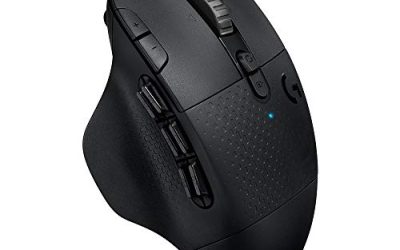
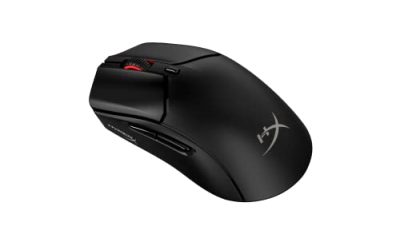
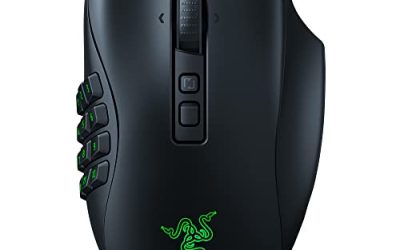
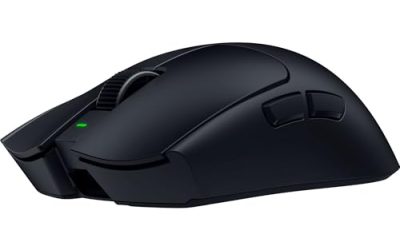
The best 4K gaming mouse for most players is the Razer Viper V3 Pro. It is an ultralight wireless mouse that supports 4000 Hz and 8000 Hz polling through Razer’s HyperPolling dongle. “4K” in mouse shopping normally means a 4000 Hz polling rate (a position report every 0.25 ms), not a mouse built for 4K monitors. This guide covers both readings, because any modern high-DPI sensor also works fine on a 4K display.
As an Amazon Associate we earn from qualifying purchases at no extra cost to you.


Top 3 picks at a glance
What “4K gaming mouse” actually means
Two different searches share this phrase:
- 4K polling rate (4000 Hz): the mouse reports its position 4,000 times per second instead of the usual 1,000. This is the meaning most buyers want, and it is what the picks below are chosen for.
- A mouse for a 4K monitor: there is no special “4K” mouse category here. You need a sensor that tracks cleanly at 800-1600 DPI and a polling rate your CPU can handle. Every pick below qualifies.
Quick comparison of the picks
| Pick | Best for | Key specs (per manufacturer) | Typical price |
|---|---|---|---|
| Razer Viper V3 Pro | Best overall | Wireless, about 54 g, up to 8000 Hz with HyperPolling dongle, 35K-class optical sensor | $150-$180 |
| Razer DeathAdder V3 Pro | Best ergonomic shape | Wireless, about 63 g, 4000 Hz with HyperPolling dongle (sold separately), right-handed ergo | $130-$160 |
| Corsair Sabre v2 Pro Wireless | Best 4000 Hz without extra dongle hunting | Wireless, lightweight, 4000 Hz class polling over the included receiver, high-DPI optical sensor | $120-$160 |
| Endgame Gear OP1 8k v2 | Best wired / no battery tradeoff | Wired, 8000 Hz capable, lightweight shell | $70-$100 |
| Logitech G Pro X Superlight 2 | Best if 2000 Hz is enough | Wireless, about 60 g, 2000 Hz Lightspeed, 32K DPI sensor | $140-$170 |
Prices are general market ranges and move with sales. Confirm polling-rate options and what is in the box on the manufacturer’s spec sheet before buying, because dongle bundles differ by region and revision.
Best overall: Razer Viper V3 Pro
It is a symmetrical, very light esports mouse, and its HyperPolling dongle gives you 1000, 2000, 4000 and 8000 Hz options in software. It suits claw and fingertip grips on medium-to-small hands. The main trade-off is battery life. Higher polling drains the cell much faster than the headline 1000 Hz figure suggests (see the worked example below). The shape is also fairly flat, so large palm-grip hands may find it cramped.
Best ergonomic shape: Razer DeathAdder V3 Pro
The DeathAdder keeps the sculpted right-handed hump that palm-grip players like, and it can reach 4000 Hz when paired with the HyperPolling dongle. It suits medium and large hands that find symmetrical mice uncomfortable. The trade-offs are the extra cost of the dongle and a weight of about 63 g, which is heavier than the Viper. It is also right-handed only.
Best without extra dongle hunting: Corsair Sabre v2 Pro Wireless
Corsair’s lightweight wireless mouse is aimed at competitive FPS players and supports 4000 Hz-class polling over its own wireless receiver, so you do not have to buy a second dongle. It suits players already using Corsair iCUE who want a simpler setup. Its trade-off is a smaller accessory and shape ecosystem than Razer or Logitech, and the shape leans toward claw and relaxed-claw grips.
Best wired value: Endgame Gear OP1 8k v2
A wired mouse has no battery to drain, so 4000 or 8000 Hz costs you nothing in runtime. It suits players who leave the mouse at a desk and want the cheapest route to high polling. The trade-offs are the cable, which needs a good flexible cord or a mouse bungee, and a shell that favors small-to-medium hands.
Best if 2000 Hz is enough: Logitech G Pro X Superlight 2
This is a deliberate step down from true 4K. It tops out at 2000 Hz, but it has excellent shape consistency, a well-regarded sensor and mature software. It suits players who care more about feel, weight and battery life than about the last 0.25 ms. The trade-off is that you give up the 4000 Hz headline spec.
Worked example: what 4000 Hz really changes
Polling rate sets the interval between position reports. Here is what that means in practice:
| Polling rate | Report interval | Reports per frame at 144 fps | Reports per frame at 360 fps |
|---|---|---|---|
| 1000 Hz | 1.0 ms | about 7 | about 2.8 |
| 2000 Hz | 0.5 ms | about 14 | about 5.6 |
| 4000 Hz | 0.25 ms | about 28 | about 11 |
| 8000 Hz | 0.125 ms | about 56 | about 22 |
The gain is clearest at high frame rates. At 360 fps, a 1000 Hz mouse delivers fewer than three updates per frame, so some frames show slightly stale aim data. At 4000 Hz you get about 11. At 60 fps the benefit is much harder to notice.
Why your DPI has to match your polling rate
A mouse only sends a report when it has moved. To fill every 4000 Hz slot you need at least one count of movement per report, so you need 4,000 counts per second.
- At 800 DPI: 4,000 / 800 = 5 inches per second of hand speed
- At 1600 DPI: 4,000 / 1600 = 2.5 inches per second
- At 400 DPI: 4,000 / 400 = 10 inches per second
At slow, precise aim, a 400 DPI setup will not saturate 4000 Hz, so the extra rate does nothing. That is why many 4K-polling users run 800-1600 DPI and lower in-game sensitivity to compensate.
Battery cost, as an illustration
Suppose a mouse is rated for 95 hours at 1000 Hz. If 4000 Hz drains the battery two to three times faster, which is a plausible range but an assumption rather than a published figure, you would get roughly 32-48 hours. At 3 hours of play a day, that means charging about every 10-16 days instead of monthly. Check the manufacturer’s runtime table for each polling setting.
How to choose: decision matrix
| Your situation | Choose | Why |
|---|---|---|
| Competitive FPS at 240 fps or higher, claw or fingertip grip | Razer Viper V3 Pro | Lowest weight, 4000/8000 Hz options |
| Palm grip, medium-large hand | Razer DeathAdder V3 Pro | Ergonomic hump, 4000 Hz with the right dongle |
| Already in the Corsair ecosystem | Corsair Sabre v2 Pro Wireless | 4000 Hz class without a separate dongle purchase |
| Tight budget, desktop only | Endgame Gear OP1 8k v2 | No battery penalty |
| Older CPU (about 4 cores) or capped at 144 fps | 1000-2000 Hz mouse such as Superlight 2 | Higher polling adds CPU load and gives little at low fps |
| Playing on a 4K monitor at 60-120 fps | Any pick above, set to 1000-2000 Hz | Frame rate is too low to use 4K polling |
Settings that make a 4K polling mouse work
- Plug the dongle into a rear motherboard USB port. Front-panel and hub ports can add noise and drop reports at high rates.
- Use the extension cable and keep the dongle within about 20 cm of the mouse. Wireless stability matters more at 4000 Hz because each dropped report is a larger share of the signal.
- Set DPI to 800-1600 and lower in-game sensitivity. This lets you saturate the polling rate at normal aim speeds.
- Raise polling in steps. Try 2000 Hz first, then 4000 Hz, and watch your 1% low frame rate. If it drops, step back.
- Turn off motion sync or leave it on, depending on the manufacturer’s advice. Check the vendor’s guidance, since it can add a small delay but smooth the data.
When 4K polling is not worth it
If your game runs below 144 fps, the extra reports are mostly wasted. Some games and engines also handle very high polling rates poorly, causing stutter on weaker CPUs or in menus. For competitive shooters on a fast CPU, 4000 Hz is a reasonable upgrade. For single-player games on a 4K 60 Hz TV, a good 1000 Hz mouse is just as good and lasts longer between charges.
Frequently Asked Questions
Is a 4K gaming mouse the same as a 4000 Hz mouse?
Usually yes. In mouse marketing, “4K” refers to a 4000 Hz polling rate, and “8K” to 8000 Hz. It does not mean the mouse is built for 4K monitors, though any modern mouse works with one.
Do I need a special mouse for a 4K monitor?
No. A 4K display has more pixels, so many players raise DPI slightly to cross the screen with less hand movement, typically 800-1600 DPI. Any quality sensor handles this without trouble.
Does 4000 Hz polling lower FPS?
It can, mostly on older or low-core-count CPUs, because each report creates work for the system. On a modern 6-core or better processor the effect is usually small, but it varies by game and system. If your 1% lows drop, use 2000 Hz instead.
Is 8000 Hz better than 4000 Hz?
Only marginally for most players. Going from 1000 Hz to 4000 Hz is a bigger step than 4000 Hz to 8000 Hz, and 8000 Hz costs more CPU and battery. It makes the most sense on wired mice or at very high frame rates.
Do wireless mice work at 4000 Hz?
Yes, on models that ship with a compatible dongle, such as the Razer HyperPolling dongle or Corsair’s Slipstream receiver. Battery life falls noticeably, so expect to charge more often than at 1000 Hz.
Which monitor refresh rate do I need to benefit?
Aim for at least 240 Hz, or a game running at 240 fps or more. Below about 144 Hz, a 1000-2000 Hz mouse gives you almost everything that 4000 Hz would.
Related guides
More from Amazon
Programs that pair well with the guide above. Offers and eligibility are set by Amazon and may change.
A free business account with business pricing and bulk-buying tools for work, shop or home office.
Create a business accountFree shipping on eligible items, Prime Video and more. Eligible new members can start with a free trial.
Start a Prime free trialAudiobooks and podcasts to listen to on the go. Eligible new members can start with a free trial.
Try Audible freeAd-free music streaming. Eligible new subscribers can start with a free trial.
Try Music Unlimited freeAs an Amazon Associate we earn from qualifying purchases.