
A programmable power supply replaces the frustration of guessing resistor values or cobbling together wall adapters when you need a stable, adjustable voltage source for bench work. Whether you are powering a microcontroller board, driving LEDs, testing a laptop charging circuit, or running a small motor through its speed range, a variable supply with digital readout and software control turns trial-and-error into a repeatable setup.
The market splits sharply between switching bench units that offer raw wattage at low cost and linear or triple-output designs that trade price for lower ripple and independent channel control. Owner feedback consistently flags build quality, display readability at an angle, and whether the advertised programmability actually works through a PC connection as the real differentiators. This roundup for 2026 compares published specifications, listed prices, and aggregated user reports across eight models to help you match capability to workflow without overspending.
As an Amazon Associate we earn from qualifying purchases at no extra cost to you.


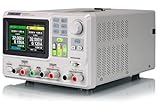


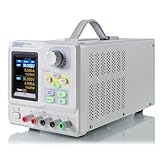
Top 3 picks at a glance
Quick Picks
| Product | Best for | Price |
|---|---|---|
| HM310T | Software-controlled automation on a budget | $99.99 |
| Jesverty SPS-3010 | Cheapest 4-digit display entry | $42.74 |
| Siglent SPD3303X-E | Multi-rail development and serial testing | $459 |
| Encoder Knob (Black) | Simple knob-turn bench utility | $49.99 |
| Rigol DP832A | Low-noise linear power for analog work | $619 |
| FNIRSI DPS-150 | Compact desk use with flip display | $79.99 |
| Encoder Knob USB-C | Modern connector convenience at low cost | $44.98 |
| Siglent SPD1305X | Single-channel programmable accuracy | $328 |
How We Picked
We narrowed candidates by four criteria that recur in owner reviews and spec comparisons: output range versus intended use, display precision and readability, genuine programmability (USB or SCPI interface with working PC software), and protection features such as overcurrent or short-circuit cutoff. Price-to-wattage mattered as a secondary filter to flag overpriced units.
The 8 Best Programmable Power Supply in 2026
HM310T
The HM310T targets makers and repair technicians who want PC-controlled voltage and current curves without spending four figures. Its 0-30V / 0-10A range covers most low-voltage bench tasks, and the 4-digit display gives adequate resolution for fine adjustments.
- Pro: Ships with PC software and USB interface, enabling scripted ramp sequences and logging.
- Pro: 100W output capacity suits motor loads and multi-board debugging at this price tier.
- Con: Switching topology introduces ripple that can disturb sensitive analog circuits.
Skip it if your work demands sub-millivolt noise or independent dual channels; the single-output switching design will not serve those needs.
Jesverty SPS-3010
At roughly $43, the SPS-3010 is the lowest-priced unit here with a 4-digit LED readout, making it a sensible first bench supply for hobbyists learning power supply fundamentals. Coarse and fine adjustment knobs speed up manual voltage setting.
- Pro: Built-in 5V/2A USB port handy for powering logic boards alongside the main output.
- Pro: Price-to-capability ratio is hard to beat for occasional use.
- Con: No programmable interface; all adjustments are manual, so it cannot automate test sequences.
Skip it if you need software control, data logging, or repeatable remote-set profiles for production testing.
Siglent SPD3303X-E
Three independent outputs and full SCPI programmability place this unit in a different class. Owners highlight the ability to cross-join or series-combine channels for higher voltage or current without external wiring.
- Pro: Triple-channel architecture supports simultaneous rail sequencing for FPGA or microprocessor bring-up.
- Pro: Proven Siglent software ecosystem with working UART and USB remote control.
- Con: Significantly more expensive than single-output alternatives; overkill for single-voltage tasks.
Skip it if your work involves only one voltage at a time and you do not need programmable sequencing.
Encoder Knob (Black)
This unnamed 30V/10A unit leans on a rotary encoder and output enable/disable button for a tactile, straightforward workflow. A short-circuit alarm and USB quick-charge port round out a practical package for general-purpose bench tasks.
- Pro: Encoder knob provides smooth, repeatable voltage changes without fiddly multi-turn pots.
- Pro: Dedicated enable/disable button lets you drop the load instantly without resetting settings.
- Con: No PC interface; programmability is limited to manual adjustment and preset recall at best.
Skip it if automation or scripted power profiles are part of your workflow.
Rigol DP832A
Linear regulation, three channels, and 195W total output make the DP832A a serious instrument for analog designers, RF engineers, and anyone sensitive to switching noise. Maximum ranges of 30V/3A on two main channels plus 5V/3A cover most development scenarios.
- Pro: Linear topology delivers low output ripple, ideal for audio and precision analog circuits.
- Pro: Rigol’s SCPI support and front-panel programming ease integration into automated test rigs.
- Con: Highest price here, and 3A per main channel caps current for heavier loads like motors.
Skip it if you need more than 3A on a single rail or your budget does not stretch past $500.
FNIRSI DPS-150
FNIRSI packed a 4-digit IPS flip display into a small footprint, appealing to users with cramped desks or those who angle the screen toward standing position. The 30V/5A range suits LED strings, small loads, and charging tasks.
- Pro: Flip display improves visibility from multiple bench positions without repositioning the unit.
- Pro: Compact size fits easily on a crowded workbench alongside other tools.
- Con: 5A maximum current limits headroom for inductive loads or high-wattage motor testing.
Skip it if you routinely draw more than 150W or need multi-channel output.
Encoder Knob USB-C
For $45, this unit combines the encoder-knob ergonomics with both USB-A and Type-C quick-charge outputs, making it convenient for phone or battery-pack charging experiments. Overcurrent protection adds a safety layer for unprotected loads.
- Pro: Dual quick-charge ports (USB-A and Type-C) simplify testing modern USB-PD devices.
- Pro: OCP provides automatic cutoff, reducing risk of damaging boards during short-circuit faults.
- Con: No PC software or SCPI interface; all programming is manual.
Skip it if your workflow requires remote or scripted voltage changes.
Siglent SPD1305X
A single-channel, fully programmable supply at $328, the SPD1305X balances Siglent’s reliable software and SCPI support with a more focused spec of 30V/5A / 150W. Owners praise the straightforward interface for learning programmable control before committing to multi-channel units.
- Pro: Compact programmable design with proven Siglent software for ramp, step, and logging functions.
- Pro: Lower price than the triple-output SPD3303X-E while retaining the same ecosystem quality.
- Con: 5A ceiling and single output restrict versatility for multi-rail or high-current work.
Skip it if you need independent dual or triple outputs; the SPD3303X-E is the logical step up.
Buying Guide
Switching vs. Linear Topology
Switching supplies convert voltage efficiently, delivering high wattage in a compact, affordable chassis, but their switching frequency injects ripple into the output—often 50-200 mV peak-to-peak on budget units. Linear supplies regulate with pass transistors, producing ripple in the low millivolt range at the cost of size, weight, and heat. For digital logic, LED driving, or battery charging, switching is fine. For audio circuits, reference voltage work, or sensitive sensor excitation, a linear design like the Rigol DP832A is worth the premium.
Programmability and Connectivity
A unit that says “programmable” without a working USB or SCPI interface is misleading. Confirm the manufacturer provides PC software and that it supports the commands you need—voltage set, current limit, output toggle, and ideally measurement readback for logging. The HM310T and Siglent models include software; the cheaper encoder-knob units do not. If your workflow involves automated test sequences, regression checks, or data logging, programmability is non-negotiable.
Output Range, Channels, and Protection
Match voltage and current headroom to your worst-case load plus a safety margin. A 30V/10A switching unit delivers 300W, while a 30V/5A supply caps at 150W. Triple-channel designs let you cross-join for higher voltage or current, or power independent rails simultaneously. Protection features—overcurrent, overvoltage, short-circuit, and overtemperature—matter most when testing boards that may already have faults. Look for automatic output disable rather than just an alarm, as the latter still stresses components momentarily.
Our Verdict
The Siglent SPD3303X-E is the top pick for anyone whose work genuinely needs three independent, programmable rails—FPGA development, serial bus testing, and multi-rail analog design justify its price. The budget pick is the Jesverty SPS-3010 at under $43, offering 4-digit precision and 300W headroom for hobbyist bench tasks. The Rigol DP832A wins over both when your circuits demand low-noise linear power and you can accept the 3A per-channel current limit.
FAQ
What does “programmable” actually mean on a bench power supply?
It means an external device—typically a computer over USB or UART—can set output voltage, current limits, and on/off state via commands, usually SCPI. This allows scripted test sequences and data logging that manual knob adjustment cannot replicate.
Do I need a triple-output supply?
Only if your circuits require multiple independent voltage rails powered simultaneously, such as an FPGA board needing core, I/O, and auxiliary voltages with specific sequencing. Single-rail work does not benefit from the extra channels.
Is switching noise a real problem for hobbyist projects?
For digital logic, LED arrays, and motor drivers, typical switching ripple is negligible. For sensitive analog front-ends, audio amplifiers, or high-resolution ADC excitation, the ripple can show up in measurements or audible output, making a linear supply the safer choice.
How much current headroom should I leave above my load requirement?
Aim for at least 20-30% above your expected peak draw. Inductive loads like motors can spike several times their steady-state current at startup, and running a supply near its limit reduces lifespan and can trigger protection cutouts during transients.


