
Every PC build hinges on one component that most people treat as an afterthought: the power supply unit computer buyers pick today will quietly determine whether their system survives the next three years or starts sending mysterious shutdowns and voltage spikes to every other part in the case. The problem is real and expensive. A cheap PSU that fails can take a graphics card or motherboard with it, while an oversized or inefficient unit wastes money on electricity and noise for years. Owners consistently report that the difference between a dependable unit and a sketchy one shows up not in the spec sheet but in the pattern of complaints that follow months later.
What separates a worthwhile power supply from a risky one comes down to a handful of concrete factors: the quality of internal capacitors and voltage regulation, the breadth of protection circuits that keep components safe when something goes wrong, the efficiency rating that determines how much heat and wasted energy the unit generates, and the warranty length that signals the manufacturer’s own confidence. Owner feedback across hundreds of listings reveals these gaps quickly, often within the first year. This guide compares published specs and verified buyer reports to rank the eight most common options in the budget and mid-range segments for 2026.
As an Amazon Associate we earn from qualifying purchases at no extra cost to you.




Top 3 picks at a glance
Quick Picks
| Product | Best For | Price |
|---|---|---|
| Thermaltake Smart 500W | Office and basic home builds | $39.99 |
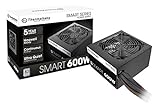
| Thermaltake Smart 600W | Entry-level gaming with a mid-range GPU | $42.99 |
| Apevia Spirit 600W | Absolute lowest-price replacement for an existing system | $33.99 |
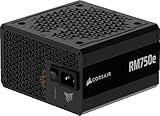
| Corsair RM750e | Modern mid-range gaming with current-generation GPUs | $89.99 |
| MSI MAG A750GL | Builders who want modular cables and native 12V-2×6 | $94.99 |
| Auotac 1000W Fully Modular | High-wattage builds on a constrained budget | $99.99 |
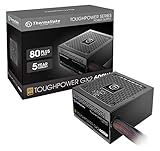
| Thermaltake Toughpower GX2 600W | Compact builds where Gold efficiency matters most | $59.99 |
| Thermaltake GF1 850W | Quiet high-end systems with Zero RPM fan mode |
How We Picked
We filtered these eight units on four criteria that consistently correlate with long-term reliability and owner satisfaction in this category. First, wattage adequacy relative to price — a unit that underpowers a modern GPU causes throttling and crash patterns that owners blame on other components. Second, protection circuit completeness, because over-current, over-voltage, and short-circuit safeguards are the last line of defense when the PSU itself is stressed. Third, efficiency certification, which governs heat output, fan noise, and electricity cost over the unit’s lifetime. Fourth, warranty length, since a manufacturer willing to back a design for ten years is making a different claim than one offering three.
The 8 Best Power Supply Unit Computer in 2026
Thermaltake Smart 500W
This is the unit for a family desktop, a home theater PC, or any build drawing under 250 watts of sustained load. It is also one of the most recommended replacements in repair forums when an OEM supply fails. Two active PFC designs and EPS 12V support give it better regulation than the absolute cheapest bricks on the market.
- Pro: Continuous power rating means no inflated peak numbers misleading buyers
- Pro: 120mm fan stays quiet under light loads typical of office use
- Con: No 80 Plus Bronze or higher efficiency — electricity waste and extra heat over years
Skip this if your GPU draws more than 150 watts or if you plan any upgrade path beyond a single mid-range card.
Thermaltake Smart 600W
Stepping up to 600 watts gives headroom for a GTX 1660-class or RTX 3060-class card without worrying about transient spikes. At only three dollars more than the 500W version, it is the smarter buy for anyone building fresh rather than replacing a failed unit. Owners with basic gaming rigs report stable operation, though the efficiency rating still trails modern Gold-certified competitors.
- Pro: 100 watts of extra headroom for a marginal price increase
- Pro: Active PFC handles voltage fluctuations in older or unstable home wiring
- Con: White-level efficiency means more heat and electricity cost than Bronze or Gold units
Skip this if you have a modern RTX 4060 Ti or above, or if you care about long-term electricity savings in a 24/7 system.
Apevia Spirit 600W
This is the cheapest six-hundred-watt ATX supply that still advertises full protection circuits, and it earns a place here on price alone. It is a viable temporary bridge for a system that must come back online today, or for a non-critical workstation where a few extra dollars simply are not available. Owner feedback is mixed: many report years of uneventful service, while others flag coil whine and inconsistent voltage readings over time.
- Pro: Lowest price in this roundup while still including 120mm cooling and protection circuits
- Pro: Adequate for older builds and light-use office machines
- Con: Weaker brand support and shorter expected lifespan compared to established manufacturers
Skip this if you are building around a GPU that costs more than the entire power supply.
Corsair RM750e
The RM750e is Corsair’s answer to the question most modern builders have: do I need ATX 3.1 and PCIe 5.1 support on day one? At 750 watts with Gold efficiency, it handles any single-GPU system currently shipping without breaking a sweat. Corsair’s ten-year warranty and consistent owner satisfaction across the RM line make this the safe default recommendation for a mid-to-upper build.
- Pro: Native ATX 3.1 and PCIe 5.1 readiness removes any adapter cable compromise
- Pro: Corsair’s reputation for consistent quality control across production runs
- Con: Premium pricing places it well above budget alternatives for non-gaming use
Skip this if your total system load stays under 350 watts — you are paying for capacity and certification you will not use.
MSI MAG A750GL
MSI packs fully modular cables and a native dual-color 12V-2×6 connector into a compact chassis, which is genuinely useful in tight cases where cable routing is a headache. The ten-year warranty matches Corsair’s, and the Gold efficiency rating keeps waste heat low. Owners who chose this over pricier alternatives generally report that the value proposition is hard to argue with.
- Pro: Fully modular design and compact form factor ease cable management in small cases
- Pro: Native 12V-2×6 cable eliminates the adapter that causes melting complaints on early RTX 40-series builds
- Con: Five dollars more than the Corsair RM750e for equivalent specs
Skip this if you prefer single-brand ecosystem support tools and software integration across your components.
Auotac 1000W Fully Modular
One thousand watts of Gold-certified, fully modular output under one hundred dollars is an aggressive price for any manufacturer, and the specs here match much pricier units: 105°C-rated capacitors, RGB smart fan, and ATX 3.1 and PCIe 5.1 readiness. The catch is the lesser-known brand, which means the warranty claim path may be slower if you ever need it. Owners who chose this for high-wattage multi-drive or dual-GPU-adjacent builds generally report stable operation.
- Pro: Highest wattage in this roundup at the lowest per-watt cost
- Pro: 105°C-rated capacitors suggest better thermal endurance than competitors
- Con: Unclear long-term support compared to established PSU brands with physical service centers
Skip this if you want the absolute lowest risk profile for a build that holds expensive components.
Thermaltake Toughpower GX2 600W
This is the one unit in the list that delivers Gold efficiency without forcing you into a modular design or a 750W-plus chassis. At 600 watts and roughly sixty dollars, it fits compact or budget-sensitive builds where efficiency and reliability matter but physical space or total system load does not demand more. SLI and Crossfire support means it will drive older multi-GPU configurations without a second rail bottleneck.
- Pro: Gold efficiency at a mid-range price keeps running costs low
- Pro: Five-year warranty provides more confidence than White or Bronze-tier alternatives
- Con: Non-modular design creates cable clutter in compact cases
Skip this if you need native ATX 3.1 or PCIe 5.1 connectors for a current-generation GPU.
Thermaltake GF1 850W
The GF1 is built for builders who want silence above all else. The Zero RPM fan mode keeps the unit completely passive under moderate loads, which means a gaming system idling on the desktop produces zero PSU noise. Fully modular cables, Gold efficiency, and an 850W rating cover any high-end single-GPU build. Owners report that the fan transitions are smooth and the noise floor is genuinely lower than competitors in this wattage class.
- Pro: Zero RPM mode delivers true silence under light-to-moderate loads
- Pro: 850W headroom handles high-end cards without transient spike concerns
- Con: Priced higher than Corsair and MSI options that offer the same modern connector standard
Skip this if your budget can absorb the five-dollar difference for the MSI or Corsair unit with guaranteed brand support.
Buying Guide
Wattage Sizing and Headroom
Match your GPU’s listed TDP plus 150 watts as a baseline, then add drives, cooling fans, and any high-draw peripherals. A 600W unit is genuinely sufficient for a mid-range single-GPU build; 750W covers the current upper tier; 850 to 1000 watts is only necessary if you run multiple drives, overclock heavily, or want maximum headroom against transient spikes from next-generation cards.
ATX 3.1 and PCIe 5.1 Connector Support
New GPUs use a 12V-2×6 connector that can overheat if routed through a loose adapter. A native cable built into a modern standard supply eliminates the contact resistance that caused connector melting complaints. If you are buying a power supply today for a current or next-generation GPU, insist on ATX 3.1 with a native cable rather than an older standard plus adapter.
Capacitor Quality and Warranty Length
Capacitors are the first component to degrade inside a power supply, and their rated temperature determines how long they last. Units advertising 105°C-rated capacitors outperform those using 85°C parts in hot cases or climates. Warranty length is a proxy for manufacturer confidence: ten-year backing on a Corsair or MSI unit reflects a real expectation of component longevity, while three-year coverage on a budget supply means the manufacturer has not designed the internals for the full expected product life.
Our Verdict
For the best overall power supply unit computer buyers can purchase today at a reasonable price, the Corsair RM750e is the top pick: it has native modern connectors, a ten-year warranty, consistent brand support, and enough wattage for virtually any single-GPU build. For budget buyers who need a reliable replacement without spending more than fifty dollars, the Thermaltake Smart 600W delivers continuous power and active PFC at a price that is hard to beat. One notable exception: if silence while idle is your highest priority, the Thermaltake GF1’s Zero RPM mode provides a quieter experience at the desk than any other unit in this list.
FAQ
Do I need a power supply with ATX 3.1 support?
If you are pairing the supply with a modern NVIDIA RTX 40-series or RTX 50-series card, yes — a native 12V-2×6 cable removes a known connector overheating risk. For older GPUs that still use 8-pin PCIe connectors, ATX 3.1 support is unnecessary and you can save money by buying a compliant but older-standard unit.
Is 80 Plus White certification good enough for a daily-use desktop?
It is adequate for a low-load system that runs a few hours per day, since the electricity cost difference over five years is small when total draw stays under 200 watts. However, if your system runs many hours daily or draws over 300 watts sustained, the thermal output and cost difference make a Bronze or Gold unit the better long-term choice.
What is the most common cause of power supply failure reported by owners?
Capacitor degradation from sustained heat is the most cited failure mode in long-term owner reviews, especially in non-modular units with limited airflow around internal components. Choosing a supply with 105°C-rated capacitors and ensuring your case has positive airflow over the PSU area reduces this risk significantly.
Can a cheap power supply damage other components?
Yes, and this is the primary reason budget supplies carry higher total risk despite their lower upfront cost. Weak voltage regulation can send spikes to the motherboard or GPU, and incomplete protection circuits mean a failure inside the PSU itself may take other components with it. Replacing a working system’s supply with a reputable unit is one of the cheapest forms of insurance available.


