
Best Small Form Factor PCs for Compact Gaming Setups
The best small form factor PCs for gaming are a compact, upgradeable mini-ITX build for enthusiasts, the Cooler Master NR200P V2 for a straightforward air-cooled gaming tower, and the Minisforum AtomMan G7 PT for buyers who want a ready-made system with discrete graphics. The right pick depends less on the smallest possible case than on whether its GPU, power supply, cooler, and airflow can work together without excessive heat or fan noise.
“Small form factor” covers everything from palm-sized integrated-graphics PCs to cases that hold full-size graphics cards. This comparison focuses on systems capable of meaningful 1080p or 1440p gaming, and on the trade-offs that matter after the parts are installed.
As an Amazon Associate we earn from qualifying purchases at no extra cost to you.
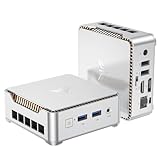

Quick comparison
| Option | Approx. internal volume | GPU and power constraints | Cooling, noise, and access | Best fit |
|---|---|---|---|---|
| Custom mini-ITX in Cooler Master NR200P V2 | About 18.3 L | Supports large graphics cards, subject to card dimensions; SFX/SFX-L PSU | Room for multiple fans and a 280 mm radiator; panels come off for service | High-performance gaming with room to tune |
| Custom mini-ITX in Fractal Design Terra | About 10.4 L | GPU thickness and CPU cooler height compete for space; SFX PSU | Compact, but tight clearances make assembly and cooling more sensitive | Small desk footprint and a carefully chosen GPU |
| Custom mini-ITX in Lian Li A4-H2O | About 11 L | Short, compact GPU required; SFX PSU | Designed around a 240 mm liquid cooler; radiator and tubing complicate access | Powerful gaming in a portable case |
| Minisforum AtomMan G7 PT | Compact prebuilt enclosure | Integrated, factory-configured GPU and power delivery | Less component choice and upgrade flexibility; cooling is tuned as a complete system | Gaming without planning a parts list |
Case volume is approximate and does not predict temperature on its own. A case with more liters can still run hot if the graphics card draws air against a panel; a smaller one can work well when its components and airflow are matched.
Choose by the constraint you care about most
- Want the least compromise on performance and maintenance? Choose an NR200P V2-style build. Its extra space makes it easier to fit a capable GPU, route cables, and reach components later.
- Need the smallest conventional gaming tower? Consider the Terra, but select the graphics card and CPU cooler together. A thicker GPU can force a shorter CPU cooler, while a larger cooler may limit GPU thickness.
- Want a compact liquid-cooled build? The A4-H2O reserves space for a 240 mm radiator, but you must verify the GPU’s length, thickness, and power connector clearance before buying.
- Prefer a ready-to-use PC over assembly? The AtomMan G7 PT combines a processor and discrete graphics in a compact system. Check the exact configuration and available upgrade access; a prebuilt is generally less flexible than a standard mini-ITX desktop.
What the spec sheet does not tell you
GPU fit includes the power cable
Check graphics-card length, height, thickness, and the manufacturer’s recommended connector clearance—not just the case’s maximum GPU dimensions. A card can fit on paper but leave its power cable sharply bent against the side panel. For cards using a 12V-2×6 power connector, seat the plug fully and avoid forcing the cable sideways immediately at the connector. This is especially important in narrow cases such as the Terra and A4-H2O.
Cooling headroom affects noise as well as temperature
Small fans and restricted intakes often have to spin faster to move the same heat. A compact PC may therefore be safe to use but louder under a sustained gaming load than a larger tower. Prefer a graphics card with a cooler suited to the case, keep intake paths clear, and avoid placing the enclosure inside a closed cabinet. In a tight sandwich-layout case, the GPU and CPU may draw warm air from opposite sides of the same limited space.
Upgrade access is a practical cost
In an NR200P V2, removing a panel to replace memory or add storage is relatively simple. In a smaller case, reaching a motherboard connector may mean first removing the graphics card, radiator, or power supply. Plan the build so commonly changed parts—such as storage and memory—remain accessible, and confirm whether a prebuilt uses standard desktop components before counting on future upgrades.
Check the power budget before choosing parts
A compact build needs enough PSU capacity for both sustained load and short power spikes. Here is a planning example, not a claim about any single PC:
- Graphics card: 320 W maximum board power
- CPU: 120 W sustained package power
- Motherboard, memory, storage, and fans: approximately 70 W
- Estimated combined load: 320 + 120 + 70 = 510 W
Adding roughly 20–25% headroom gives a target around 610–640 W. A quality 650 W SFX unit may suit this example, but check the GPU maker’s PSU recommendation, the exact CPU power limits, and the PSU’s connector support. If the selected GPU has higher power draw, choose a larger-capacity unit rather than relying on a tight estimate. Also verify PSU dimensions: SFX and SFX-L are not interchangeable in every case layout.
Performance expectations by build type
A mini-ITX gaming desktop can use the same class of CPU and GPU as a mid-tower PC, so the case does not automatically make it slower. The real limits are component selection, cooling, and whether the system can sustain boost clocks without overheating or becoming uncomfortably loud. A midrange discrete GPU is a sensible target for compact 1440p gaming; a stronger GPU can make sense in the NR200P V2, while the tightest cases reward choosing a cooler-running card over the largest model available.
Integrated-graphics mini PCs occupy a different tier. They can suit esports, older games, and lighter settings, but should not be treated as equivalent to a desktop with a discrete GPU. For a prebuilt like the AtomMan G7 PT, look up the exact CPU/GPU configuration and independent performance measurements for the games and resolution you care about; product names alone do not tell you whether a particular configuration meets your target.
Final picks
Best balance for a custom gaming PC: Cooler Master NR200P V2. Its roughly 18.3-liter layout gives builders more room to manage GPU fit, cooling, noise, and future access than the smallest cases.
Best for minimizing case volume: Fractal Design Terra, provided you accept the component trade-offs and check clearances before ordering. It is not the best choice for a first build with oversized parts.
Best compact liquid-cooled layout: Lian Li A4-H2O, if a 240 mm radiator and a compatible compact GPU match your priorities.
Best for avoiding a custom parts list: Minisforum AtomMan G7 PT, after confirming the specific configuration offers the gaming performance and upgrade options you need.
Before buying any small gaming PC, verify the exact GPU dimensions, CPU cooler or radiator clearance, PSU size and connectors, and intended airflow. Those checks matter more than saving another liter of case volume.


