Valorant rewards one thing above almost everything else: consistent, repeatable aim. Rounds are decided by crosshair placement, micro-adjustments onto heads at long angles, and the ability to stop a flick exactly where you intended. That puts the mouse at the center of your setup. A heavy shell drags on small corrections, a sensor that spins out or adds smoothing ruins trust in your own movement, and a shape that fights your grip makes every duel feel slightly off. The good news is that the current generation of esports mice has largely solved the sensor problem, so choosing the best gaming mouse for Valorant now comes down to weight, polling rate, shape, and how the mouse behaves over hundreds of hours of ranked play. The four picks below were selected from published listing specifications on Amazon US — sensor model, polling rate, weight, and switch type as stated by the manufacturers — rather than from detailed research, so you can compare the hard numbers directly and match them to your grip and hand size.
As an Amazon Associate, we earn from qualifying purchases.
Our Top Picks
 Logitech G Pro X Superlight 2 Lightspeed WirelessClassic1.57 x 2.5 x 4.92 inches0.1 poundsCheck on Amazon
Top 3 picks at a glance

Quick answer
If you want the short version: the Razer Viper V3 Pro is the most complete Valorant mouse here, pairing a 55 g symmetrical shell with a Focus Pro 35K Gen-2 sensor and true 8000 Hz wireless polling through the included HyperPolling dongle. The Logitech G Pro X Superlight 2 is the safer, more proven alternative at 60 g with an 8 kHz report rate and LIGHTFORCE switches, while the Superlight 2 DEX takes the same internals and puts them in a right-handed ergonomic shape for palm and relaxed claw players. If you prefer a wired, driverless mouse built purely for FPS, the BenQ Zowie EC2-C remains a specialist favorite. Most Valorant players should start with the Viper V3 Pro or the Superlight 2 and choose between them based on shape preference.
Key takeaways
- Weight matters more than maximum DPI in Valorant: all three wireless picks sit between 55 g and 60 g, which reduces fatigue and makes micro-corrections easier to control.
- Polling rate is the current battleground — the Razer and Logitech flagships reach 8000 Hz, while the wired Zowie EC2-C tops out at 1000 Hz but compensates with a driverless, plug-and-play design.
- Shape should follow your grip: symmetrical shells suit claw and fingertip players, while the Superlight 2 DEX and EC2-C serve right-handed ergonomic grips.
- Every sensor in this roundup is a flagship optical sensor with DPI headroom far beyond what Valorant players actually use, so sensor choice is effectively a solved problem at this level.
The picks
1. Razer Viper V3 Pro (White)

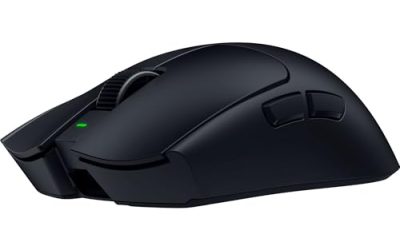
The Viper V3 Pro is the mouse that best matches what Valorant asks for. At 55 g it is the lightest pick in this roundup, and that low mass shows up in exactly the movements the game demands: fast target switching between two angles, small tracking adjustments on a moving Jett or Raze, and hard flicks that need to stop dead on a head-sized target. The symmetrical shell is a proven esports shape that works naturally for claw and fingertip grips, and it avoids the tall rear hump that can push palm players’ wrists into an uncomfortable angle. Razer’s Focus Pro 35K Gen-2 optical sensor is the company’s flagship, with the tracking consistency and lift-off behavior competitive players expect, and the Optical Switches Gen-3 use light-based actuation that eliminates the debounce delay and double-click degradation associated with traditional mechanical switches.
The headline feature for latency-focused players is true 8000 Hz polling, delivered wirelessly through the included Razer HyperPolling dongle. That means the mouse reports its position up to 8,000 times per second rather than the standard 1,000, shaving the interval between reports down to 0.125 ms. Whether you can feel the difference depends on your monitor refresh rate and sensitivity, but for high-refresh setups it removes one more variable from the input chain. Battery life is rated at up to 95 hours at 1000 Hz polling, so expect less at 8000 Hz — a fair trade that most players schedule around by charging between sessions. This listing is the white colorway, which also resists the visible shine that black shells develop over time.
Specs
- Weight: 55 g
- Sensor: Razer Focus Pro 35K Gen-2 optical
- Polling rate: true 8000 Hz via included HyperPolling wireless dongle
- Switches: Razer Optical Switches Gen-3
- Battery life: up to 95 hours at 1000 Hz
- Shape: symmetrical, right-handed with side buttons
- Connection: wireless
See the Razer Viper V3 Pro on Amazon
2. Logitech G Pro X Superlight 2
The G Pro X Superlight 2 is the default recommendation in professional FPS for a reason: it is a conservative, refined design that gets everything right without asking the player to adapt to anything unusual. At 60 g it is marginally heavier than the Viper V3 Pro, but the difference is small enough that shape preference should decide between them. The safe, symmetrical shell with its gently curved sides suits claw and fingertip grips and medium-sized hands particularly well, and Logitech’s build quality and quality control have made this the mouse many players buy when they simply do not want to think about their mouse anymore. The HERO 2 sensor tracks at up to 44,000 DPI — far beyond any usable Valorant sensitivity — and delivers the flawless, smoothing-free tracking that tactical shooters require.
Logitech matches Razer on polling with an 8 kHz report rate over its LIGHTSPEED wireless connection, so the Superlight 2 gives up nothing on paper in input latency. Its LIGHTFORCE switches are a hybrid optical-mechanical design: optical actuation for speed and consistency, with a mechanical feel that many players prefer over purely optical clicks. Battery life is rated at 95 hours, and the five-button layout keeps the design focused — two side buttons for voice chat, a ping, or a key ability bind, and nothing else to hit by accident mid-duel. If you play on a shared or travel setup, the mature software ecosystem and wide availability of replacement skates and grips are practical bonuses that do not show up in a spec table.
Specs
- Weight: 60 g
- Sensor: Logitech HERO 2 optical
- Maximum DPI: 44,000
- Polling rate: 8 kHz report rate
- Switches: LIGHTFORCE hybrid optical-mechanical
- Battery life: 95 hours
- Buttons: 5
- Shape: symmetrical
- Connection: LIGHTSPEED wireless
See the Logitech G Pro X Superlight 2 on Amazon
3. Logitech G Pro X Superlight 2 DEX
The Superlight 2 DEX takes the same flagship internals as the standard Superlight 2 — HERO 2 sensor, up to 8 kHz polling, 95-hour battery — and reshapes the shell into a right-handed ergonomic form. That matters for Valorant players who use a palm or relaxed claw grip and find flat symmetrical mice cramp their hand or leave their ring and pinky fingers dragging. The sculpted right side and contoured body give your hand more surface to rest on, which spreads pressure during long ranked sessions and can make low-sensitivity arm aiming feel more stable, since the mouse stays planted in the palm through wide sweeps. At 60 g it keeps the low weight that makes those sweeps easy to start and stop.
Because the DEX shares its platform with the Superlight 2, you are not trading performance for comfort: the polling ceiling reaches up to 8 kHz, charging is over USB-C, and the sensor is the same HERO 2 found in the symmetrical model. The trade-off is grip compatibility. Fingertip players and anyone who lifts the mouse constantly may find the ergonomic sculpting works against them, and left-handed players are excluded entirely. Treat the DEX as the pick for right-handed palm and claw players who want flagship wireless performance in a shaped shell — a combination that was surprisingly rare until recently, and one that makes it the comfort pick of this roundup without any asterisk on the spec sheet.
Specs
- Weight: 60 g
- Sensor: Logitech HERO 2 optical
- Polling rate: up to 8 kHz
- Battery life: 95 hours
- Charging: USB-C
- Shape: right-handed ergonomic
- Connection: LIGHTSPEED wireless
See the Logitech G Pro X Superlight 2 DEX on Amazon
4. BenQ Zowie EC2-C

The Zowie EC2-C is the outlier of this group, and deliberately so. It is wired, it is driverless, and its 3360 sensor and 1000 Hz maximum polling rate look modest next to the wireless flagships above. What it offers instead is one of the most respected ergonomic shapes in FPS history. The EC form factor has been refined over years of professional Counter-Strike play, and its curves are designed to fill a right-handed palm or claw grip in a way that makes the mouse feel like an extension of the hand rather than a peripheral. Zowie’s own listing describes the EC2-C as “Optimized for FPS,” and the design philosophy backs that up: no software, no firmware distractions, and settings adjusted with buttons on the mouse itself, with DPI steps of 400, 800, 1600, and 3200 that cover the range Valorant players actually use.
The wired connection uses a flexible paracord-style cable that minimizes drag on the mousepad, and it removes batteries, charging, and wireless interference from the equation entirely — you plug it in and it works identically every time, on any PC, including tournament and internet-café machines where installing software is not an option. The honest trade-offs are the 1000 Hz polling ceiling and the lack of wireless freedom, which some players will feel after using an 8000 Hz mouse. But for players who value shape above every other variable — and in tactical FPS, shape is a legitimate thing to value most — the EC2-C remains a serious pick rather than a nostalgia choice.
Specs
- Sensor: 3360 optical
- DPI steps: 400 / 800 / 1600 / 3200
- Polling rate: up to 1000 Hz
- Connection: wired, paracord-style cable
- Software: driverless, on-device adjustment
- Shape: right-handed ergonomic
- Positioning: listed by BenQ as “Optimized for FPS”
See the BenQ Zowie EC2-C on Amazon
How to choose
Start with grip and shape, because they decide which of these mice you can actually aim with for hours. Fingertip and aggressive claw players generally do best on the symmetrical Viper V3 Pro or Superlight 2, where the flat sides and low profile let the fingers drive micro-adjustments. Palm and relaxed claw players should look first at the Superlight 2 DEX or the Zowie EC2-C, whose ergonomic sculpting supports the hand instead of asking the fingers to do all the work. Hand size matters too: smaller mice reward smaller hands, and forcing a large hand onto a small shell is a common cause of cramping that players misdiagnose as a sensitivity problem.
Next, think about polling rate realistically. The jump from 1000 Hz to 8000 Hz reduces the reporting interval from 1 ms to 0.125 ms. On a 240 Hz or 360 Hz monitor, with the rest of your input chain in good shape, high polling can make cursor movement feel marginally smoother and more immediate, and both Razer and Logitech now deliver it wirelessly. It is not a substitute for practice, and it does increase battery drain and slightly raise system load, but if you are buying a flagship in 2026 there is little reason to give it up. The EC2-C is the exception that proves the rule: its shape is the selling point, and its 1000 Hz ceiling is the price of that specialization.
Weight is the third decision. The 55–60 g range of the wireless picks is the current competitive standard: light enough for fast flicks and low fatigue, heavy enough to feel controlled during slow angle holds. If you play very low sensitivity and sweep your whole forearm, lighter mice reduce the effort of each reset to the center of the pad. Finally, consider the practical layer: wireless mice need charging habits, the Viper’s 8000 Hz mode depends on its included dongle, and the Zowie’s driverless design is genuinely valuable if you play on machines you do not own. None of these mice will hold you back sensor-wise — every sensor here tracks far beyond human input — so buy on shape, then weight, then polling.
Who should skip
Skip the 8000 Hz flagships if your monitor is 60 Hz or 144 Hz and you have no upgrade planned: you will pay for polling performance your display cannot meaningfully show, and a simpler mouse would serve you just as well. Skip the Zowie EC2-C if you have already adapted to wireless and high polling — going back to a cable and 1000 Hz will feel like a downgrade no matter how good the shape is. Skip the Superlight 2 DEX if you are left-handed or a committed fingertip player, and skip the symmetrical mice if you know from experience that flat shells cramp your hand. And if your current mouse has a modern sensor and a shape you like, skip this entire upgrade cycle: in Valorant, settings, practice, and crosshair placement will gain you more rounds than any hardware change on this page.
FAQ
Is 8000 Hz polling worth it for Valorant?
For players on high-refresh monitors (240 Hz and above), 8000 Hz polling reduces the mouse reporting interval to 0.125 ms and can make aim feel slightly more responsive, particularly during fast flicks. Both the Viper V3 Pro and the Superlight 2 line offer it wirelessly. On lower-refresh displays the benefit is much harder to perceive, so it should be treated as a nice flagship feature rather than a requirement for ranked play.
What DPI and sensitivity do these mice support for Valorant?
Valorant players typically play at low effective DPI, commonly built around 400 or 800 DPI with a low in-game sensitivity. Every mouse here covers that range comfortably: the HERO 2 and Focus Pro 35K Gen-2 sensors extend to tens of thousands of DPI, while the Zowie EC2-C offers fixed steps of 400, 800, 1600, and 3200. What matters is not the maximum figure but consistent tracking at your chosen setting, which all four sensors deliver.
Should I choose the Superlight 2 or the Superlight 2 DEX?
Choose based on shape. The standard Superlight 2 is symmetrical and suits claw and fingertip grips; the DEX is a right-handed ergonomic shell that suits palm and relaxed claw grips. Internals are essentially shared — HERO 2 sensor, up to 8 kHz polling, 95-hour battery, 60 g weight — so your grip style, not the spec sheet, is the deciding factor.
Is a wired mouse like the Zowie EC2-C still viable in 2026?
Yes, for the right player. The EC2-C trades wireless freedom and high polling for one of the most proven ergonomic FPS shapes, a drag-free paracord-style cable, and a completely driverless setup that works identically on any machine. If shape is your top priority and you play at a fixed desk, it remains a legitimate competitive choice; if you value polling rate and cable-free movement, the wireless picks are better suited.
Final verdict
For most Valorant players, the Razer Viper V3 Pro is the first mouse to buy: it is the lightest here, its Focus Pro 35K Gen-2 sensor is flawless for this game’s demands, and its true 8000 Hz wireless polling through the included dongle leaves nothing on the table. The Logitech G Pro X Superlight 2 is the equally defensible alternative if you prefer its shape, switch feel, or Logitech’s ecosystem, and the Superlight 2 DEX is the version to get if your palm or relaxed claw grip wants ergonomic support. The BenQ Zowie EC2-C stands apart as the wired, driverless specialist for players who put shape above all else. Pick by grip first, and any of these four will let your aim — not your hardware — decide your rank.
Product and ASIN Reference
| Product | ASIN |
|---|---|
| Razer Viper V3 Pro (White) | B0CW25XR5S |
| Logitech G Pro X Superlight 2 | B09NBWL8J5 |
| Logitech G Pro X Superlight 2 DEX | B0DB5JJTC9 |
| BenQ Zowie EC2-C | B09JRZZ4RV |
Related guides
More from Amazon
Programs that pair well with the guide above. Offers and eligibility are set by Amazon and may change.
A free business account with business pricing and bulk-buying tools for work, shop or home office.
Create a business accountFree shipping on eligible items, Prime Video and more. Eligible new members can start with a free trial.
Start a Prime free trialAudiobooks and podcasts to listen to on the go. Eligible new members can start with a free trial.
Try Audible freeAd-free music streaming. Eligible new subscribers can start with a free trial.
Try Music Unlimited freeAs an Amazon Associate we earn from qualifying purchases.