The best dual fuel thermostat for most homes is the Ecobee Smart Thermostat Premium, because it exposes separate heat pump and furnace switchover settings and works with remote sensors. The Nest Learning Thermostat (4th gen) is the better choice if you want automatic scheduling, and the Honeywell Home T9 and Emerson Sensi Touch 2 cover room-sensor and budget-conscious setups. Whichever you pick, confirm it supports “heat pump with fossil fuel backup” and that your wiring has the terminals to match.
A dual fuel system pairs an electric heat pump with a gas (or propane or oil) furnace. The thermostat decides which one runs based on outdoor temperature and cost. A thermostat that only knows “heat pump with electric aux heat” cannot do this safely, since it may run the compressor and furnace together. That is why this category has fewer valid options than a general thermostat roundup.
As an Amazon Associate we earn from qualifying purchases at no extra cost to you.
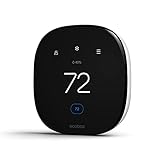

Quick comparison of the best dual fuel thermostats
| Pick | Best for | Key specs | Price range |
|---|---|---|---|
| Ecobee Smart Thermostat Premium | Best overall | Heat pump + furnace support, SmartSensor included, built-in air quality sensor, Wi-Fi, HomeKit/Alexa/Google | Mid-range to premium |
| Nest Learning Thermostat (4th gen) | Best hands-off scheduling | Dual fuel and heat pump support, learning schedule, Wi-Fi, Matter, optional remote sensors | Premium |
| Honeywell Home T9 | Best for multi-room temperature balancing | Smart room sensors, up to 3 heat / 2 cool stages with heat pump options, Wi-Fi | Mid-range |
| Emerson Sensi Touch 2 | Best value touchscreen | Dual fuel configuration, C-wire adapter support, Wi-Fi, color touchscreen | Budget to mid-range |
| Honeywell Home T6 Pro (heat pump/dual fuel model) | Best simple programmable option | Up to 2 heat / 1 cool for heat pumps, 7-day programming, installer setup menu | Budget |
Check each model’s current spec sheet before buying. Manufacturers sell variants (Wi-Fi versus non-Wi-Fi, different stage counts), and the dual fuel option is sometimes only listed in the installation guide.
Best overall: Ecobee Smart Thermostat Premium
This is the easiest model to tune for a dual fuel system. Per the manufacturer’s documentation, the installer menu lets you set a compressor minimum outdoor temperature and an auxiliary heat maximum outdoor temperature. Together these define when the heat pump hands off to the furnace. The included remote sensor also helps in homes where the thermostat hallway runs warmer or cooler than the bedrooms. This matters because longer, steadier heat pump cycles are more efficient than short bursts.
Trade-off: It is among the pricier options, and its extra features (air quality monitoring, voice control) do nothing for the switchover logic itself.
Best for hands-off scheduling: Nest Learning Thermostat (4th gen)
Google lists support for heat pumps with dual fuel backup. It can learn your schedule and uses a temperature-balance preference in setup, so it suits people who never want to touch a schedule. Its wiring guidance is clear, and the thermostat reads outdoor conditions from local weather data rather than a wired outdoor sensor.
Trade-off: You get less granular control over exact lockout temperatures than with the Ecobee. If you want to set a specific numeric switchover point, check that the equipment settings expose it for your wiring.
Best for multi-room balance: Honeywell Home T9
The T9 pairs with wireless room sensors and prioritizes the rooms you occupy. That helps when a heat pump’s slower, lower-temperature output makes uneven rooms more noticeable than a furnace blast would. It supports multi-stage and heat pump configurations, including aux or fossil fuel setups.
Trade-off: Sensors are often sold separately and the app is less polished than competitors. Verify your exact variant supports dual fuel before buying.
Best value: Emerson Sensi Touch 2
The Sensi Touch 2 offers a clear touchscreen and includes a dual fuel option in its installer configuration. It also supports a power adapter for homes without a common wire. It is a good fit when you want proper heat pump plus furnace logic without paying for sensors and air quality hardware.
Trade-off: There are fewer fine-tuning options, and no included remote sensor ecosystem comparable to Ecobee’s.
Best simple programmable: Honeywell Home T6 Pro
If you only want a reliable programmable schedule, a T6 Pro heat pump model handles basic configurations. Installers know the setup menu well, which can lower labor time. Confirm the exact model number supports fossil fuel backup (not only electric aux), as the base T6 Pro lines differ in staging.
Trade-off: Limited remote features and no sensor-based comfort balancing.
Check your wiring first
A dual fuel install needs terminals for both systems. Typical connections are:
- R and C: power. If there is no C wire, you need a power adapter kit or a spare wire pair.
- Y1 (and Y2): heat pump compressor stage(s).
- O/B: reversing valve. Most brands use O (energize in cooling); some use B. The thermostat setting must match.
- W1 (and W2): the furnace (or aux) heat call. In dual fuel, this goes to the furnace.
- G: blower fan.
If your thermostat cable has only four conductors (R, Y, W, G), you may not have O/B or C available. Many cases can be solved with a wiring adapter, but you may need a pro to confirm the furnace control board allows it. Also check that the furnace is not a 24V-incompatible or proprietary communicating system, since those usually need the brand’s own control.
Worked example: where your switchover temperature should sit
The switchover (balance) point is where running the furnace becomes cheaper than running the heat pump. The breakeven heat pump COP is:
Breakeven COP = (29.3 kWh per therm × furnace AFUE) ÷ price ratio, where the price ratio is how many kWh of electricity cost the same as one therm of gas.
Example: a 96% AFUE furnace delivers 29.3 × 0.96 ≈ 28.1 kWh of heat per therm. If one therm costs as much as 8 kWh of electricity, breakeven COP = 28.1 ÷ 8 ≈ 3.5. Heat pumps often deliver a COP near 3 at mild temperatures and lower near freezing (per typical manufacturer performance data), so in this case the furnace would win almost all the time. If a therm costs as much as 12 kWh, breakeven COP ≈ 2.3, and the heat pump wins until it drops below that point in colder weather.
| Therm cost equals this many kWh of electricity | Breakeven COP (96% AFUE) | Suggested compressor lockout approach |
|---|---|---|
| 6 kWh (cheap gas isn’t present; power is relatively costly) | 4.7 | Heat pump rarely wins; set lockout high, roughly 40–45°F |
| 8 kWh | 3.5 | Lockout roughly 35–40°F |
| 10 kWh | 2.8 | Lockout roughly 30–35°F |
| 12 kWh | 2.3 | Lockout roughly 25–30°F |
| 16 kWh (cheap power relative to gas) | 1.8 | Lockout roughly 15–25°F, or at the unit’s rated minimum |
These temperature bands are illustrative. Real COP curves vary by model, so look at your outdoor unit’s capacity table, and use your utility’s actual rates. Cold-climate heat pumps hold higher COP at low temperatures, so they can justify a lower lockout. Never set the lockout below the outdoor unit’s rated operating limit.
Which thermostat fits your situation
| Your situation | Best choice | Why |
|---|---|---|
| Want to set exact lockout temperatures and use sensors | Ecobee Smart Thermostat Premium | Numeric installer settings plus remote sensor |
| Don’t want to program anything | Nest Learning Thermostat (4th gen) | Learns schedule automatically |
| Uneven rooms or a large home | Honeywell Home T9 | Room sensors prioritize occupied rooms |
| Tight budget, no sensors needed | Emerson Sensi Touch 2 or T6 Pro | Proper dual fuel logic without extras |
| No C wire | Sensi Touch 2, Ecobee (with its power extender kit), or a C-wire adapter | Powering without a rewire |
| Proprietary or communicating HVAC | The manufacturer’s own control | Third-party thermostats may not work |
Settings that matter after installation
- Select the correct equipment type: “Heat pump with furnace/fossil fuel backup,” not “heat pump with electric aux.” The wrong choice can run both heat sources at once.
- Set O/B polarity: match your reversing valve. If heating blows cold air (or the reverse), this is usually the cause.
- Set the compressor lockout: use the table above and the outdoor unit’s rated minimum.
- Avoid aggressive setbacks: large temperature recoveries tend to trigger the furnace, because a heat pump takes longer to recover. Keep setbacks small, around 2–3°F.
- Enable compressor protection: keep the default anti-short-cycle delay (often about 5 minutes) to protect the compressor.
How to choose
- Confirm the feature in writing. Look for “dual fuel,” “fossil fuel kit,” or “heat pump with gas furnace” in the manual.
- Count your wires. You need at least R, Y, W, G and O/B, plus ideally C.
- Prefer numeric control. The ability to set a specific outdoor temperature threshold beats a vague “balance” slider if you know your rates.
- Consider outdoor temperature source. Some units use local weather data, while others can use a wired outdoor sensor from the equipment manufacturer.
- Budget for installation. A professional visit is worthwhile if your furnace control board or outdoor unit is unusual.
Frequently Asked Questions
What is a dual fuel thermostat?
It is a thermostat that controls a heat pump and a fuel-burning furnace as one system. It runs the heat pump in mild weather and switches to the furnace when it gets cold or when gas is cheaper per unit of heat. A standard heat pump thermostat controls electric backup heat instead.
Can I use a regular heat pump thermostat with a dual fuel system?
Only if it explicitly supports fossil fuel or dual fuel backup. A thermostat that treats the second stage as electric strip heat may run the compressor and furnace simultaneously, which can be inefficient and potentially harmful to equipment.
What outdoor temperature should my system switch to the furnace?
It depends on your electricity and gas prices and your heat pump’s efficiency curve. In many homes the range is roughly 25–40°F. Use the breakeven COP calculation above and your outdoor unit’s rated capacity data, or ask an installer to set it.
Do I need a C wire for a dual fuel thermostat?
Most smart thermostats need continuous 24V power. If you lack a C wire, you can often use a power adapter kit or repurpose an unused wire in the cable. If neither works, a professional can check the furnace board.
Will a smart thermostat save money on a dual fuel system?
It can, mainly by selecting the cheaper heat source and avoiding unnecessary furnace runtime. Savings depend on your local rates and climate, so treat any manufacturer savings claim as a typical estimate rather than a guarantee.
Is Ecobee or Nest better for dual fuel?
Ecobee generally gives more direct control over switchover settings and includes a sensor, while Nest focuses on automation. If you want to dial in exact thresholds, Ecobee is usually the better fit. If you prefer automation, Nest is simpler.
Related guides
More from Amazon
Programs that pair well with the guide above. Offers and eligibility are set by Amazon and may change.
A free business account with business pricing and bulk-buying tools for work, shop or home office.
Create a business accountFree shipping on eligible items, Prime Video and more. Eligible new members can start with a free trial.
Start a Prime free trialAudiobooks and podcasts to listen to on the go. Eligible new members can start with a free trial.
Try Audible freeAd-free music streaming. Eligible new subscribers can start with a free trial.
Try Music Unlimited freeAs an Amazon Associate we earn from qualifying purchases.