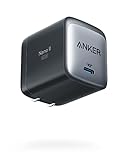
The best UK charger for most people is a compact GaN wall charger with two USB-C ports and a total output of around 65W, such as the Anker 735 Charger (GaNPrime 65W). It runs a phone at full speed and a laptop or handheld PC at a useful rate. If you charge three or four devices from one socket, step up to a 100W four-port unit. Match the wattage to your biggest device first, then to how many things you plug in at once.
As an Amazon Associate we earn from qualifying purchases at no extra cost to you.


Top 3 picks at a glance
Quick comparison of the best chargers for UK buyers
| Pick | Best for | Key specs (per manufacturer) | Price range |
|---|---|---|---|
| Anker 735 Charger (GaNPrime 65W) | Best overall: phone + laptop | 65W max, 2x USB-C + 1x USB-A, GaN, USB PD | Mid-range |
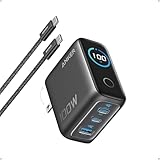
| UGREEN Nexode 100W 4-port | Desk and multi-device setups | 100W total, 3x USB-C + 1x USB-A, GaN, USB PD | Mid-range |
| Apple 140W USB-C Power Adapter | 16-inch MacBook Pro and other 140W laptops | 140W, single USB-C, USB PD 3.1 (28V/5A) | Premium |
| Samsung 45W Super Fast Charging Wall Charger | Galaxy phones and tablets | 45W, single USB-C, PPS support | Budget to mid-range |
| Generic 20-30W GaN USB-C (spec class) | Phone-only, travel, bedside | 20-30W, one USB-C, PD + PPS | Budget |
| 45W single-port USB-C PD (spec class) | Handheld gaming PCs, small laptops | 45W at 15-20V, USB PD | Budget to mid-range |
Best overall: Anker 735 Charger (GaNPrime 65W)
This is the sensible default for a household with one laptop and a couple of phones. A 65W USB-C Power Delivery output covers most ultrabooks, the Nintendo Switch family, and phones that use USB PD. The USB-A port handles earbuds, a controller or an older power bank.
Trade-off: the 65W is a shared budget. Per Anker’s spec sheet, the output drops when several ports are used, so a laptop on one port will slow down if you add a phone on another. It also won’t run a 16-inch performance laptop at full tilt.
Best for a desk or bedside hub: UGREEN Nexode 100W 4-port
A four-port 100W charger replaces a cluster of single adapters. It suits a desk with a laptop, phone, tablet and headset charging at once. When all four ports are occupied, the power is split between them, but you still get a sensible rate on each.
Trade-off: it is larger than a 65W unit, and a laptop that needs more than 65W will only get the full 100W when the other ports are empty or drawing little.
Best for high-power laptops: Apple 140W USB-C Power Adapter
If your laptop ships with a 140W charger, the Apple 140W adapter is a safe pick because it supports USB PD 3.1 at 28V and 5A. It is not limited to Apple hardware; any USB-C laptop that negotiates up to 140W can use it. Use a cable rated for 5A, because a basic 3A cable will cap the charge at 60W.
Trade-off: it has one port and costs more than any other pick here. Many gaming laptops with a barrel-style charger do not use USB-C for full power at all, so check before buying.
Best for Samsung Galaxy phones: Samsung 45W Super Fast Charging Wall Charger
Samsung phones use PPS (Programmable Power Supply), a USB PD extension that adjusts voltage in small steps. Samsung’s own 45W charger supports it, which is how the compatible flagship models reach their top charging speeds. Many Galaxy models are limited to 25W, so on those the 45W charger gives no speed gain over a 25W one.
Trade-off: one port only, and the extra watts are wasted on phones that cap at 25W.
Best budget: a 20-30W GaN USB-C charger
For a single phone, a small 20-30W USB-C charger with PD and PPS is enough. Pick a known brand and look for GaN to keep it compact. Skip the 5W “cube” that came with old phones; it is far slower.
Trade-off: it will charge a laptop only very slowly, or not at all while the laptop is in use.
Best for handheld gaming PCs: a 45W USB-C PD charger
Handhelds like the Steam Deck and many Windows handhelds ship with chargers in the 45W range. A 45W PD charger is the minimum for playing while charging. A 65W charger works equally well and doubles as a laptop charger.
How to choose: a worked power budget
Add up the maximum draw of everything that will charge at once, then add about 10-15% headroom. Here is an example desk setup:
| Device | Typical max draw |
|---|---|
| Ultrabook (PD) | 65W |
| Phone (fast charge) | 25W |
| Wireless earbuds case | 5W |
| Controller | 10W |
| Total | 105W |
With 10% headroom, that is around 115W. A 100W charger will manage this fine, because devices seldom all draw their maximum at once, but a 65W unit would clearly be too small.
Charge time estimate
A rough formula is: battery watt-hours ÷ (charger watts × 0.8) = hours to charge. Take a 5,000 mAh phone battery at about 3.85V, which is roughly 19Wh. On a 25W charger that is 19 ÷ (25 × 0.8) ≈ 0.95 hours, though real charging tapers near full, so expect a little over an hour. A 50Wh handheld on a 45W charger while idle needs 50 ÷ (45 × 0.8) ≈ 1.4 hours. If you are gaming and the handheld draws 30W, only about 15W is left for the battery, so charging is much slower.
Which charger for which situation
| Your situation | Minimum charger | Better choice |
|---|---|---|
| One phone, bedside | 20W USB-C PD | 30W GaN |
| Samsung flagship phone | 25W PPS | 45W PPS if the phone supports it |
| Handheld gaming PC | 45W PD | 65W PD |
| Ultrabook + phone | 65W, two ports | 100W, three or four ports |
| 16-inch laptop over USB-C | 100W | 140W PD 3.1 |
| Travel, several devices | 65W, two ports | 100W with a UK plug and a short cable |
UK safety and compatibility checks
- Plug and fuse: UK chargers use the BS 1363 three-pin plug. A sound charger has a fuse inside the plug, usually 3A, which is plenty for even a 140W unit at 230V (about 0.6A).
- Markings: look for UKCA or CE marking and a readable manufacturer name. Unbranded chargers with no markings, or with implausible wattage for their size, are a risk. Counterfeit chargers can lack proper insulation, so buy from the brand’s own store or an authorised seller.
- Standards: look for USB PD, and PPS if you have a Samsung or Google phone. Plain “fast charge” labels can mean a proprietary protocol that does not work with your device.
- Cables: a charger is only as fast as its cable. Up to 60W works on any USB-C charging cable; 100W to 240W needs an e-marked cable rated for 5A.
- Folding pins: a folding UK plug helps with portability, but check that it locks firmly.
Frequently Asked Questions
How many watts do I need for a phone and a laptop together?
Add the two draws. A 65W laptop and a 25W phone need about 90W if both charge at full speed, so a 100W multi-port charger is the safe choice. A 65W charger still works, but the laptop and phone will charge more slowly when both are plugged in.
Will a higher-wattage charger damage my phone?
No. USB PD and PPS devices negotiate their own power, so the phone only draws what it can handle. A 100W charger will give a 25W phone 25W and no more.
Is GaN better than a regular charger?
GaN (gallium nitride) chargers run cooler and are smaller for the same wattage because they waste less energy as heat. Charging speed is set by the wattage and protocol, not by GaN itself. For the same output, GaN is mainly a size and heat advantage.
Can I use a laptop USB-C charger for my gaming handheld?
Usually yes, if it supports USB PD and delivers at least the handheld’s rated wattage, often 45W. Handhelds negotiate power over USB PD, so a 65W laptop charger works. Always use a cable that suits the wattage.
Why is my fast charger charging slowly?
The most common causes are a low-spec cable, a shared-power port that is splitting its output, or a protocol mismatch such as a missing PPS. Try a different cable, move other devices to another charger, and check the port labels. Heat can also reduce speed once the battery is warm or nearly full.
Do I need a UK-specific charger?
You need a charger with a BS 1363 plug, or a good adapter. Most modern chargers accept 100-240V, so UK chargers work abroad with a plug adapter, and foreign chargers work here only with a safe, properly fused adapter. A native UK plug is the simplest and safest option.
Related guides
More from Amazon
Programs that pair well with the guide above. Offers and eligibility are set by Amazon and may change.
A free business account with business pricing and bulk-buying tools for work, shop or home office.
Create a business accountFree shipping on eligible items, Prime Video and more. Eligible new members can start with a free trial.
Start a Prime free trialAudiobooks and podcasts to listen to on the go. Eligible new members can start with a free trial.
Try Audible freeAd-free music streaming. Eligible new subscribers can start with a free trial.
Try Music Unlimited freeAs an Amazon Associate we earn from qualifying purchases.