Our Short List of 3
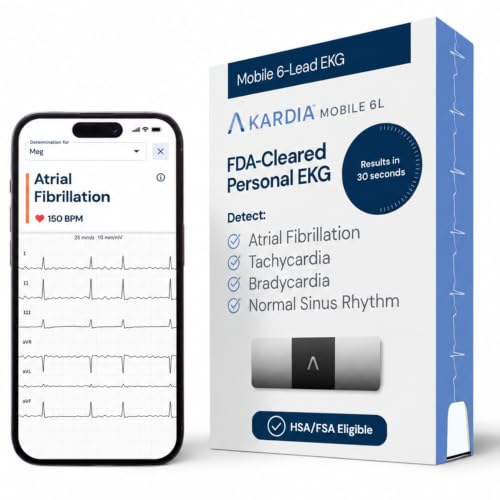
- six-lead ECG, 30-second recordings, Bluetooth connection to iOS and Android, replaceable CR2016 coin cell, unlimited recordings in the app, no subscription required for basic recording and detection.
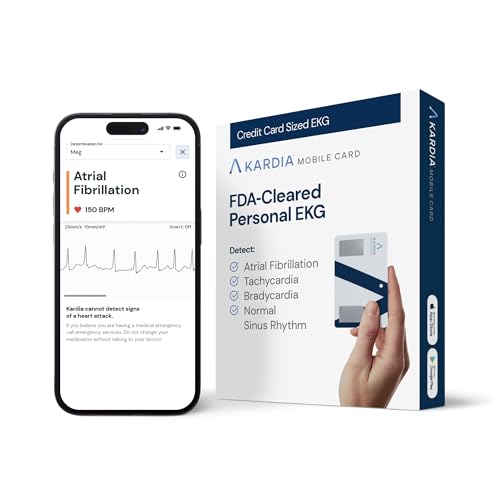
- single-lead ECG, credit-card size, Bluetooth connection to iOS and Android, rechargeable lithium battery with a long standby life, no subscription required for basic recording and detection.

- single-lead ECG, 30-second recordings, Bluetooth connection to iOS and Android, CR2016 coin cell, unlimited recordings in the app, HSA and FSA eligible.
All 4 Picks at a Glance
| Product | Specs | Action |
|---|---|---|
| 1. AliveCor KardiaMobile 6L — Best Overall AFib Monitor |
| Check price on Amazon |
| 2. AliveCor KardiaMobile Card — Best Wallet-Sized AFib Monitor |
| Check price on Amazon |
| 3. AliveCor KardiaMobile 1-Lead — Best Simple AFib Monitor |
| Check price on Amazon |
 5. EMAY 6L Portable ECG Monitor — Best Six-Lead Monitor With a Screen |
| Check price on Amazon |
The best AFib monitors are personal ECG devices that record your heart rhythm at home and flag possible irregular rhythms, including atrial fibrillation, so you have a trace to share with a clinician. Unlike a fitness tracker that only estimates heart rate from your wrist, these devices record an actual electrocardiogram, which is the waveform a clinician looks at when checking rhythm. That difference matters when the question is not how fast your heart is beating, but whether the rhythm itself is regular.
This guide covers five ECG monitors sold on Amazon US, from six-lead handheld recorders to a device the size of a credit card. Every pick below is a dedicated ECG monitor, not a smartwatch and not a chest strap, and each one is designed to record a rhythm trace in about 30 seconds and send it to a phone app. Before you buy, understand what these devices can and cannot do: they record rhythm data and can flag a possible irregular rhythm, but they do not diagnose a condition, they do not detect a heart attack, and they do not replace regular medical care. If you have symptoms such as chest pain, shortness of breath, fainting, or a racing heart that will not settle, seek medical care promptly rather than waiting to record a trace.
Our Top Picks
Top 3 picks at a glance
How to Choose
1. Number of leads
A single-lead device records one view of the heart, which is enough for the basic rhythm check these products are designed around: normal rhythm, possible AFib, slow heart rate, or fast heart rate. A six-lead device records six views, giving a clinician more angles on the same 30-second window. Six leads are useful if your clinician has asked for more detailed traces, or if you want richer recordings to share at appointments. For a simple at-home rhythm check, one lead is the standard starting point, and the extra leads are a bonus rather than a necessity.
2. FDA clearance
Look for devices described by the manufacturer as FDA-cleared for personal ECG recording and rhythm detection. Clearance means the device went through a regulatory process for its stated purpose, which is a meaningful quality signal in a category where unregulated gadgets also exist. All five picks in this guide are described by their makers as FDA-cleared personal ECG devices. Treat any monitor that makes bold health claims without clearance with caution.
3. What the device flags
Different devices flag different rhythm patterns. The most common set is normal sinus rhythm, possible AFib, bradycardia (a slow heart rate), and tachycardia (a fast heart rate). Some devices, with an optional membership, flag additional patterns such as premature beats. Check the flagged-pattern list before you buy, and remember that a flag is a prompt to contact a clinician, not a diagnosis on its own. A device that reports “possible AFib” is telling you the trace looked irregular, and a clinician should look at it.
4. Standalone screen versus phone-only
Some monitors have their own screen and work without a phone nearby, storing readings on the device itself. Others are phone-dependent: the device is a sensor, and the phone app shows the trace and stores the history. A standalone screen is handy if you want a quick check without opening an app, or if the person using the device is not comfortable with a smartphone. A phone-only device is usually smaller and lighter, and the app makes it easy to email a trace to a clinician.
5. Subscription and sharing
Most of these devices record and store basic ECGs with no ongoing membership. Optional memberships add features such as extra rhythm detection, cloud storage, or clinician consultation services. Decide whether you want those extras before you buy, because the headline device and the full-feature experience can differ. Also check how recordings are shared: emailing a PDF trace to your clinician is the most useful sharing path, and every pick below supports sharing from its companion app.
6. Battery and portability
Home ECG monitors are small by design, but battery styles differ. Some use a coin cell that lasts a year or two of occasional use, some use a rechargeable lithium battery, and some use a replaceable coin cell rated for a couple of hundred hours of recording. If the device will live in a wallet, a bag, or a bedside drawer, size and weight matter more than battery style. If it will be used several times a day, a rechargeable or long-life coin cell is the more convenient option.
7. Compatibility and ease of use
Check that the companion app works with your phone, and that the recording method suits the person using it. Most devices record with two fingers on metal electrodes, and six-lead models add a third contact point on the knee or ankle. If the user has a pacemaker or an implanted defibrillator, note that these devices are generally not recommended for use with those implants, and a clinician should be consulted first. Simplicity matters here more than in most gadget categories: a rhythm check should take seconds, with no cables, gels, or setup.
Top Picks
1. AliveCor KardiaMobile 6L — Best Overall AFib Monitor
- six-lead ECG, 30-second recordings, Bluetooth connection to iOS and Android, replaceable CR2016 coin cell, unlimited recordings in the app, no subscription required for basic recording and detection.
AliveCor KardiaMobile 6L on Amazon
The KardiaMobile 6L is the most capable dedicated AFib monitor in this roundup, and the one to choose if you want the most complete at-home rhythm picture. It is a six-lead personal ECG monitor, which means it records six views of the heart in a single 30-second session: leads I, II, III, aVR, aVL, and aVF. It connects to a smartphone or tablet over Bluetooth, and the companion app displays the trace and stores an unlimited history of recordings.
What sets the 6L apart is the amount of information in each recording. A single-lead device gives a clinician one angle; the 6L gives six, which can be more useful when a trace is shared ahead of an appointment. The device detects normal sinus rhythm, possible AFib, bradycardia, and tachycardia, with additional rhythm patterns available through an optional membership. It is FDA-cleared, HSA and FSA eligible, and pocket-sized, so it fits in a bag or a bedside drawer without taking up real space.
Who it is for: anyone who wants the most detailed at-home ECG available in a handheld device, and anyone whose clinician has asked for six-lead traces.
Caveats: it needs a phone or tablet nearby to view and store recordings, since the device itself has no screen. It is not recommended for use with pacemakers or implanted defibrillators, and it does not check for heart attack.
2. AliveCor KardiaMobile Card — Best Wallet-Sized AFib Monitor
- single-lead ECG, credit-card size, Bluetooth connection to iOS and Android, rechargeable lithium battery with a long standby life, no subscription required for basic recording and detection.
AliveCor KardiaMobile Card on Amazon
The KardiaMobile Card is a single-lead ECG monitor built into a device the size of a credit card, designed to live in a wallet so it is always on hand. It records a medical-grade single-lead EKG in about 30 seconds, connects to a phone over Bluetooth, and detects normal sinus rhythm, possible AFib, bradycardia, and tachycardia. For rhythm checks away from home, the card form factor is the most practical in this guide.
The Card is the most advanced single-lead device in the Kardia range, and its thin, light build is the whole point: at a few grams, it adds nothing noticeable to a wallet. The trade-off against the 6L is the single lead, so each recording carries one view of the heart rather than six, but one lead is the standard approach for catching an irregular rhythm when it happens.
Who it is for: people who want an AFib monitor they can carry everywhere without thinking about it, and anyone who travels or spends long days away from home.
Caveats: single-lead only, so recordings carry less detail than a six-lead device. It has no screen of its own, so a phone is needed to view results. Not recommended for use with pacemakers or implanted defibrillators.
3. AliveCor KardiaMobile 1-Lead — Best Simple AFib Monitor
- single-lead ECG, 30-second recordings, Bluetooth connection to iOS and Android, CR2016 coin cell, unlimited recordings in the app, HSA and FSA eligible.
AliveCor KardiaMobile 1-Lead on Amazon
The original KardiaMobile is a compact single-lead ECG monitor that does the essential job with the least fuss. Place two fingers on the electrodes, wait about 30 seconds, and the app shows the trace and a rhythm result: normal sinus rhythm, possible AFib, bradycardia, or tachycardia. It is FDA-cleared, pocket-sized, and works with most smartphones and tablets, with no subscription required for basic recording.
This is the pick for someone who wants a straightforward rhythm checker without extra features to learn. It has been on the market for years, which means the companion app and the sharing workflow are mature, and recordings can be emailed to a clinician in a few taps. The coin-cell battery lasts a long time under occasional use, and the device itself is small enough to keep on a nightstand or in a drawer by the bed.
Who it is for: first-time buyers, older users who want the simplest possible device, and anyone who wants a proven single-lead monitor at the entry point of the range.
Caveats: single-lead only, and no screen on the device itself. It is not recommended for use with pacemakers or implanted defibrillators, and it does not check for heart attack.
4. EMAY Portable ECG Monitor — Best Standalone AFib Monitor
EMAY Portable ECG Monitor on Amazon
The EMAY Portable ECG Monitor is the pick for anyone who wants a rhythm check without reaching for a phone. Unlike the Kardia devices, it has its own LCD screen, so it records an ECG and heart rate and shows the result on the device itself, with storage on board for past readings. It works as a stand-alone device with no subscription required, and it can also pair with a smartphone app for viewing traces on a larger screen and sharing reports.
The standalone design suits a household where the phone is not always nearby, or a user who prefers a device with buttons and a screen over an app-driven workflow. It records in about 30 seconds using thumb electrodes, with several recording positions described by the maker, and it stores readings for later playback on its own display. Reports can be saved to a phone and shared with a clinician when the app is used.
Specs
- standalone ECG monitor with LCD screen, on-device storage for readings, 30-second recordings, optional smartphone app for iOS and Android, rechargeable battery, no subscription required.
Who it is for: people who want to check their rhythm without a phone, and households where a screen on the device itself is easier than an app.
Caveats: a smaller brand than AliveCor, with a smaller support and app ecosystem. The rhythm-detection feature set is more basic than the Kardia range, so check that it flags the patterns you care about before buying.
5. EMAY 6L Portable ECG Monitor — Best Six-Lead Monitor With a Screen
- six-lead ECG, standalone screen with instant results, storage for up to 100 readings, optional smartphone app and PC software, no subscription required.
EMAY 6L Portable ECG Monitor on Amazon
The EMAY 6L combines the two features that otherwise sit in separate picks: six-lead recording and a standalone screen. It records ECG and heart rate in six channels, displays results on its own screen in about 30 seconds, stores up to 100 readings on the device, and pairs with a smartphone app and PC software for larger viewing and report sharing. No subscription is required for recording or storage.
This is the most feature-complete option in the EMAY range, and the natural alternative to the KardiaMobile 6L for buyers who want the device itself to show the result. The six-lead recording gives a clinician more views of the heart per session, and the on-device storage means readings are kept even when the phone is not connected. The ability to save and share reports from the app makes it practical for bringing traces to appointments.
Who it is for: buyers who want six-lead detail and a screen on the device, and anyone who prefers to keep readings stored on the monitor itself.
Caveats: as with the other EMAY pick, the app and support ecosystem is smaller than the Kardia one. Confirm app compatibility with your phone before buying, and remember that no home ECG monitor replaces a clinician’s assessment.
Comparison Table
| Monitor | Leads | Screen on device | Rhythm patterns flagged | Subscription needed | Best for |
|---|---|---|---|---|---|
| AliveCor KardiaMobile 6L | Six | No | Normal, possible AFib, slow, fast | No, basic use | Most detailed at-home ECG |
| AliveCor KardiaMobile Card | One | No | Normal, possible AFib, slow, fast | No, basic use | Carrying everywhere |
| AliveCor KardiaMobile 1-Lead | One | No | Normal, possible AFib, slow, fast | No, basic use | Simple first monitor |
| EMAY Portable ECG Monitor | One | Yes | Rhythm and heart rate | No | Phone-free checks |
| EMAY 6L Portable ECG Monitor | Six | Yes | Rhythm and heart rate, six channels | No | Six leads with a screen |
Which One Is Right for You?
Choose the KardiaMobile 6L if you want the most complete recording and your clinician values six-lead traces, or if you simply want the most capable device in the category. It is the strongest all-rounder here, with the only real drawback being the need for a phone to view results.
Choose the KardiaMobile Card if portability matters most. A monitor that lives in your wallet is the one you will actually have with you when an irregular rhythm shows up, and for AFib monitoring, being present at the right moment is half the job.
Choose the KardiaMobile 1-Lead if you want the simplest, most proven option. It does the core job, a 30-second rhythm check, with no extra features to manage, and it is the easiest of the Kardia devices to hand to someone who is not comfortable with gadgets.
Choose the EMAY Portable ECG Monitor if you want a screen on the device and a phone-free workflow. It suits a bedside table or a living room, where a quick check should not require opening an app.
Choose the EMAY 6L if you want both six-lead recording and a screen. It is the only pick here that offers both, and the on-device storage keeps readings available even when the phone is elsewhere.
Whatever you choose, set expectations correctly. A home ECG monitor is a recording tool, not a doctor. Share unusual traces with your clinician, keep a note of when symptoms happen, and do not change medication or treatment based on a device result alone. If you have a pacemaker or an implanted defibrillator, ask your clinician before using any personal ECG device.
Frequently Asked Questions
Can a home monitor diagnose AFib?
No. A home ECG monitor records a rhythm trace and can flag a possible irregular rhythm, but only a clinician can diagnose AFib, usually after looking at the trace and considering your history and other findings. Treat a “possible AFib” result as a reason to contact your clinician, not as a diagnosis, and treat a normal result as reassuring rather than conclusive, since AFib can come and go.
Do I need a subscription to use these monitors?
No, for basic recording. All five picks record ECGs and store a history without an ongoing membership. Optional memberships add extras such as additional rhythm detection, cloud features, or clinician consultation services, but the core rhythm check works without them. Check the membership details for the specific device before buying, since the extras differ between brands.
How is a six-lead monitor different from a single-lead one?
A single-lead monitor records one view of the heart, which is enough for the basic rhythm check. A six-lead monitor records six views in the same 30-second session, giving a clinician more angles on the rhythm. Six leads do not make the AFib flag itself more certain, but the extra views can be more useful when a trace is shared with a clinician for a fuller look.
Can I share my recordings with my doctor?
Yes. Every pick in this guide pairs with an app that can share recordings, usually by emailing a trace or saving a report to your phone. Bring the trace to your appointment, or send it ahead if your clinician’s office accepts that. Note the date, time, and any symptoms you felt during the recording, since that context helps a clinician interpret the trace.
Disclosure: As an Amazon Associate, we may earn from qualifying purchases.
Related guides
More from Amazon
Programs that pair well with the guide above. Offers and eligibility are set by Amazon and may change.
A free business account with business pricing and bulk-buying tools for work, shop or home office.
Create a business accountFree shipping on eligible items, Prime Video and more. Eligible new members can start with a free trial.
Start a Prime free trialAudiobooks and podcasts to listen to on the go. Eligible new members can start with a free trial.
Try Audible freeAd-free music streaming. Eligible new subscribers can start with a free trial.
Try Music Unlimited freeAs an Amazon Associate we earn from qualifying purchases.