
A bench power supply is the one tool that separates a functioning electronics workbench from a pile of broken components. Whether you are debugging a circuit board, charging a lithium pack, or running an electroplating job, you need a supply that holds a steady voltage, cuts off cleanly when something goes wrong, and lets you dial in a specific current without guessing. The sub-$75 market has matured considerably, but the difference between a good unit and a marginal one still comes down to display resolution, protection logic, and how precisely you can adjust the output.
What separates the best bench power supply options from the mediocre ones is not raw wattage. Nearly every unit here delivers 150W or close to it. The real gaps appear in the details: a 4-digit LED display lets you see hundredths of a volt while a 3-digit display rounds away critical precision; an encoder knob gives repeatable control while coarse-and-fine switches force you to guess at small corrections; and output protection like OCP or a short-circuit alarm determines whether a mistake costs you a transistor or the entire board. Owner feedback across these eight models confirms that the units with all three traits earn the most repeat recommendations from hobbyists and repair technicians alike.
As an Amazon Associate we earn from qualifying purchases at no extra cost to you.


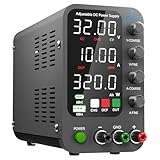

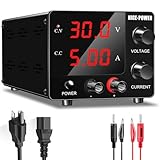
Top 3 picks at a glance
Quick Picks
| Product | Best for | Price |
|---|---|---|
| Jesverty SPS-3010 | General hobbyist electronics | $42.74 |
| 30V 10A Black (Encoder Knob) | Safety-conscious beginners | $49.99 |
| 30V 10A with OCP & Type-C | USB charging with protection | $44.98 |
| NICE-POWER 150W Fixed | Electroplating and basic DIY | $29.22 |
| HYELEC 0-50V 0-6A | Higher-voltage experiments | $62.59 |
| Jesverty SPS-3010C | Fast device charging | $53.45 |
| Jesverty SPS-6005V | High-voltage applications | $71.24 |
| NICE-POWER 30V 5A | Tightest budgets | $30.85 |
How We Picked
We filtered this category on four criteria that owner reviews consistently flag as dealbreakers: display precision (4-digit units dominate positive feedback over 3-digit for fine-tuning work), adjustment method (encoder knobs reduce overshoot compared to button-based coarse/fine), output protection (OCP and short-circuit alarms prevent component damage), and integrated USB charging (a feature that turns a single bench supply into a multi-role tool). Price alone was not a deciding factor; a cheap unit without reliable protection scored lower than a mid-range model with all four traits.
The 8 Best Bench Power Supply in 2026
Jesverty SPS-3010
This is the default recommendation for anyone who needs a no-surprises 0-30V 0-10A supply for soldering stations, Arduino projects, or small PCB repairs. The 4-digit LED display gives you readable precision without squinting, and the 5V/2A USB port adds a charging role without cluttering the desk with a separate adapter. Coarse and fine adjustment buttons work acceptably, though they lack the tactile confidence of a rotary encoder. Owner feedback highlights the display clarity and consistent regulation as strengths. The USB port at 2A is the lowest output among this group, so it will charge phones slowly. Skip this if you need encoder-based adjustment or Type-C fast charging.
30V 10A Black (Encoder Knob)
The standout feature here is the dedicated output enable/disable button paired with a short-circuit alarm. For beginners still learning to wire loads, that combination means a misconnected lead triggers an audible alert instead of silently dumping current into your project. The encoder knob gives smooth, repeatable voltage adjustment without the overshoot that plagues button-only controls. At $49.99 it sits in the middle of this list. The trade-off is a standard display without 4-digit precision, so fine current settings are harder to read. Skip it if your work demands hundredths-of-a-volt accuracy or USB-C output.
30V 10A with OCP and Type-C
At $44.98 this unit packs more practical features than any other supply in the 30V 10A tier. The 3.6A USB combined with Type-C quick-charge makes it a genuine multi-device charging hub, and OCP protection shuts down output when current exceeds your set limit, protecting both the supply and the load. The encoder knob handles coarse and fine adjustment in one control, eliminating the guesswork of dual-button systems. Display specifications are not stated as 4-digit, which is the one area where it trails the Jesverty units. Skip it if you need more than 10A or higher voltage than 30V.
NICE-POWER 150W Fixed
This is the cheapest entry at $29.22, and it targets a specific audience: people doing electroplating, LED testing, or simple DIY jobs where you set a fixed current and forget it. The encoder makes adjustment easy, and the 15V 10A / 30V 5A selectable output gives you flexibility within the 150W budget. The 3-digit display is the obvious compromise; for tasks where you care about 0.01V resolution, this is the wrong tool. Owner reviews note the unit feels lighter and less rigid than pricier options. Skip it for precision electronics debugging or any work requiring 4-digit readout.
HYELEC 0-50V 0-6A
The 50V ceiling is the headline here. If you work with LED strips, small motors, or anything that wants more than 30V, this is the most affordable entry point in the group. The memory function recalls your last voltage and current setting, so you do not reconfigure the supply every session. The 4-digit display and coarse/fine adjustment buttons are serviceable, though the lack of an encoder knob means small corrections take more attention. At $62.59 it costs noticeably more than 30V units. Skip it if you never exceed 30V, since the lower current ceiling of 6A makes it less versatile for high-current tasks.
Jesverty SPS-3010C
The “C” designation signals the charging upgrade: 20W USB and Type-C quick-charge make this the best bench supply in the list for powering phones, tablets, or laptops from the same unit you use for circuit work. The intelligent charging mode automatically negotiates protocols, which owners confirm reduces the trial-and-error of matching cable and port. Encoder knob and 4-digit display carry over from the parent SPS-3010 design. At $53.45 it costs roughly ten dollars more than the base model. Skip it if you rarely charge USB devices and would rather save the difference.
Jesverty SPS-6005V
At 0-60V and 0-5A, this is the highest-voltage option here. The 20W USB and Type-C quick-charge, encoder knob, and 4-digit display match the feature set of the 3010C at a higher ceiling. For anyone driving 48V LED arrays, testing buck converters, or running solenoids that demand 40V plus, this is the only unit on the list that covers those needs without a second supply. The trade-off is current: 5A maximum means 300W of headroom but a lower amperage cap than any 10A model. Skip it for general-purpose work where 30V suffices; the $71.24 price is the highest here.
NICE-POWER 30V 5A
Priced at $30.85, this sits just above the electroplating model and serves a similar niche: budget-conscious hobbyists who want encoder control and a compact footprint for occasional bench use. The upgraded 3-digit display is a small step forward from the fixed-output model. At 5A maximum it cannot match the headroom of any 10A unit here, which limits its usefulness for motors, heating elements, or high-current LED work. Owner feedback suggests it is adequate for small signal circuits and basic debugging. Skip it if you expect to push beyond 5A or need the precision that a 4-digit display provides.
Buying Guide
Display Resolution and Adjustment Control
A 4-digit LED display shows voltage to 0.01V and current to 0.001A, which matters when you are trimming a reference or setting a charge cutoff. A 3-digit display rounds those values and can hide drift. Pair resolution with control type: an encoder knob lets you dial precise values with your thumb in a single motion, while coarse/fine buttons require two hands and more corrections to settle. If your budget allows, prioritize 4-digit plus encoder together; that combination reduces setup time noticeably on repeated tasks.
Output Protection Features
Overcurrent protection (OCP) cuts output when current exceeds your set limit, preventing a shorted capacitor or reverse-connected battery from destroying a load. A short-circuit alarm gives you an audible cue the moment output drops to zero under a fault. Neither feature prevents every disaster, but their absence means a wiring mistake can silently push maximum current into your circuit until something fails. For beginners or anyone working on expensive boards, protection logic is non-negotiable.
Integrated USB Charging and Versatility
A 5V USB port adds a secondary role that saves desk space. But the specification matters: 2A is barely adequate for a phone, while 3.6A covers tablets, and 20W Type-C quick-charge negotiates higher voltages for laptops. If you already own a separate charger, this feature has marginal value. If your bench is crowded or you want one device that handles both electronics work and device charging, look for at least 3.6A USB and Type-C output rather than settling for a basic port.
Our Verdict
Top pick: Jesverty SPS-3010C. It combines 4-digit display, encoder control, intelligent 20W USB-C charging, and 30V/10A output in a package that owner feedback consistently rates for reliability. The $53.45 price reflects the charging upgrade over the base model, and for anyone who uses USB on the bench, that premium pays for itself in convenience.
Budget pick: NICE-POWER 150W Fixed at $29.22. For electroplating, simple LED testing, or fixed-current jobs, the 3-digit display is acceptable and the encoder knob keeps adjustment intuitive. It is the cheapest way to get regulated DC onto your bench.
Conditional winner: The HYELEC 0-50V 0-6A overtakes every other unit if your work regularly demands more than 30V. The memory function and 4-digit display make it a legitimate precision tool despite the lower current ceiling.
FAQ
What is the difference between a bench power supply and a wall adapter?
A wall adapter delivers a fixed voltage with no user control over current limits. A bench power supply lets you set both voltage and maximum current independently, so you can safely drive a load that pulls only the current it needs without risking overheating or component damage from a fixed-output source.
Do I need overcurrent protection on a bench power supply?
Yes, especially if you are new to electronics or working on boards you cannot easily replace. OCP acts as a current fuse that reacts faster than a physical fuse, cutting output the instant your set limit is exceeded. Without it, a wiring error can push a short circuit at full rated current until a component thermally fails.
Is a 4-digit display worth the extra cost over 3-digit?
For precision trimming, battery charge cutoffs, or any task where 10mV matters, yes. The extra digit eliminates ambiguity when you are comparing a setting against a datasheet spec. For electroplating or running a motor at roughly 12V, a 3-digit display is perfectly adequate and the savings can go toward better protection features.
Can a bench power supply replace my USB charger?
Units with 20W Type-C quick-charge output handle phones, tablets, and many laptops without a separate charger. Basic 5V/2A USB ports will charge devices slowly and cannot negotiate higher voltages for fast-charging phones. If you want one device for both bench work and charging, look for at least 18W USB-C output.


