
A power outage at the wrong moment costs more than the electricity bill. It can corrupt a database, kill an active PFC power supply, or take out a router mid-firmware update. An apc power supply battery backup exists to bridge those seconds between grid failure and graceful shutdown, and to smooth out the brownouts and surges that degrade components over months. The problem is that the market is flooded with units that undersell their real capability, and buyers routinely pick a model whose wattage rating falls short of their actual load.
What separates a worthwhile unit from a wasted purchase comes down to three things: honest wattage headroom above your connected gear, the waveform quality your equipment actually needs, and whether the automatic voltage regulation responds fast enough to hold output steady during a sag. Modern switching power supplies with active PFC can misbehave on simulated sine wave inverters, so that distinction is not a marketing gimmick but a functional requirement. The eight units below cover the realistic range from single-router protection to full workstation and NAS coverage, and they are ranked here on published specifications, current pricing, and what owners consistently report after months of use.
As an Amazon Associate we earn from qualifying purchases at no extra cost to you.
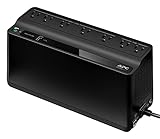


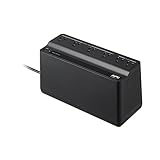


Top 3 picks at a glance
Quick Picks
| Product | Best for | Price |
|---|---|---|
| APC BE600M1 | PC and router pair | $83.99 |
| APC BX1500M | Workstation with AVR needs | $189.99 |
| APC BE650G1 | Desktop with moderate load | $109.99 |
| CyberPower CP1500PFCLCD | Active PFC power supplies | $239.95 |
| APC BE425M | Router and small electronics | $62.50 |
| APC BR1500MS2 | High-end workstation | $299.99 |
| APC BX1000M | Office electronics | $183.99 |
| APC BR1000MS | Computer with sensitive PSU | $191.43 |
How We Picked
We weighted four criteria: rated wattage with realistic headroom over typical loads, output waveform type (pure sine versus simulated) and its compatibility with active PFC supplies, AVR response quality for handling brownouts without draining battery, and owner-reported failure rates or battery lifespan complaints. Units that looked impressive on a spec sheet but generated consistent negative feedback on runtime or reliability were ranked lower regardless of their VA number.
The 8 Best Apc Power Supply in 2026
APC BE600M1
The BE600M1 fits a single PC, a monitor, and a router without straining its 330W rating. Owners praise its compact footprint and the straightforward PowerChute software for scheduling graceful shutdowns. The 600VA/330W spec is modest but honestly rated for this tier, and the simulated sine wave output handles most consumer-switching supplies without complaint. Its main limitation is runtime: with a mid-range desktop drawing 150-200W you are looking at roughly three to five minutes, which is enough for a shutdown but not for riding out a longer outage. Skip this if your GPU system idles above 200W or if you need to keep a NAS online during extended power events.
- Pros: compact and quiet, PowerChute shutdown reliability
- Con: limited runtime under heavy load
APC BX1500M
At 1500VA/900W with an LCD readout and full AVR, the BX1500M is the default recommendation for a workstation that cannot afford a mid-render crash. The LCD provides real-time load percentage and estimated runtime, which owners find more useful than the LED bars on cheaper units. AVR correction quality is consistent, and the ten-outlet layout means you can leave the display and peripherals on protected circuits. The simulated sine wave is the one point of friction: active PFC supplies may draw extra current or behave intermittently, and some owners report their PSUs clicking when the AVR engages. If your system uses a high-efficiency 80 Plus Platinum or Titanium supply, look at pure sine alternatives instead.
- Pros: excellent runtime at rated load, informative LCD, strong AVR
- Con: simulated sine wave can conflict with high-efficiency PSUs
APC BE650G1
The BE650G1 splits the difference between the BE600M1 and the BX series with a slightly higher 390W rating and a form factor that fits under most desks without blocking rear ports. It targets a desktop plus one monitor on a single outlet bank. Owners appreciate the USB connectivity for PowerChute Personal Edition, which is simpler to configure than the Business Suite on larger units. The trade-off is that it still uses a simulated sine wave, so the same active PFC caveats apply. Skip it if you need to protect more than two devices simultaneously or if your system draws more than 250W under load.
- Pros: good price-to-capacity ratio, simple USB-based management
- Con: simulated sine wave, narrow wattage ceiling
CyberPower CP1500PFCLCD
This is the unit to choose when compatibility with modern power supplies is non-negotiable. The CP1500PFCLCD delivers pure sine wave output at 1500VA/1000W, making it the only product on this list that guarantees clean power for active PFC supplies regardless of their efficiency rating. Twelve outlets with individually protected banks, a backlit LCD, and AVR all round out a package that owners describe as the most versatile in the sub-250-dollar UPS tier. The price is the highest here, and the chassis is noticeably larger than the APC BX1500M, which matters on a cramped desk. If budget is the primary constraint and your PSU tolerates simulated sine, the BX1500M offers more value.
- Pros: pure sine wave, twelve outlets, generous 1000W rating
- Con: highest price and bulkiest chassis in this group
APC BE425M
The BE425M is a network-equipment UPS, not a computer UPS. At 425VA/225W it will not support a gaming rig, but for a cable modem, router, and a small NAS it provides surprisingly long runtime because the load is so light. Owners report keeping internet connectivity alive for well over an hour during outages, which turns the unit into a home-office safety net. The trade-off is minimal headroom: add a monitor or a second device and you are near capacity. Skip it for any PC application.
- Pros: excellent runtime at low load, compact and quiet
- Con: too small for any computer beyond the lightest office box
APC BR1500MS2
The BR1500MS2 is the top-tier apc power supply in this roundup and the only APC model here with pure sine wave output at 1500VA/900W. For a workstation with a high-efficiency PSU, a NAS, and a secondary display, it delivers clean power through both grid operation and battery mode. Owner feedback consistently highlights the absence of the clicking or buzzing that simulated sine units produce when feeding active PFC loads. The 299.99 price is hard to justify for a basic office PC, and the physical size demands a dedicated floor space or a deep desk shelf. If your hardware tolerates simulated sine and you do not need network management cards, the BX1500M at roughly 110 dollars less is a rational alternative.
- Pros: pure sine wave, premium build, network management option
- Con: highest APC price and largest footprint
APC BX1000M
The BX1000M occupies the sweet spot for an office desktop with a monitor and a modest GPU. At 1000VA/600W it handles loads that would saturate the BE650G1 while costing less than the BX1500M. The LCD shows load percentage and battery health, and the AVR is well-regarded for smooth voltage correction without audible clicks on most consumer PSUs. Its simulated sine output remains the single reason a power user might look past it. Skip it if your system’s PSU generates whine on simulated sine, or if you need more than 600W of protected capacity.
- Pros: balanced wattage and price, clean AVR behavior
- Con: simulated sine wave limits PSU compatibility
APC BR1000MS
The BR1000MS is the pure sine wave answer for anyone who needs a smaller footprint than the BR1500MS2 but still requires clean output for a sensitive power supply. At 1000VA/600W it matches the BX1000M in wattage while delivering a waveform that eliminates the compatibility risk entirely. Owners with high-end NAS setups and small-form-factor workstations praise its quiet operation and the reliability of its pure sine inverter. The limitation is capacity: a system that idles at 300W and spikes above 500W will drain the battery faster than expected. If your load is light and your PSU is finicky, this is the most rational choice in the APC lineup for pure sine protection at a sub-200-dollar price.
- Pros: pure sine wave at a reasonable price, compact and quiet
- Con: 600W ceiling constrains headroom for demanding systems
Buying Guide
Matching Wattage to Your Real Load
Do not size a UPS by its VA number. Divide the wattage by the power factor (typically 0.6 for consumer units) to get the true continuous watt rating, then add twenty-five percent headroom. A system that draws 350W at full tilt needs at least a 500W-rated UPS. Overlooking this leads to overloaded alarms during normal operation and collapsed runtime the moment power drops.
Pure Sine versus Simulated Sine
Simulated (stepped) sine wave is cheaper to produce and works for basic electronics. Active PFC power supplies, however, can draw excess current, buzz, or reject the waveform during a transfer. If your system uses an 80 Plus Gold-rated PSU or newer, pure sine removes this risk entirely. The premium is typically fifty to one hundred dollars and is worth paying for any workstation or NAS that runs 24/7.
AVR Quality and Battery Swappability
Automatic voltage regulation corrects brownouts and overvoltage without switching to battery, which extends cell life and reduces the number of deep cycles per year. Check whether the unit allows user-replaceable batteries; most internal cells degrade within three to five years, and a model that locks you out of replacement forces a full hardware purchase sooner than necessary.
Our Verdict
The APC BX1500M is the best overall apc power supply in this group for most workstation owners: 900W of capacity, strong AVR, and a price that undercuts pure sine alternatives by a wide margin. The BE425M is the budget pick when the job is simply keeping your router and modem alive. If your system uses an active PFC supply that has shown sensitivity to simulated sine output, the CyberPower CP1500PFCLCD becomes the better buy despite its higher price, because waveform compatibility is not optional when the goal is zero downtime.
FAQ
Can I plug a laser printer into a UPS?
No. Laser printers draw a large inrush current during fusing that can instantly overload a UPS inverter or trip its breaker. Connect printers to a surge-only outlet if available, or to a wall receptacle outside the UPS.
How long do UPS batteries last?
Typical lead-acid cells in consumer UPS units last three to five years depending on cycle count and ambient temperature. Most units built within the last several years expose battery health through their management software or LCD, so you can plan a replacement before the cells fail silently during an outage.
Does a UPS waste energy when the grid is fine?
A line-interactive UPS with AVR draws very little idle power because the load runs directly from the wall through the transformer correction path. The battery charger does add a few watts of constant draw, but the annual cost is negligible compared to the hardware and data risk the unit mitigates.
Can I use an apc power supply with a generator?
Generally yes, but a small portable generator with poor voltage regulation can cause the UPS to cycle rapidly between battery and line, which wastes battery cycles. Run the generator without connected loads first, verify the output is stable, and only then bring the UPS online.


