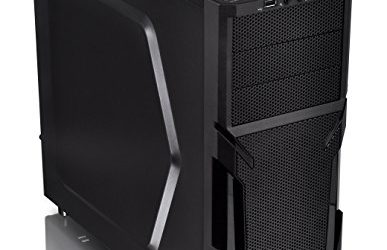
The best ruggedized PC case for most buyers is a thick-steel, filtered mid tower such as the Fractal Design Define 7 or Meshify 2, because they resist dents, keep dust out and survive being moved, while a true industrial rackmount chassis is the right answer only for workshops, vehicles and dusty production floors. Gaming-oriented cases are often thin steel with tempered glass, which looks good but handles knocks poorly, so durability is a deliberate buying decision, not a default.
A truly military-rated PC case is rare in the consumer market. When shoppers search for a ruggedized case, they usually mean one of four things: a sturdy steel build that tolerates LAN-party transport, strong dust filtering for a garage or workshop, a case that holds heavy components without flexing, or a sealed industrial enclosure. This guide covers each, and shows how to calculate dust protection and carry weight so you buy the right class.
Quick comparison of tough PC cases
| Pick | Best for | Key specs | Usual price range |
|---|---|---|---|
| Fractal Design Define 7 | Best overall tough tower | Steel panels, sound-damping, multiple dust filters, supports large GPUs and radiators | $170-$220 |
| Fractal Design Meshify 2 | Best sturdy airflow case | Steel frame, mesh front, removable filters, long GPU support | $160-$200 |
| Corsair 4000D Airflow | Best budget sturdy case | Steel body, mesh front, front and bottom filters, easy cable routing | $90-$120 |
| Compact steel cube or small-form-factor case with handle | Best for transport and LAN events | Mini-ITX or micro-ATX, carry handle or short footprint, 8-14 L | $100-$250 |
| 4U industrial rackmount chassis class | Best for workshops and harsh environments | Thick steel, front filters, rails, ATX support | $150-$400 |
Best overall: Fractal Design Define 7
The Define 7 is heavy and solid. It uses thick steel panels with sound-damping material, and its filtered intakes make it a good fit for rooms where dust is a constant problem. Its internal layout supports big graphics cards, tall air coolers and multiple drives, so you can build a serious system without a flexing frame. Per the manufacturer’s spec sheet, it supports a wide range of radiator sizes.
The trade-off is airflow and size. Closed front panels reduce airflow compared with mesh designs, so keep your component heat in mind, and the case is large and heavy to carry.
Best sturdy airflow case: Fractal Design Meshify 2
The Meshify 2 trades the closed front for a mesh intake backed by a filter, so you get better cooling with the same solid steel build. It is a good choice for a high-power gaming PC that lives in a dusty room, since the filter is easy to remove and clean.
The trade-off is that a mesh front lets more noise out. It also costs more than entry-level cases.
Best budget: Corsair 4000D Airflow
The 4000D Airflow is a widely used budget case with a steel frame, mesh front, and decent filters. It is not ruggedized in any formal sense, but its construction is far sturdier than cases built mainly from thin plastic and glass, and it is easy to build in.
The trade-off is the glass side panel on many variants. Glass shatters on impact, so if you move the PC often, remove the glass or choose a solid-steel panel option.
Best for transport: compact steel cube with handle
Small-form-factor cases keep weight and bulk down. A mini-ITX build in a 10 to 14 liter steel case can weigh under 8 kg fully built, which is realistic to carry to events or between sites. Look for a case that places the glass away from impact points, or choose a solid panel.
The trade-off is thermal and expansion limits. Small cases restrict graphics card length and cooler height, and build difficulty is higher.
Best for harsh environments: industrial rackmount chassis
A 4U rackmount chassis made from thick steel, with a filtered front and an ATX motherboard layout, is the closest consumer-grade equivalent to a ruggedized PC. It suits workshops, studios, server closets and mobile installations, and it mounts securely to rails. Spec class matters more than brand: look for removable front filters, thick-gauge steel and standard ATX power supply support.
The trade-off is noise and looks. Small fans spin fast, and the chassis is not designed for a desk.
Worked example: how much dust protection do you get?
Dust enters wherever air is pulled in through an unfiltered gap. The basic principle is positive pressure: if intake airflow exceeds exhaust airflow, air leaves through small gaps instead of entering them.
Suppose a case has two 140mm intake fans rated 70 CFM each and one 140mm exhaust fan rated 70 CFM. Intake is 140 CFM, exhaust is 70 CFM, so the case runs at roughly 2:1 positive pressure, which keeps most dust out as long as the intake filters are clean. Real airflow is lower than the rating because of filter resistance, but the ratio still holds. If you instead run one intake and two exhaust fans, the case runs at negative pressure and draws dust through every seam and unfiltered opening.
| Fan layout | Intake CFM | Exhaust CFM | Pressure result | Dust outcome |
|---|---|---|---|---|
| 2 intake, 1 exhaust | 140 | 70 | Positive | Least dust, clean filters at front |
| 2 intake, 2 exhaust | 140 | 140 | Neutral | Moderate dust |
| 1 intake, 2 exhaust | 70 | 140 | Negative | Dust pulled through gaps |
Worked example: carry weight
A mid tower in thick steel often weighs 10 to 14 kg empty. Add a power supply (about 1.5 to 2 kg), a large graphics card (1.5 to 2.5 kg), a tower cooler (about 1 kg) and drives, and the finished PC reaches roughly 16 to 22 kg. Lifting that regularly is a different problem from lifting a 7 kg small-form-factor build. If you carry the system more than a few times a year, a compact case plus a padded transport bag is more practical than a heavy tower.
Decision matrix: which tough case fits your situation
| Your situation | Choose | Reason |
|---|---|---|
| Home office with pets or dust | Define 7 or Meshify 2 | Filtered, sturdy, easy to clean |
| Garage or workshop | 4U industrial rackmount class with filters | Thick steel, serviceable filters |
| LAN events or frequent travel | Compact steel small-form-factor case | Low weight, smaller footprint |
| Tight budget but want steel | Corsair 4000D Airflow, solid panel if possible | Sturdy and inexpensive |
| Children or high-traffic area | Solid-steel side panel, no glass | Avoids shattering and cuts |
What makes a case tougher
- Steel thickness: thicker panels resist denting and reduce flex. Thin steel can bend under the weight of a heavy GPU.
- Removable filters on every intake: filters on the front, bottom and any side vents are what protect the system.
- Solid panels over glass: glass looks good but is the weakest part of the case.
- GPU support: a bracket or vertical support stops a heavy card from sagging in transit.
- Power supply shroud and cable management: secure cables do not rattle or loosen.
- Feet and handles: rubber feet, a stable base and reinforced handles on mobile cases.
Common mistakes
- Assuming a gaming case marketed as strong is ruggedized when it is mostly glass and thin steel.
- Buying mesh panels without removable filters for a dusty room.
- Moving a PC with the heavy GPU unsupported, which can stress the PCIe slot.
- Choosing negative pressure by adding extra exhaust fans and no filtered intake.
Frequently Asked Questions
Is there such a thing as a military-grade PC case for consumers?
Truly certified rugged enclosures exist, but they are built for industrial and defense equipment and cost much more. For home and small business use, a thick-steel, filtered case gives most of the real-world durability you need.
Do glass panels make a case less durable?
Yes. Tempered glass is strong against scratches but can shatter from a sharp impact. If the PC is moved often or sits in a busy area, choose a solid-steel side panel or remove the glass for transport.
How often should I clean the filters in a dusty room?
Every two to four weeks in dusty rooms, and every two to three months in clean homes. Clogged filters reduce airflow, which raises temperatures and fan noise.
Is a rackmount case a good choice for a gaming PC?
It can be, if you accept more fan noise and limited graphics card clearance. A 4U chassis with an ATX layout handles most mainstream parts, but check GPU length and cooler height against the manufacturer’s spec sheet.
What size case is best for moving a PC often?
A small-form-factor case in the 10 to 20 liter range is easier to carry and pack. Pair it with a padded bag and remove or secure heavy parts when travelling.
Related guides
More from Amazon
Programs that pair well with the guide above. Offers and eligibility are set by Amazon and may change.
A free business account with business pricing and bulk-buying tools for work, shop or home office.
Create a business accountFree shipping on eligible items, Prime Video and more. Eligible new members can start with a free trial.
Start a Prime free trialAudiobooks and podcasts to listen to on the go. Eligible new members can start with a free trial.
Try Audible freeAd-free music streaming. Eligible new subscribers can start with a free trial.
Try Music Unlimited freeAs an Amazon Associate we earn from qualifying purchases.