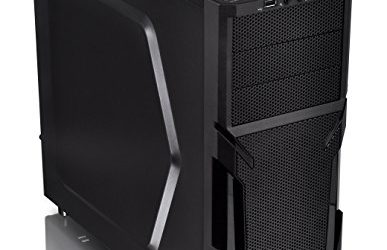
The best retro PC cases in 2026 are the ones that give you a beige-box or wood-and-metal look while still fitting a modern GPU and proper airflow. For most builders the Fractal Design North is the safest pick, a mid-tower with a walnut front that reads as vintage furniture. If you want true late-1990s styling, you will usually be choosing a horizontal desktop-style case or a beige tower and accepting some compromises in cooling and cable space.
“Retro” covers several different looks, so decide which one you mean before you spend money. Some builders want the chunky beige tower of the Pentium era. Others want a wooden hi-fi look, a slim horizontal desktop, or a compact cube reminiscent of early 2000s workstations. Each of these has different limits on GPU length, radiator support and drive bays, and those limits matter more than the nostalgia.
Quick comparison of retro-style case picks
| Pick | Best for | Key specs | Typical price range |
|---|---|---|---|
| Fractal Design North | Best overall retro look | ATX mid-tower, real wood front, mesh option, up to 355 mm GPU with front fans fitted per the maker’s spec sheet | Usually $140-$180 |
| Fractal Design Terra | Small-footprint wood and aluminium | Compact ITX-class tower, sculpted aluminium body, SFX-class power supply | Usually $170-$200 |
| Cooler Master Qube 500 Flatpack | Budget, customizable colors | ATX cube-style frame, modular panels, flat-packed | Usually $90-$120 |
| Beige-box homage ATX tower (spec class) | Authentic 1990s styling | Plastic or steel front, 5.25-inch bay look, usually limited airflow | Usually $80-$200 depending on maker |
| Horizontal desktop-style case (spec class) | Under-monitor “pizza box” look | Low-profile ATX or micro-ATX, low-profile cooler, 2-slot GPU limits | Usually $90-$250 |
Best overall: Fractal Design North
The North uses a solid wood front panel over a conventional airflow-minded chassis, which is why it works as a retro-leaning choice without the usual thermal penalty. According to the manufacturer’s spec sheet it supports ATX boards, long graphics cards and up to 360 mm radiators in the roof, and you can swap the wood front for a mesh front if temperatures become a concern. It suits builders who want a mid-century look rather than a literal 1995 beige box. The trade-off is that it is more “Scandinavian furniture” than “retro computer”, so it will not satisfy anyone chasing floppy-drive nostalgia.
Best compact: Fractal Design Terra
The Terra pairs a brushed aluminium shell with a walnut accent and a small footprint. It targets small-form-factor builds, so you are limited to an ITX board, an SFX-class power supply and a GPU that fits the maker’s stated clearance. It suits someone who wants a desk-friendly machine with a warm, analog-hi-fi look. The trade-off is price per liter and a build that is harder to cable than a mid-tower, so plan the power supply and cooler choice before ordering parts.
Best budget and most customizable: Cooler Master Qube 500 Flatpack
The Qube 500 is a cube-style frame with a modular layout that lets you move the motherboard tray and swap panel colors. It does not look like a 1990s tower, but its blocky industrial shape and the ability to choose retro color blocks make it a favorite for themed builds. It suits people on a tight budget who like to tinker. The main trade-off is that it ships flat-packed, so assembly takes extra time, and airflow depends on which panels you choose.
Best for authentic beige: homage ATX towers
A handful of makers and small studios produce beige or cream towers styled after 1990s PCs, often with a faux 5.25-inch drive bay front or a turbo-button style badge. Because this market changes quickly, check the current listings and confirm the exact model supports your motherboard size and GPU length. Look for a case that still includes a vented front and at least two intake fans. The trade-off is airflow: many fully authentic fronts are mostly solid, and a modern 250-350 W GPU in a closed front will throttle without extra venting.
Best for a desktop look: horizontal low-profile cases
Horizontal cases sit under the monitor like a 1990s desktop. They work well for office-style builds and emulation or retro-gaming machines. The limit is cooler height, usually 60-70 mm for low-profile air coolers, and many accept only a one- or two-slot GPU. They suit builds around efficient processors and 75-150 W graphics cards. The trade-off is that high-end parts are out of reach.
How to choose: a worked airflow and fit check
Retro cases fail on three numbers: GPU length, CPU cooler height and total heat. Use this worked example for a mid-range build.
- Power budget: a 125 W CPU plus a 220 W GPU plus about 60 W for board, drives and fans comes to roughly 405 W of sustained heat. Pick a case that can pass that heat out through at least two intake and one exhaust fan.
- Fan airflow: three 120 mm fans at about 50 CFM each move about 150 CFM, which is plenty for 400 W. A case with a solid front and only one small intake will be well below this.
- GPU clearance: measure the card length in millimeters and add 10-15 mm for cable bends. A 330 mm card needs a case rated for at least 345 mm.
- Cooler clearance: a tower air cooler is often 155-165 mm tall. A case rated for 150 mm will not close.
| Your situation | Choose | Why |
|---|---|---|
| Gaming PC with a 250 W+ GPU | Fractal Design North with mesh front | Full-size airflow with a retro-friendly look |
| Small desk, ITX parts | Fractal Design Terra | Small footprint, premium materials |
| Themed build on a budget | Cooler Master Qube 500 Flatpack | Modular and inexpensive |
| Emulation or office build, 75 W GPU | Horizontal or beige homage case | Looks the part, heat is low |
| Quiet living-room machine | North with wood front and low-RPM fans | Warm look, low noise |
Tips for making a retro build work
- Keep the build modest if the front is closed. A 65 W CPU and 150 W GPU stay cool behind a mostly solid front; a 300 W GPU does not.
- Use filtered fans mounted behind the front panel so the retro face stays clean but air still flows.
- Choose a neutral power supply with a cream or white cable set if you want a coordinated look. Color matching is cosmetic, so do not pay a large premium.
- Plan cable routing early. Retro cases often have shallow rear space, so a modular power supply saves several centimeters of clutter.
- Set a fan curve that stays under about 1,000 RPM at idle to keep the machine quiet, then allow ramping above 70 degrees Celsius on the GPU.
Frequently Asked Questions
Can a retro-style case handle a modern high-end GPU?
Some can, but many cannot. Cases with a real mesh or vented front, such as the Fractal Design North, handle high-end cards well. Fully authentic solid-front beige towers usually need a lower-power GPU or extra venting modifications.
Are retro cases more expensive than normal cases?
Wood and aluminium models usually cost $140-$200, which is higher than many standard mesh cases at $70-$110. Budget options like modular cube frames cost less, but you give up some of the vintage look.
Will a horizontal desktop case fit a gaming graphics card?
Only low-profile or compact cards fit most horizontal cases. Check the maker’s maximum card length and slot width, and expect a ceiling of roughly 75-150 W for the graphics card in slim designs.
Do retro cases run hotter?
They can, because decorative fronts restrict airflow. You can offset this with more intake fans, a lower-power GPU or a mesh front option. Temperatures vary with your components, room temperature and fan settings.
What size motherboard should I choose for a retro build?
ATX fits full-size towers like the North, while mini-ITX suits compact cases like the Terra. Micro-ATX is a good middle ground for horizontal desktops that accept it.
Related guides
More from Amazon
Programs that pair well with the guide above. Offers and eligibility are set by Amazon and may change.
A free business account with business pricing and bulk-buying tools for work, shop or home office.
Create a business accountFree shipping on eligible items, Prime Video and more. Eligible new members can start with a free trial.
Start a Prime free trialAudiobooks and podcasts to listen to on the go. Eligible new members can start with a free trial.
Try Audible freeAd-free music streaming. Eligible new subscribers can start with a free trial.
Try Music Unlimited freeAs an Amazon Associate we earn from qualifying purchases.