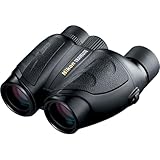
The best binoculars for discreet long-distance observation are a compact, dark-finished 8×32 or 8×42 roof-prism model with good low-light glass. Pick 10x only if you can steady it on a car window, bag or tripod. For most people, an 8×42 such as the Nikon Monarch M5 or Vortex Diamondback HD is the best all-rounder, and a Zeiss Terra ED 8×32 is the better pick when small size and low visibility matter more.
A note on the word “spying”: this guide covers legal observation of public places and your own surroundings, such as wildlife, birds, sports, property watching, vehicle spotting and neighborhood-watch style monitoring. Using optics to look into private homes, bedrooms, bathrooms or other places where people expect privacy is illegal in many jurisdictions, and most binocular makers say nothing that would make it acceptable. Local laws vary, so check yours.
As an Amazon Associate we earn from qualifying purchases at no extra cost to you.



Our Top Picks
Top 3 picks at a glance
Quick comparison of the picks
| Pick | Best for | Key specs | Price range |
|---|---|---|---|
| Nikon Monarch M5 8×42 | Best overall | 8x, 42 mm objectives, exit pupil 5.25 mm, ED glass, roof prism | Mid-range to upper mid-range |
| Vortex Diamondback HD 8×42 | Best value all-rounder | 8x, 42 mm, exit pupil 5.25 mm, HD glass, rubber armor | Mid-range |
| Zeiss Terra ED 8×32 | Best compact and low-profile | 8x, 32 mm, exit pupil 4.0 mm, ED glass, lighter body | Mid-range to upper mid-range |
| Celestron Nature DX 8×32 | Best budget | 8x, 32 mm, exit pupil 4.0 mm, roof prism, multi-coated optics | Budget |
| Canon 10×30 IS II | Best for long range without a tripod | 10x, 30 mm, optical image stabilization, battery powered | Upper mid-range to premium |
| Digital night vision binoculars (spec class) | Best for after dark | Infrared illuminator, digital sensor, usually 3x to 10x digital magnification | Mid-range to premium |
Best overall: Nikon Monarch M5 8×42
The Monarch M5 8×42 suits anyone who wants one pair for stakeouts at dusk, birding and general watching. Per Nikon’s spec sheet, it uses ED glass and a wide field of view, which keeps edges sharp and reduces color fringing on high-contrast targets such as a figure against a bright sky. Its 5.25 mm exit pupil lets your eye collect nearly all the light at dusk.
Main trade-off: It is not small. At roughly 650 to 800 g (the usual weight for this class), it is bulky for a jacket pocket, and a 42 mm objective is harder to hide than a 32 mm one.
Best value: Vortex Diamondback HD 8×42
The Diamondback HD 8×42 gives you the same 8×42 layout as the Monarch at a lower price, with a rubber-armored body that has little gloss. Vortex backs it with its transferable lifetime warranty, per the company’s published terms, which matters if you carry it in a car or backpack.
Main trade-off: Edge sharpness and low-light contrast sit a step below the upper mid-range, so you will notice softer corners when scanning wide areas.
Best compact: Zeiss Terra ED 8×32
Choose the Terra ED 8×32 if you want something that fits a coat pocket and does not look like surveillance gear. A 32 mm body is shorter and lighter than a 42 mm body, and the smaller objective lenses reflect less sunlight. It still has a 4.0 mm exit pupil, which is usable until the light is quite low.
Main trade-off: Less light gathering than 42 mm models, so you lose some detail in the last 20 to 30 minutes of dusk.
Best budget: Celestron Nature DX 8×32
The Nature DX 8×32 is a sensible entry point with roof-prism optics and multi-coated lenses. It gives you the compact, forgiving 8×32 format at a budget price.
Main trade-off: Expect more color fringing and a smaller sharp center than ED models, and a build that is less tolerant of knocks.
Best for long range without a tripod: Canon 10×30 IS II
Image-stabilized binoculars like the Canon 10×30 IS II remove most hand shake at 10x. That is what makes 10x practical when you are leaning out of a window or standing with no support. Canon’s stabilization is battery powered and engaged with a button, so you can turn it off to save power.
Main trade-off: It is heavier than a standard 8×32, needs batteries, and costs more than non-stabilized models with similar glass.
Best after dark: digital night vision binoculars
Standard binoculars cannot show detail in near darkness, so a digital night vision model is the only real answer. These are spec-class products from several makers, with infrared illuminators and screens in place of optical eyepieces. Note that an infrared illuminator is visible to other night vision devices and some cameras, so it is not truly covert. Digital magnification also reduces image quality compared with optical magnification.
How to choose: the numbers that matter
Magnification: 8x versus 10x
Magnification divides distance: an 8x binocular makes a target 160 m away look like it is 20 m away. A 10x makes the same target look like 16 m. The cost is shake. Hand tremor is magnified too, so 10x without support often looks worse than 8x in real use. Use 8x if you are handholding. Use 10x only with a rest, a monopod or image stabilization.
Light gathering at dusk
Two simple formulas help here. Exit pupil equals objective diameter divided by magnification. The twilight factor is the square root of magnification times objective diameter, and higher is better in low light.
| Format | Exit pupil (mm) | Twilight factor | Typical use |
|---|---|---|---|
| 8×32 | 4.0 | 16.0 | Compact, daytime, early dusk |
| 8×42 | 5.25 | 18.3 | All-round, dusk and dawn |
| 10×30 (stabilized) | 3.0 | 17.3 | Long range, bright to moderate light |
| 10×42 | 4.2 | 20.5 | Long range with a rest |
| 12×50 | 4.2 | 24.5 | Tripod-only, heavy |
A worked example: an 8×42 has an exit pupil of 42 divided by 8, or 5.25 mm, and a twilight factor of the square root of 336, about 18.3. A 10×30 has an exit pupil of only 3.0 mm and a twilight factor of about 17.3. That is why a stabilized 10×30 holds its own in daylight but struggles when the light fades.
Field of view and how much you will actually see
Angular field of view is listed in degrees. Each degree covers roughly 17.5 m of width per 1000 m of distance. A 7.0 degree field therefore shows about 122 m of width at 1000 m, or about 12 m at 100 m. A narrow 5.5 degree field shows about 9.6 m at 100 m. That is the difference between seeing a whole parked car and a door and a bumper. A wide field also helps you find a moving target quickly.
Staying low profile
- Finish: Choose a matte black or dark green body. Avoid chrome rings and bright logos.
- Lens glare: Objective lenses can flash in direct sun. Keep them shaded or angled, and use the lens hood or eyecup extensions.
- Size: A 32 mm model reads as birdwatching gear. A 50 mm model looks like surveillance equipment.
- Strap: Replace bright straps with a plain dark one, or use a harness to keep the binoculars against your chest.
- Support: A bean bag on a car window or a fence post steadies 10x better than your hands.
Decision matrix: match your situation to a pick
| Your situation | Choose | Why |
|---|---|---|
| Watching from a parked car at dusk | 8×42 (Monarch M5 or Diamondback HD) | 5.25 mm exit pupil, steady with a window rest |
| Walking in public, want to stay unremarkable | 8×32 (Zeiss Terra ED or Celestron Nature DX) | Small, light, looks like birding gear |
| Long distance of 300 m or more, handheld | Canon 10×30 IS II | Stabilization offsets 10x shake |
| Long distance with a tripod | 10×42 or 12×50 | Higher magnification becomes usable |
| Watching a yard or property at night | Digital night vision binoculars | Optical models cannot see in near darkness |
| Tight budget | Celestron Nature DX 8×32 | Compact format at a budget price |
Features worth paying for, and ones to skip
- Worth it: ED or HD glass for color fringing, fully multi-coated lenses for contrast, and phase-corrected roof prisms for sharpness.
- Worth it: Eye relief of at least 15 mm if you wear glasses, plus twist-up eyecups.
- Worth it: Waterproof, nitrogen- or argon-purged bodies that do not fog when moving between warm and cold air.
- Skip: Marketing claims like “100x zoom” or very high-power zoom binoculars. They are typically dim, narrow and shaky.
- Skip: Built-in cameras or “spy” labeled gadgets with tiny lenses, which are usually low in optical quality.
Legal and ethical limits
Watching a public street, a wildlife area or your own boundary is generally lawful. Aiming binoculars at windows, into private yards where fences are meant to block view, or following a specific person can breach voyeurism, stalking or harassment laws. If you are worried about a crime or a safety issue, record the date and time and report it to the local police instead of confronting anyone.
Frequently Asked Questions
What magnification is best for discreet observation?
For handheld use, 8x is the best balance of detail, steadiness and field of view. Go to 10x only if you can rest the binoculars on something solid or use image stabilization. Anything above 12x generally needs a tripod.
Are compact binoculars good enough for long-distance viewing?
Yes, up to a point. An 8×32 shows plenty of detail out to a couple of hundred meters in good light, but a 42 mm model gathers more light at dawn and dusk. Compact models are best when low visibility and portability matter more than low-light performance.
Can binoculars see at night?
Standard optical binoculars cannot see in near total darkness. They only make better use of whatever light is available, and an 8×42 helps most in twilight. For real darkness you need a digital or thermal night vision device.
Is it legal to use binoculars to watch people?
Observing public spaces is typically legal, but looking into private spaces where people expect privacy is not in many places. Laws on voyeurism and harassment vary by state and country. When in doubt, do not point optics at people or their homes.
How do I stop lens glare from giving me away?
Keep the objective lenses out of direct sun, use the lens hoods or extended eyecups, and avoid shiny finishes. Observing from inside a vehicle or in shade also helps. Smaller 32 mm objectives produce less glint than 42 mm or 50 mm ones.
Is image stabilization worth it?
For 10x and above, handheld, yes. Stabilization removes most small shake, so you can read details like a license plate or distinguish features at range. It adds weight and cost, and it needs batteries, so for 8x use it is usually unnecessary.
Related guides
More from Amazon
Programs that pair well with the guide above. Offers and eligibility are set by Amazon and may change.
A free business account with business pricing and bulk-buying tools for work, shop or home office.
Create a business accountFree shipping on eligible items, Prime Video and more. Eligible new members can start with a free trial.
Start a Prime free trialAudiobooks and podcasts to listen to on the go. Eligible new members can start with a free trial.
Try Audible freeAd-free music streaming. Eligible new subscribers can start with a free trial.
Try Music Unlimited freeAs an Amazon Associate we earn from qualifying purchases.