The best binoculars for stargazing for most people are 10×50 models for handheld sweeps, or 15×70 models such as the Celestron SkyMaster 15×70 if you will use a tripod. Aperture sets how many faint stars and nebulae you can see, and magnification beyond about 15x only helps when the binoculars are mounted. Pick by aperture, exit pupil and how you will hold them, not by the biggest number on the box.
As an Amazon Associate we earn from qualifying purchases at no extra cost to you.



Top 3 picks at a glance
Quick comparison of the best stargazing binoculars
| Pick | Best for | Key specs | Price range |
|---|---|---|---|
| Nikon Aculon A211 10×50 | Best overall handheld | 10x, 50 mm, 5.0 mm exit pupil, roughly 6.5° true field (per Nikon’s spec sheet) | Budget to mid-range |
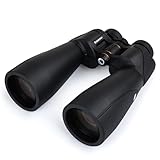
| Celestron SkyMaster 15×70 | Best value for deep sky | 15x, 70 mm, 4.7 mm exit pupil, roughly 4.4° field | Budget |
| Celestron Cometron 7×50 | Best budget, wide sweeps | 7x, 50 mm, 7.1 mm exit pupil, very wide field | Budget |
| Fujinon FMT-SX 7×50 | Best premium, rugged | 7x, 50 mm, 7.1 mm exit pupil, sharp edge-to-edge | Premium |
| Canon 15×50 IS All-Weather | Best image-stabilized | 15x, 50 mm, battery-powered stabilization, 3.3 mm exit pupil | Premium |
| Celestron SkyMaster 25×100 | Best for mounted “big glass” | 25x, 100 mm, 4.0 mm exit pupil, heavy | Mid-range |
What actually matters for stargazing: the numbers
Binoculars are labeled magnification x aperture, so 10×50 means 10x with 50 mm lenses. Two derived numbers tell you more than the label.
Worked example: exit pupil and light grasp
Exit pupil is aperture divided by magnification. It is the beam of light that leaves the eyepiece and must fit into your dark-adapted pupil, which is roughly 7 mm in a young adult and often 5-6 mm after about age 50.
- 7×50: 50 / 7 = 7.1 mm, which can overfill an older pupil and waste some light.
- 10×50: 50 / 10 = 5.0 mm, a good match for most adults.
- 15×70: 70 / 15 = 4.7 mm, comfortable and bright.
- 25×100: 100 / 25 = 4.0 mm, fine, but the magnification demands a mount.
Light grasp compared with the eye is (aperture / 7 mm) squared. A 50 mm lens collects about 51 times more light than a 7 mm pupil, a 70 mm lens about 100 times and a 100 mm lens about 204 times. In theory that is a gain of about 4.3, 5.0 and 6.5 magnitudes in limiting brightness. Real gains are smaller because of coatings, sky conditions and your eyes. Going from 50 mm to 70 mm roughly doubles the light, which is why 70 mm binoculars show many more faint star clusters.
Why magnification alone is a trap
Handheld, most people can hold about 8x-10x steady. At 15x, hand tremor smears the stars, and at 20x or more a tripod is close to mandatory. Higher power also darkens the sky background less than it dims extended objects, so a bigger number does not make nebulae easier to see. The field of view also shrinks. A 7×50 with a 7° true field frames the whole Pleiades and much of Orion’s sword. A 25×100 with about 2.7° frames only part of them, though it shows more detail inside.
Best overall: Nikon Aculon A211 10×50
This is the sensible first pair for hobbyists. The 10×50 format gives a 5 mm exit pupil, a wide field and a weight most adults can hold for several minutes at a time. It shows the Andromeda Galaxy, the Orion Nebula, the Beehive cluster, Jupiter’s four large moons and thousands of Milky Way stars from a reasonably dark site. The trade-off is that the Aculon is a basic porro-prism design with modest edge sharpness and eye relief that can be tight for glasses wearers. It is still the best balance of price, portability and handheld usability.
Best value for deep sky: Celestron SkyMaster 15×70
The SkyMaster 15×70 is the classic budget astronomy binocular. The 70 mm lenses collect about twice the light of 50 mm glass, and 15x is enough to split many double stars and resolve more of globular clusters like M13. The trade-off is that they are heavy and effectively tripod-only. Handheld, the view jitters, and your arms tire within a minute or two. Budget a tripod and an L-bracket adapter, since the binoculars have a tripod thread. Edge sharpness and collimation vary at this price, so buy from a seller with an easy return policy. Celestron also sells a SkyMaster Pro 15×70 with better coatings and optics for a higher price.
Best budget for wide sweeps: Celestron Cometron 7×50
The Cometron 7×50 is cheap, light and very wide-field, so it suits kids, casual Milky Way scanning and comet hunting. The 7.1 mm exit pupil works well for young eyes at truly dark sites. It is the lowest-risk purchase on this list. The trade-off is limited magnification, so planets stay tiny, and the optical quality is entry-level.
Best premium: Fujinon FMT-SX 7×50
Fujinon’s FMT-SX line has long been a reference for rugged marine and astronomy binoculars, with sharp stars to the edge of the field and a waterproof body. Choose it if you want a lifetime instrument and mostly observe under dark skies. The trade-offs are the price, a weight that benefits from a tripod after long sessions, and the 7x power, which gives a wide but not magnified view.
Best image-stabilized: Canon 15×50 IS All-Weather
Canon’s stabilized binoculars use battery power to cancel hand shake, so 15x becomes usable without a tripod. Stars look steady and the stabilizer reveals fainter detail that shake would otherwise blur. This suits people who cannot set up a tripod or who observe from a balcony or a reclining chair. The trade-offs are the price, the need for batteries (cold weather shortens their life) and a smaller 50 mm aperture than the 70 mm tripod models.
Best “big glass”: Celestron SkyMaster 25×100
The 25×100 shows noticeably more faint galaxies, nebulae and cluster members than any handheld pair. It is heavy enough that it needs a sturdy photo tripod or a parallelogram binocular mount, not a light travel tripod. It suits someone who wants telescope-like views without eyepiece swapping. The trade-off is setup effort. If you will not set it up, you will not use it.
Decision matrix: match your situation to a choice
| Your situation | Choose | Why |
|---|---|---|
| No tripod, quick sessions, first pair | 10×50 (Nikon Aculon A211) | 5 mm exit pupil, steady enough by hand |
| Kid or very casual user | 7×50 (Celestron Cometron) | Light, wide field, easy to aim |
| Own or will buy a tripod, want deep-sky objects | 15×70 (SkyMaster) | About double the light of 50 mm, 15x detail |
| Cannot use a tripod but want 15x | Canon 15×50 IS | Stabilization replaces the mount |
| Dark-sky site, lifetime pair | Fujinon FMT-SX 7×50 | Sharp edges, rugged, wide field |
| Light-polluted city, mainly Moon and planets | 10×50 or 15×70 | Faint-object gains are limited, so extra aperture helps less |
| Glasses wearer | Check eye relief of 14 mm or more | Short eye relief cuts off the field |
How to choose: a short checklist
- Decide handheld or mounted. Handheld means up to 10×50. Mounted opens up 15×70 and larger.
- Check the exit pupil. Aim for 4-5 mm if you are over 40 and 5-7 mm if you are young. Divide aperture by magnification.
- Prefer BaK-4 prisms and fully multi-coated lenses. BK-7 prisms often show gray corners in the exit pupil, and poor coatings cost contrast against a dark sky.
- Check eye relief. Glasses wearers should look for 14-15 mm or more, per the manufacturer’s spec sheet.
- Look for a tripod thread. Most 15×70 and larger models have a threaded socket under the hinge cover, but you still need an adapter.
- Plan for weight. A 10×50 is about 1 kg or a little less, a 15×70 is typically 1.3-1.6 kg, and 25×100 models run to several kilograms.
Whatever you choose, look from a spot away from streetlights. A dark site matters more than the extra 20 mm of aperture.
Frequently Asked Questions
Are 10×50 or 15×70 binoculars better for stargazing?
10×50 is better if you hold them in your hands, since they are lighter and steadier. 15×70 gathers about twice the light and shows more detail, but it needs a tripod for a sharp view. If you plan to buy a tripod, the 15×70 is the stronger deep-sky tool.
Do I need a tripod for stargazing binoculars?
You do not need one up to about 10x, though a reclining chair or a braced elbow helps. At 15x and above, hand shake blurs stars noticeably, so a tripod or image stabilization is strongly recommended. Anything at 20x or larger should be mounted.
What can I see with binoculars that I cannot see by eye?
You can see Jupiter’s four Galilean moons, the crescent phase of Venus, hundreds of stars in the Pleiades and the Andromeda Galaxy as a clear oval glow. From a dark site you can also see the Orion Nebula, the Double Cluster and many star clouds in the Milky Way. Saturn’s rings need roughly 25x or more to show up as more than a bump.
Is a bigger exit pupil always better?
No. The exit pupil only helps up to the size of your own dark-adapted pupil. A 7 mm exit pupil can waste light if your pupil opens only to 5 mm, and it often means lower magnification. For most adults, 4-5 mm is a good target.
Can I use hunting or birding binoculars for astronomy?
Yes, a 10×42 birding pair works for the Moon, bright clusters and the Milky Way. It will show fewer faint objects than 50 mm models because of the smaller aperture. The extra sharpness of good roof-prism birding binoculars is a plus, but you will pay more for each millimeter of aperture.
Are image-stabilized binoculars worth it for astronomy?
They are worth it if you want 12x-15x power without a tripod, or if you have limited mobility or space. Stabilization removes the shake that otherwise limits handheld use. The trade-offs are cost, battery dependence and a smaller aperture than tripod-mounted 70 mm binoculars.
Related guides
More from Amazon
Programs that pair well with the guide above. Offers and eligibility are set by Amazon and may change.
A free business account with business pricing and bulk-buying tools for work, shop or home office.
Create a business accountFree shipping on eligible items, Prime Video and more. Eligible new members can start with a free trial.
Start a Prime free trialAudiobooks and podcasts to listen to on the go. Eligible new members can start with a free trial.
Try Audible freeAd-free music streaming. Eligible new subscribers can start with a free trial.
Try Music Unlimited freeAs an Amazon Associate we earn from qualifying purchases.