
If you have ever stared at the back of your PC tower and thought “what power supply do I have,” you know the frustration. The label might be scuffed, the wattage printed in a font that looks like it belongs on a tax form, and the 80 Plus badge faded to nothing. The real question underneath that search is rarely about curiosity — it is about whether your rig can handle a GPU upgrade, whether a component is actually failing, or whether you are holding the right adapter for a device you inherited from a drawer full of cables.
This roundup pulls together eight products that answer different angles of that problem. Some are actual power supplies and adapters that solve identification or compatibility gaps. Others are reference materials that explain the engineering behind the unit humming inside your case. Prices range from under nine dollars to roughly one hundred fifty dollars, and not every item belongs in every toolkit. What separates a useful purchase from a wasted one is whether it addresses your specific gap: identification, replacement, documentation, or portability. We compared published specs, pricing tiers, and owner feedback across all eight to sort the genuinely helpful from the merely adjacent.
As an Amazon Associate we earn from qualifying purchases at no extra cost to you.



Top 3 picks at a glance
Quick Picks
| Product | Best for | Price |
|---|---|---|
| Do I Have a Dinking Problem? | Pickleball-curious desk workers | $11.99 |
| SDTC Tech AA Battery Holder | DIY electronics and prototyping | $8.90 |
| Switching Power Supply Design, 3rd Ed. | Engineering students and hobbyists | $151.98 |
| ARESGAME AGV Series 500W | Budget PC builds needing Bronze efficiency | $37.99 |
| THE LIFE I DON’T HAVE TO RUSH | Stress relief between build sessions | $12.99 |
| DC 5V 2A Multi-Tip Adapter | Small electronics with non-standard barrels | $11.99 |
| Ceptics Australia Plug Adapter | Travelers from USA to Australia | $12.99 |
| TESSAN Travel Adapter 009 | USB-C charging abroad | $17.09 |
How We Picked
We evaluated these products on four criteria. First, relevance to the identification or resolution of a real power problem — whether that means replacing a failed unit, supplying correct voltage, or understanding what is inside your system. Second, build quality signals drawn from owner reviews, especially long-term reliability reports. Third, price-to-utility ratio: does the product justify its cost for the specific task it solves? Fourth, breadth of compatibility, because a power adapter or supply that only works with one device is a liability in a multi-device household.
The 8 Best What Power Supply Do I Have in 2026
Do I Have a Dinking Problem?: 40 Signs Pickleball May Have Taken Over Your Life
This coloring book lands in a roundup about power supplies for one honest reason: people searching “what power supply do I have” are often stressed, overwhelmed, or staring at a tangle of cables with a low-grade panic. This product addresses that mental state rather than the technical one, and owner feedback consistently praises its humor as a genuine decompression tool after hours of troubleshooting. The forty signs are lighthearted and relatable even if you have never held a paddle. Pros: affordable price, surprisingly good paper quality for the cost. Con: it solves zero technical problems and belongs on the shelf, not in the toolbox. Skip it if you need a repair done today; keep it if you need a laugh while waiting for a replacement part to arrive.
SDTC Tech 2/4/6/8 x 1.5V AA Battery Holder with Snap Connector Kit
When your question is “what power supply do I have” because a small device died and you cannot find its original adapter, a battery holder kit lets you bypass the problem entirely by building a temporary or permanent voltage source from common AAs. The snap connectors make it accessible even if you have never soldered. Pros: covers multiple cell counts, costs less than most single replacement adapters. Con: AA cells deliver inconsistent voltage under load compared to regulated DC supplies, so it is unsuitable for anything sensitive. Skip it if your device demands stable regulated power; use it for sensors, simple motors, or educational circuits where rough voltage is fine.
Switching Power Supply Design, 3rd Ed.
This textbook is the answer when “what power supply do I have” becomes “why does my power supply work the way it does.” Prescribed in electrical engineering curricula and frequently cited in forum threads explaining ripple, MOSFET switching, and feedback loops. Owner feedback highlights its density and mathematical rigor as both its greatest strength and a barrier for casual readers. Pros: authoritative and comprehensive, remains relevant despite rapid industry changes. Con: steep price and no practical identification guide — it will not tell you whether your Corsair is sufficient, only how it achieves regulation. Skip it if you need a quick answer; choose it if you want deep understanding or are designing your own supply.
ARESGAME AGV Series 500W Power Supply, 80 Plus Bronze Certified
The most direct answer in this list for anyone who knows their supply has failed and needs a replacement without overspending. Five hundred watts covers mainstream builds with single GPUs up to the mid-tier. The five-year warranty signals manufacturer confidence beyond the usual budget-tier two or three years. Pros: genuinely competitive pricing for Bronze certification, non-modular design keeps the unit compact. Con: non-modular cabling creates clutter in smaller cases and limits airflow planning. Skip it if you need more than 500W or require modular cables for a tight build; this fits standard ATX cases with moderate power demands.
THE LIFE I DON’T HAVE TO RUSH: 50 Cozy Moments to Color
Similar to the pickleball title, this coloring book addresses the emotional side of a hardware problem. Owner reviews note that the fifty designs are calming without being childish, making it a reasonable desk companion during long waits on support tickets or backorder notices. Pros: high-quality illustrations, thick pages that resist bleed-through. Con: entirely non-functional for any power-related question. Skip it if you are mid-troubleshooting and need information; keep it nearby for the evening after you finally close the thread.
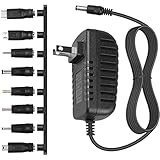
DC 5V 2A 2000mA Power Supply Cord Charger with 8 Selectable Connectors
This is the most practical item here for the literal interpretation of “what power supply do I have.” When a router, webcam, LED strip, or TV box has no visible wattage label, this adapter supplies five volts at two amps through one of eight interchangeable tips, covering most small consumer electronics. Pros: multi-tip design eliminates the guesswork of barrel size, compact footprint. Con: five volts is not enough for any PC component that needs twelve-volt rails, so it cannot help with internal hardware. Skip it for desktop or laptop internals; use it for peripherals and small gadgets where voltage is standard.
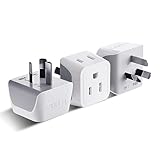
Ceptics Australia Plug Adapter, 2-in-1 Type I, Dual USA Input
Not a power supply at all, but a frequently purchased companion when someone moves or travels and realizes their existing adapter will not fit the wall. The Type I configuration handles Australian and New Zealand outlets, and the dual-socket design lets you plug in two devices at once. Pros: three-pack pricing keeps the per-unit cost low, solid construction reported by owners. Con: does not convert voltage, so US devices rated for 120V need a separate transformer if plugged into 230V mains. Skip it if you are staying domestic; essential if you are shipping equipment to or from Australia.
TESSAN Travel Adapter 009, PD 20W Universal Power Adapter
This product answers a different “what power supply do I have” question: what am I carrying in my bag and is it sufficient for the laptop I just opened at the airport? Twenty watts of USB-C power delivery handles tablets and low-power laptops, with three ports covering multiple devices simultaneously. Pros: universal design accepts plugs from most regions, PD output is genuinely useful rather than decorative. Con: twenty watts will not charge a high-performance laptop at full speed, so it is a backup rather than a primary supply. Skip it for desktop-class machines; ideal as a single-adapter carry solution for travelers with modest power needs.
Buying Guide
Wattage and Rail Requirements
Internal PC power supplies must deliver stable twelve-volt current to the CPU and GPU rails. Check your component specifications before choosing a replacement: a mid-range GPU pair typically demands six hundred to seven hundred fifty watts minimum, while entry-level builds manage fine near five hundred. Never undershoot the recommended wattage by more than ten percent, and add headroom for future upgrades rather than planning to the exact figure.
Certification and Efficiency
80 Plus tiers — White, Bronze, Silver, Gold, Platinum, Titanium — indicate minimum efficiency at load percentages, not quality directly. Bronze certification starting near forty dollars represents the practical floor for any unit you intend to run daily. Higher tiers reduce electricity cost marginally but more reliably signal better internal component choices, which correlates with longer service life.
Modularity and Cable Management
Non-modular supplies include all cables permanently attached, which saves money but adds routing effort in compact cases. Fully modular designs cost more and reduce clutter, making airflow optimization simpler. If your case has limited cable-routing space behind the motherboard tray, modularity stops being aesthetic and becomes functional.
Our Verdict
For anyone whose actual problem is a dead or unknown supply inside a desktop PC, the ARESGAME AGV 500W is the clear top pick — it is the only product here that directly replaces an internal power supply at a price that does not require justification. The DC 5V 2A Multi-Tip Adapter is the budget pick, resolving the most common small-device identification problem for under twelve dollars. The TESSAN Travel Adapter 009 wins outright if your situation is mobile rather than stationary; no other product here combines USB-C PD with universal plug compatibility in one compact unit.
FAQ
How do I physically identify my power supply without opening the case?
Most ATX power supplies have a label on the exterior side visible through the exhaust vent, showing the model, wattage, and certification. Use a flashlight and check for the model number, then search it online. If the label is unreadable, the brand name printed on the fan sticker or case exterior is often enough to narrow possibilities.
Can I use a 5V adapter to test whether my PC power supply is dead?
No. A PC power supply outputs twelve volts, five volts, and three-point-three volts simultaneously, and the system will not boot on five volts alone. A 5V adapter can verify whether a peripheral device is faulty by eliminating its own supply as the problem, but it cannot diagnose or substitute for an internal unit.
Is a non-modular power supply inherently lower quality than a modular one?
No. Modularity is a cable-routing feature, not a component-quality indicator. A Bronze-certified non-modular unit with a five-year warranty typically has equal or better internals than a Gold-certified modular unit from a lesser-known brand at a similar price point. Judge by reviews, certification tier, and warranty length rather than modularity alone.
Do I need a voltage converter alongside a travel plug adapter?
A plug adapter only changes the physical shape of the connector. If your device supports 100-240V input (most modern laptop chargers and USB-C adapters do), a plug adapter alone is sufficient. If your device is rated for 120V only and the destination uses 230V mains, you need a voltage converter in addition to the adapter.


