The RX 7900 XT is the clearly faster card and the better buy for 1440p and entry-level 4K gaming, while the newer RX 9060 XT 8GB is a cheaper, lower-power 1080p card that is not an upgrade over the 7900 XT in raw performance or VRAM. Pick the 9060 XT 8GB only if your budget, power supply or case limits rule out a 300 W card, or if you specifically want RDNA 4 features such as FSR 4 at the lowest possible price.
That answer surprises some buyers because the RX 9060 XT carries a newer architecture and a higher model number. The reality is that these two cards sit in completely different performance classes. The RX 7900 XT launched as a $899 upper-tier card with 20 GB of memory, while the RX 9060 XT 8GB launched at $299 as AMD’s mainstream option. Newer silicon closes some of the gap in ray tracing and upscaling, but it does not erase a card with more than twice the shader count and two and a half times the memory bandwidth.
As an Amazon Associate we earn from qualifying purchases at no extra cost to you.

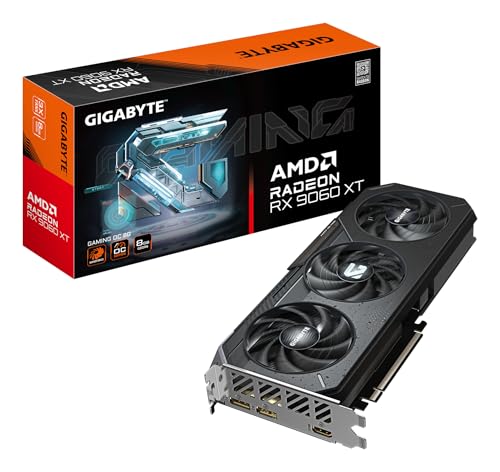

Our Top Picks
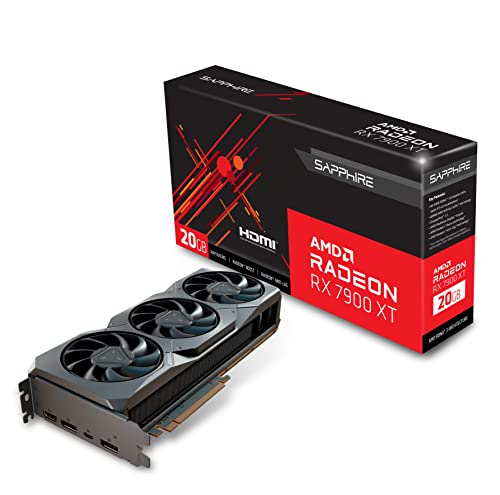

Top 3 picks at a glance
Specifications Side by Side
| Specification | RX 7900 XT | RX 9060 XT 8GB |
|---|---|---|
| Architecture | RDNA 3.0 | RDNA 4.0 |
| Release date | 3 November 2022 | 4 June 2025 |
| Launch MSRP | $899 | $299 |
| Stream processors | 5376 | 2048 |
| Boost clock | 2394 MHz | 3130 MHz |
| Process | 5 nm | 4 nm |
| TDP | 300 W | 150 W |
| Memory | 20 GB GDDR6 | 8 GB GDDR6 |
| Memory bus | 320-bit | 128-bit |
| Bandwidth | 800.0 GB/s | 322.3 GB/s |
| L2 / L3 (Infinity Cache) | 6 MB / 80 MB | 4 MB / 32 MB |
| Interface | PCIe 4.0 x16 | PCIe 5.0 x16 |
| Power connectors | 2x 8-pin | 1x 8-pin |
| Length / width | 276 mm / 2-slot | 267 mm / 2-slot |
| Display outputs | 1x HDMI 2.1a, 2x DP 2.1, 1x USB-C | 1x HDMI 2.1b, 2x DP 2.1a |
The table tells most of the story before any benchmark is run. The 9060 XT runs far higher clocks, which partly compensates for its smaller shader array, but the memory subsystem is the bigger divide: 8 GB on a 128-bit bus against 20 GB on a 320-bit bus with a larger Infinity Cache.
How Much Faster Is the RX 7900 XT in Games?
Published reviews and benchmark aggregates place the RX 7900 XT roughly 45 to 55 percent ahead of the RX 9060 XT in average rasterized performance, with the gap tending to widen as resolution rises. TechPowerUp’s RX 9060 XT review data shows even the RX 7800 XT finishing about 15 to 22 percent ahead of the 9060 XT depending on resolution, and the 7900 XT sits a full tier above the 7800 XT. Hardware Unboxed and Tom’s Hardware coverage of the 9060 XT 8GB also flagged that the 8 GB variant can fall well behind its 16 GB sibling in memory-heavy games at high texture settings, which pushes the gap to the 7900 XT even further in those titles.
In practical terms, and with the caveat that frame rates vary with settings, CPU and game patch:
- 1080p high settings: the 9060 XT 8GB generally lands in the comfortable 60 to 100+ fps range in modern AAA games, while the 7900 XT often pushes well past 120 fps and becomes CPU-limited in lighter titles.
- 1440p: the 7900 XT typically stays in the high double digits to triple digits at high or ultra settings; the 9060 XT 8GB usually needs reduced settings or upscaling to hold a smooth frame rate in demanding releases.
- 4K: the 7900 XT is a capable 4K card with some upscaling; the 9060 XT 8GB is not designed for native 4K in current games.
Ray tracing: where RDNA 4 narrows the gap
RDNA 4 brought a substantial jump in ray tracing throughput per compute unit compared with RDNA 3, so the 9060 XT loses less ground with ray tracing enabled than its shader count suggests. Even so, the 7900 XT still delivers higher ray-traced frame rates overall in most review data because of its far larger GPU. Where the 9060 XT 8GB struggles most is in path-traced or heavy RT titles, where the extra memory consumed by BVH structures pushes 8 GB to its limit.
Upscaling and frame generation
This is the 9060 XT’s strongest argument. FSR 4, AMD’s machine-learning upscaler, launched exclusively on RDNA 4 hardware, and reviewers broadly agree its image quality is a large step up from FSR 3.1, especially in performance mode. The RX 7900 XT has mainly relied on FSR 3.1 upscaling and frame generation, which works on any GPU but shows more shimmering and ghosting. If image quality at low internal resolutions matters to you, the 9060 XT’s upscaler is genuinely better, though the 7900 XT often does not need aggressive upscaling in the first place.
VRAM: 20 GB vs 8 GB
Video memory is the deciding factor for anyone planning to keep a card for several years. A rough guide for current releases:
- 1080p, high textures: 8 GB is workable in most games, but several recent titles already exceed it at maximum texture quality, causing stutter or texture pop-in.
- 1440p, high/ultra: 10 to 12 GB is the comfortable target; 8 GB forces texture compromises in a growing list of games.
- 4K or heavy ray tracing: 12 to 16 GB or more is advisable.
The 7900 XT’s 20 GB clears every one of those thresholds with room to spare. The 9060 XT 8GB meets only the first. That is why the 16 GB version of the 9060 XT exists, and anyone set on that GPU should weigh the $50 launch-price difference to the 16 GB model carefully.
Value Worked Out From Launch Prices
Using launch MSRPs and an approximate 50 percent performance lead for the 7900 XT (the midpoint of the review range):
- RX 9060 XT 8GB: $299 for a baseline of 100 performance points = about $2.99 per point.
- RX 7900 XT: $899 for roughly 150 points = about $5.99 per point.
At launch prices the 9060 XT 8GB delivered close to twice the performance per dollar. That math changes in the current market, where the 7900 XT is a previous-generation card that has been sold well below its original MSRP and is commonly found used. On the used market a 7900 XT usually trades somewhere in the $450 to $600 range depending on model and condition, which puts its cost per point much closer to the new 9060 XT 8GB while offering more than double the VRAM.
Power, PSU and Case Fit
Power draw is the other big practical split. A simple PSU sizing approach is GPU TDP plus CPU power plus about 150 W headroom:
- RX 7900 XT with a 120 W gaming CPU: 300 + 120 + 150 = 570 W, so a quality 650 W unit is the sensible floor and 750 W is comfortable, particularly for factory-overclocked models.
- RX 9060 XT 8GB with the same CPU: 150 + 120 + 150 = 420 W, so a good 500 to 550 W supply is enough.
The 7900 XT needs two 8-pin PCIe cables; the 9060 XT needs one. Both are listed as 2-slot designs at 276 mm and 267 mm respectively, but many partner versions of the 7900 XT are thicker and longer than the reference figure, so measure clearance before buying. The 9060 XT is also offered in shorter dual-fan versions that suit compact cases better.
The 9060 XT uses PCIe 5.0 x16 while the 7900 XT uses PCIe 4.0 x16. Neither card is meaningfully limited on a PCIe 4.0 board, and because both use a full x16 link, even PCIe 3.0 systems lose little performance.
Which One to Pick
| Your situation | Better choice | Why |
|---|---|---|
| 1080p, tight budget, 500-550 W PSU | RX 9060 XT 8GB | Lower price and power, FSR 4 support |
| 1080p, wants to keep the card 4+ years | RX 7900 XT (or 9060 XT 16GB) | 8 GB is already tight in new games |
| 1440p high refresh | RX 7900 XT | Roughly 45-55% faster with 20 GB VRAM |
| 4K gaming | RX 7900 XT | The 9060 XT 8GB is not a 4K card |
| Small form factor, low noise | RX 9060 XT 8GB | Half the TDP, single 8-pin |
| Already own a 7900 XT | Keep it | The 9060 XT 8GB would be a downgrade |
The bottom line: the RX 9060 XT 8GB is a sensible budget 1080p card, but it is not a step up from an RX 7900 XT in any metric except efficiency and upscaler quality. Buyers choosing between them at similar cost, such as a used 7900 XT versus a new 9060 XT, will get far more performance and longevity from the 7900 XT, provided their PSU and case can handle it.
Frequently Asked Questions
Is the RX 9060 XT 8GB an upgrade from the RX 7900 XT?
No. The RX 7900 XT is roughly 45 to 55 percent faster in average rasterized gaming according to published review data and has 20 GB of VRAM versus 8 GB. Moving from a 7900 XT to a 9060 XT 8GB would be a downgrade in performance, with only lower power draw and FSR 4 support as gains.
Can the RX 7900 XT use FSR 4?
FSR 4 launched as an RDNA 4 exclusive because it relies on hardware features introduced with the RX 9000 series. The RX 7900 XT has mainly used FSR 3.1 upscaling and frame generation, which still works well at 1440p and 4K quality modes. Its higher native performance also means it needs less aggressive upscaling than the 9060 XT.
What power supply does the RX 7900 XT need?
A quality 650 W power supply is a sensible minimum with a typical gaming CPU, and 750 W gives more headroom for overclocked partner cards. The card needs two 8-pin PCIe power connectors. Using separate cables rather than a single daisy-chained cable is the safer setup.
Is 8 GB of VRAM enough in 2026?
For 1080p at medium to high settings, 8 GB still runs most games acceptably. A growing number of recent releases exceed 8 GB at maximum textures, which causes stutter or blurry textures. Buyers planning to keep a card for several years or move to 1440p are better served by 12 GB or more.
Which card runs cooler and quieter?
The RX 9060 XT 8GB is rated at 150 W against 300 W for the RX 7900 XT, so it produces roughly half the heat. That generally means quieter fans and lower case temperatures, especially in small cases. A well-cooled partner 7900 XT can still be quiet, but it needs more airflow.
Related guides
More from Amazon
Programs that pair well with the guide above. Offers and eligibility are set by Amazon and may change.
A free business account with business pricing and bulk-buying tools for work, shop or home office.
Create a business accountFree shipping on eligible items, Prime Video and more. Eligible new members can start with a free trial.
Start a Prime free trialAudiobooks and podcasts to listen to on the go. Eligible new members can start with a free trial.
Try Audible freeAd-free music streaming. Eligible new subscribers can start with a free trial.
Try Music Unlimited freeAs an Amazon Associate we earn from qualifying purchases.