Buy the RX 7800 XT if you want the most rasterized frames per dollar at 1440p, since it is typically 10-25% faster in traditional rendering; buy the RTX 5060 Ti 16GB if you value lower power draw, DLSS 4 with Multi Frame Generation and stronger upscaling, or are building a compact, quiet system. Both carry 16 GB of VRAM, so memory is not the tiebreaker here: features and efficiency versus raw speed are.
The RX 7800 XT is a previous-generation RDNA 3 card launched in August 2023 at $499, still common on shelves and the used market. The RTX 5060 Ti 16GB is a current Blackwell card launched in April 2025 at $429. They often end up at similar prices, which is why this pairing comes up so often for 1440p builds.
As an Amazon Associate we earn from qualifying purchases at no extra cost to you.




Our Top Picks
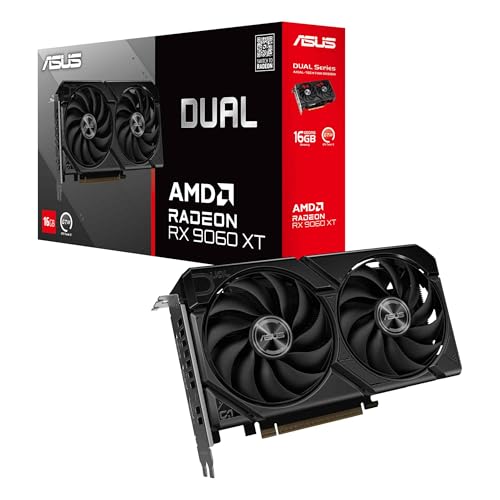 ASUS Dual Radeon RX 9060 XT 16GB GDDR6RX9060XT|16GB|Black8 x 4.7 x 1.9 inches1.3 poundsCheck on Amazon


Top 3 picks at a glance
The Spec Sheet
| Specification | RX 7800 XT | RTX 5060 Ti 16GB |
|---|---|---|
| Architecture | RDNA 3.0 | Blackwell 2.0 |
| Release date | 25 August 2023 | 16 April 2025 |
| Launch MSRP | $499 | $429 |
| Shader units | 3840 | 4608 CUDA cores |
| Boost clock | 2430 MHz | 2572 MHz |
| Process | 5 nm | 5 nm |
| TDP | 263 W | 180 W |
| Memory | 16 GB GDDR6 | 16 GB GDDR7 |
| Memory bus | 256-bit | 128-bit |
| Bandwidth | 624.1 GB/s | 448.0 GB/s |
| Cache | 4 MB L2 / 64 MB L3 | 32 MB L2 |
| Interface | PCIe 4.0 x16 | PCIe 5.0 x8 |
| Power connectors | 2x 8-pin | 1x 8-pin |
| Length / width | 267 mm / 2-slot | 241 mm / 2-slot |
| Outputs | 1x HDMI 2.1a, 3x DP 2.1 | 1x HDMI 2.1b, 3x DP 2.1b |
The RX 7800 XT has a much wider 256-bit bus and about 39% more memory bandwidth, which helps at 1440p and 4K. The RTX 5060 Ti compensates partially with a 32 MB L2 cache and fast GDDR7, and it draws 83 W less at rated TDP.
Raster vs Ray Tracing
Traditional rendering
Across published comparisons, the RX 7800 XT leads consistently in rasterized games. XDA Developers’ head-to-head testing found the RX 7800 XT ahead in most titles at 1440p, by around 15-25% in games such as Cyberpunk 2077 and Returnal, and about 15% ahead in 3DMark Time Spy. Aggregated multi-game data from comparison sites puts the average lead at roughly 10-25% depending on resolution and game selection. A middle estimate of about 15-20% at 1440p is reasonable.
For a sense of scale, and keeping in mind that numbers vary with settings, CPU and patch, a game running around 80-90 FPS on the RTX 5060 Ti at 1440p high would commonly land around 95-105 FPS on the RX 7800 XT.
Ray tracing
Ray tracing is much closer. XDA found the two nearly tied in 3DMark Port Royal, and in heavy RT games NVIDIA’s Blackwell RT cores often let the RTX 5060 Ti match or edge out the RX 7800 XT. In path-traced titles, the RTX 5060 Ti generally has the advantage, particularly once DLSS is enabled. If you plan to play with ray tracing on, the raster lead of the RX 7800 XT largely disappears.
Upscaling and Frame Generation
This is where the RTX 5060 Ti makes its case:
- RTX 5060 Ti 16GB: DLSS 4 super resolution with the transformer model, DLSS Multi Frame Generation (up to three generated frames per rendered frame), Reflex for latency reduction, and the widest game support of any upscaler.
- RX 7800 XT: FSR 3.1 upscaling and frame generation in supported titles, plus driver-level AMD Fluid Motion Frames that work in many DirectX 11 and 12 games. FSR 4, AMD’s machine-learning upscaler, launched as an RX 9000 feature, so the RX 7800 XT relies on FSR 3.1’s analytical upscaling.
In practice, DLSS Quality at 1440p on the RTX 5060 Ti tends to look cleaner than FSR 3.1 Quality, which can let the NVIDIA card close the raster gap when both are upscaling. Frame generation works best from a base of roughly 50-60 FPS; it boosts smoothness but not responsiveness.
VRAM Headroom: A Draw
Both cards carry 16 GB, which is comfortable for 1440p in current AAA games and workable for 4K with upscaling. The RTX 5060 Ti’s 128-bit bus means it relies more heavily on its L2 cache; at 4K and in bandwidth-heavy scenes, the RX 7800 XT’s wider bus gives it a slight edge. For 1080p and 1440p, both have enough memory for years.
Power, PSU and Fit
Using the formula GPU TDP plus CPU plus roughly 150 W for the rest of the system:
- RX 7800 XT with a 125 W CPU: 263 + 125 + 150 = 538 W, so a quality 650 W unit.
- RTX 5060 Ti 16GB with a 125 W CPU: 180 + 125 + 150 = 455 W, so a quality 550 W unit.
The RX 7800 XT needs two 8-pin connectors; the RTX 5060 Ti needs only one. At 241 mm, the RTX 5060 Ti reference length is shorter than the RX 7800 XT’s 267 mm, and many partner RTX 5060 Ti cards are compact dual-fan designs that fit small form factor cases. Lower power also translates into less heat and quieter fans over long sessions.
One caveat: the RTX 5060 Ti uses a PCIe 5.0 x8 link. On PCIe 4.0 and 5.0 boards this is not an issue, but on older PCIe 3.0 platforms bandwidth is halved, which can cost a little performance. The RX 7800 XT’s full x16 link avoids that concern on older boards.
Value Math
Using launch MSRP and setting the RTX 5060 Ti 16GB to 100 and the RX 7800 XT to about 117 (midpoint of the raster range):
- RTX 5060 Ti 16GB: $429 / 100 = $4.29 per performance point.
- RX 7800 XT: $499 / 117 = about $4.26 per performance point.
At launch prices the two were almost identical in raster value. Real prices decide the winner: when the RX 7800 XT sells at or below RTX 5060 Ti 16GB prices, it is the better raster deal. Used RX 7800 XT cards usually trade for roughly $350-$420.
Which One by Resolution and Budget
| Situation | Better choice |
|---|---|
| 1080p high-refresh, low power | RTX 5060 Ti 16GB |
| 1440p raster, maximum FPS per dollar | RX 7800 XT |
| 1440p with ray tracing and DLSS | RTX 5060 Ti 16GB |
| 4K with upscaling | Close; RX 7800 XT for bandwidth, RTX 5060 Ti for DLSS |
| PSU 550 W or small case | RTX 5060 Ti 16GB |
| Older PCIe 3.0 platform | RX 7800 XT |
| Linux gaming with open drivers | RX 7800 XT |
The Verdict
The RX 7800 XT is the raw-performance pick: faster in most games, with more bandwidth and a full x16 interface. The RTX 5060 Ti 16GB is the feature and efficiency pick: DLSS 4, Multi Frame Generation, competitive ray tracing and far lower power. At equal prices, rasterization-focused 1440p players should lean RX 7800 XT, while ray tracing fans and small-build users will be happier with the RTX 5060 Ti 16GB.
Frequently Asked Questions
Is the RX 7800 XT faster than the RTX 5060 Ti 16GB?
In rasterized games, yes, typically by about 10-25% depending on the game and resolution. In ray-traced titles they are much closer, and the RTX 5060 Ti can come out ahead in heavy RT. DLSS can further narrow the gap when upscaling is used.
Which is better for 1440p gaming?
For pure frame rates without ray tracing, the RX 7800 XT. For a mix of ray tracing, DLSS and lower power, the RTX 5060 Ti 16GB. Both have 16 GB of VRAM, enough for 1440p.
Does the RTX 5060 Ti 16GB lose performance on PCIe 3.0?
It can lose a small amount because it uses an x8 link, which halves bandwidth on PCIe 3.0. The impact is usually modest with 16 GB of VRAM since the card rarely needs to swap data over the bus. On PCIe 4.0 or newer it is not a concern.
What PSU do I need for each card?
A quality 650 W unit suits the RX 7800 XT with a typical gaming CPU, and it needs two 8-pin cables. The RTX 5060 Ti 16GB runs comfortably on a 550 W unit with a single 8-pin connector.
Can the RX 7800 XT use FSR 4?
FSR 4 launched as an RX 9000-series feature, so the RX 7800 XT relies on FSR 3.1 and AMD Fluid Motion Frames. Those still provide upscaling and frame generation, though image quality is generally behind DLSS 4.
Related guides
More from Amazon
Programs that pair well with the guide above. Offers and eligibility are set by Amazon and may change.
A free business account with business pricing and bulk-buying tools for work, shop or home office.
Create a business accountFree shipping on eligible items, Prime Video and more. Eligible new members can start with a free trial.
Start a Prime free trialAudiobooks and podcasts to listen to on the go. Eligible new members can start with a free trial.
Try Audible freeAd-free music streaming. Eligible new subscribers can start with a free trial.
Try Music Unlimited freeAs an Amazon Associate we earn from qualifying purchases.