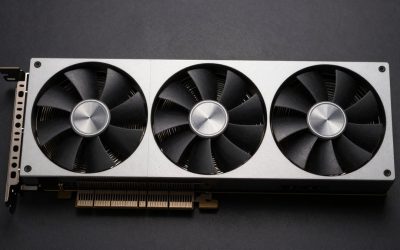
The older RX 6950 XT is clearly the faster card, typically around 25-40% quicker than the RX 9060 XT in raster games, so it is the better buy for 1440p and entry-level 4K if you can find one at a similar price; the newer RX 9060 XT, especially the 16 GB version, wins on power draw, ray tracing efficiency, FSR 4 support and warranty, which makes it the more sensible new purchase for 1080p and lighter 1440p gaming. The RX 9060 XT is not an upgrade for an RX 6950 XT owner.
The RX 6950 XT was AMD’s final RDNA 2 flagship, a refreshed RX 6900 XT launched on 10 May 2022 at $1,099. The RX 9060 XT arrived on 4 June 2025 as AMD’s mainstream RDNA 4 card in two versions: 8 GB at $299 and 16 GB at $349. One is a former halo product now sold mostly used; the other is a current mid-range card designed around efficiency and modern features.
As an Amazon Associate we earn from qualifying purchases at no extra cost to you.



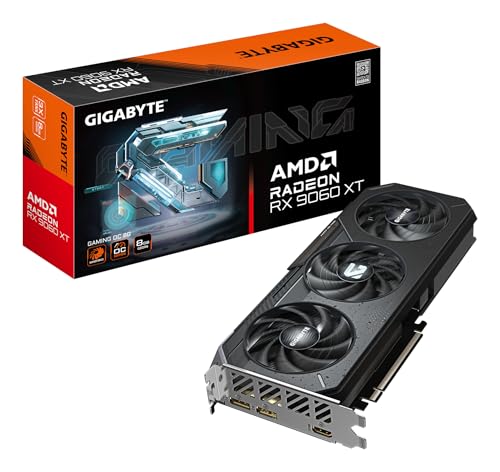
Our Top Picks
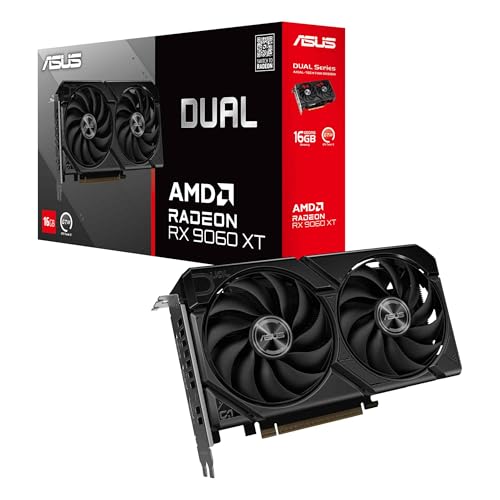 ASUS Dual Radeon RX 9060 XT 16GB GDDR6RX9060XT|16GB|Black8 x 4.7 x 1.9 inches1.3 poundsCheck on Amazon

Top 3 picks at a glance
Specifications Compared
| Specification | RX 6950 XT | RX 9060 XT 8GB | RX 9060 XT 16GB |
|---|---|---|---|
| Architecture | RDNA 2.0 | RDNA 4.0 | RDNA 4.0 |
| Release date | 10 May 2022 | 4 June 2025 | 4 June 2025 |
| Launch MSRP | $1,099 | $299 | $349 |
| Stream processors | 5120 | 2048 | 2048 |
| Boost clock | 2324 MHz | 3130 MHz | 3130 MHz |
| Process | 7 nm | 4 nm | 4 nm |
| TDP | 335 W | 150 W | 160 W |
| Memory | 16 GB GDDR6 | 8 GB GDDR6 | 16 GB GDDR6 |
| Memory bus | 256-bit | 128-bit | 128-bit |
| Bandwidth | 576.0 GB/s | 322.3 GB/s | 322.3 GB/s |
| L2 / Infinity Cache (L3) | 4 MB / 128 MB | 4 MB / 32 MB | 4 MB / 32 MB |
| Interface | PCIe 4.0 x16 | PCIe 5.0 x16 | PCIe 5.0 x16 |
| Power connectors | 2x 8-pin | 1x 8-pin | 1x 8-pin |
| Length / width | 267 mm, 3-slot | 267 mm, 2-slot | 267 mm, 2-slot |
| Display outputs | 1x HDMI 2.1, 2x DP 1.4a | 1x HDMI 2.1b, 2x DP 2.1a | 1x HDMI 2.1b, 2x DP 2.1a |
The RX 6950 XT has two and a half times the stream processors, nearly 80% more memory bandwidth and four times the Infinity Cache. The RX 9060 XT counters with much higher clocks, a far more efficient architecture and modern ray tracing and AI hardware, but it cannot close a gap this large in raw raster throughput.
Raster Performance
Full head-to-head reviews of this exact pair are scarce, so the most reliable picture comes from placing each card against common reference points. TechPowerUp’s and Hardware Unboxed’s RX 9060 XT reviews placed the 16 GB card roughly level with the RTX 5060 Ti 16GB, while the RX 6950 XT sits at about RX 7800 XT level in the same publications’ charts. Aggregated comparison sites estimate the 6950 XT’s lead over the 9060 XT at roughly 14-43%, with most landing in the 30-40% range. A balanced reading:
- 1080p: the 6950 XT is about 15-30% faster, with the gap compressed by CPU limits.
- 1440p: roughly 25-40% faster.
- 4K: 35-45% or more faster, where the 9060 XT’s 128-bit bus becomes a clear bottleneck.
In practice, the 9060 XT 16GB handles most modern games at 1080p high or ultra at roughly 70-110 fps and is serviceable at 1440p with upscaling, while the 6950 XT stays comfortably above 60 fps at 1440p ultra in most raster titles. Exact frame rates vary heavily by game, settings, CPU and driver.
The 8 GB version adds another caveat
The RX 9060 XT 8GB runs at the same speed as the 16 GB card when a game fits in 8 GB, but in newer titles at high texture settings it can fall well behind, with stutter and poor 1% lows. Hardware Unboxed and other outlets highlighted this in their RX 9060 XT 8GB coverage. Against an RX 6950 XT with 16 GB, the 8 GB card is the weakest option in this comparison for anything beyond 1080p with tuned settings.
Ray Tracing and Upscaling
This is where the newer card claws back ground. RDNA 4’s ray tracing hardware is substantially more capable per unit than RDNA 2’s, so the 6950 XT’s lead shrinks markedly in ray-traced games. In RT-heavy titles the two cards end up much closer, with the 9060 XT 16GB sometimes level and the 6950 XT holding a smaller lead in others. Neither is a strong path-tracing card.
Upscaling widens the 9060 XT’s appeal further. It supports FSR 4, AMD’s machine-learning upscaler, which produces sharper, more stable images than FSR 3.1 at the same internal resolution. The 6950 XT uses FSR 3.1 upscaling and frame generation plus AMD Fluid Motion Frames. With FSR 4 Performance or Balanced mode, the 9060 XT can deliver image quality that rivals the 6950 XT running FSR 3.1 at a higher setting, narrowing the practical gap in supported games.
Power, PSU and Running Costs
The power difference is dramatic: 335 W for the 6950 XT versus 150-160 W for the 9060 XT. Using GPU TDP plus CPU plus about 150 W of headroom:
- RX 6950 XT + 105 W CPU: 335 + 105 + 150 = 590 W, so a quality 750 W PSU is the sensible choice, given RDNA 2’s transient spikes.
- RX 9060 XT 16GB + 105 W CPU: 160 + 105 + 150 = 415 W, so a quality 500-550 W PSU is enough.
Running cost also adds up. Gaming for 20 hours per week, the roughly 175 W difference works out to about 3.5 kWh per week, or around 180 kWh per year. At $0.15 per kWh that is about $27 per year in extra electricity for the 6950 XT, more in high-cost regions.
The 6950 XT needs two 8-pin connectors and occupies three slots in reference form, while the 9060 XT needs a single 8-pin connector and is a two-slot card, making it far easier to fit into compact cases and prebuilt upgrades. Many partner 6950 XT cards are 320 mm or longer, so check case clearance carefully.
Buying a Used RX 6950 XT
The RX 6950 XT is no longer produced, so most buyers will find it used, usually in a broad range around $300-$400 depending on model and condition. At that price it offers more raw performance per dollar than a new 9060 XT 16GB. The trade-offs are no warranty in most cases, higher power draw, older display outputs (DisplayPort 1.4a), and no FSR 4. Ask for proof of stable operation under load, check fan noise and look for signs of heavy mining use.
Which to Buy
| Buyer profile | Pick |
|---|---|
| 1440p high refresh, raster focus, used OK | RX 6950 XT |
| Entry 4K gaming | RX 6950 XT |
| 1080p, new card with warranty | RX 9060 XT 16GB |
| Ray tracing with upscaling | RX 9060 XT 16GB (close in RT, FSR 4) |
| 500-550 W PSU, small case | RX 9060 XT 16GB |
| Tight budget, 1080p esports only | RX 9060 XT 8GB |
| Already own an RX 6950 XT | Keep it; the 9060 XT is a downgrade |
Unless the budget is very tight and you only play lighter games, the 16 GB version is the RX 9060 XT to buy. The $50 premium over the 8 GB model removes the VRAM bottleneck and keeps it closer to the 6950 XT in modern games.
Frequently Asked Questions
Is the RX 9060 XT faster than the RX 6950 XT?
No, the RX 6950 XT is faster in raster games, generally by about 25-40% at 1440p. The RX 9060 XT closes much of the gap with ray tracing enabled and benefits from FSR 4 upscaling. It also uses less than half the power.
Should I replace my RX 6950 XT with an RX 9060 XT?
No, that would reduce raster performance and, with the 8 GB model, cut VRAM in half. The only gains are lower power use, FSR 4 and better ray tracing efficiency. A real upgrade from a 6950 XT starts at cards like the RX 9070 XT.
Is the RX 9060 XT 8GB or 16GB better against the RX 6950 XT?
The 16 GB version is the better comparison point, since it avoids VRAM-related stutter in newer games. Both share the same GPU, so their speed is equal when memory is not a limit. At 1440p and with high textures, the 16 GB card is clearly the safer choice.
What power supply do I need for an RX 6950 XT?
A quality 750 W power supply is recommended, especially for factory-overclocked partner models. The card uses two 8-pin connectors in reference form, and some partner cards use three. The RX 9060 XT runs comfortably on a quality 500-550 W unit with one 8-pin connector.
Does the RX 6950 XT support FSR 4?
FSR 4 launched as an RDNA 4 feature, so the RX 6950 XT officially uses FSR 3.1 upscaling and frame generation. It also supports AMD Fluid Motion Frames through the driver. The RX 9060 XT supports FSR 4 in games that implement it.
Related guides
More from Amazon
Programs that pair well with the guide above. Offers and eligibility are set by Amazon and may change.
A free business account with business pricing and bulk-buying tools for work, shop or home office.
Create a business accountFree shipping on eligible items, Prime Video and more. Eligible new members can start with a free trial.
Start a Prime free trialAudiobooks and podcasts to listen to on the go. Eligible new members can start with a free trial.
Try Audible freeAd-free music streaming. Eligible new subscribers can start with a free trial.
Try Music Unlimited freeAs an Amazon Associate we earn from qualifying purchases.