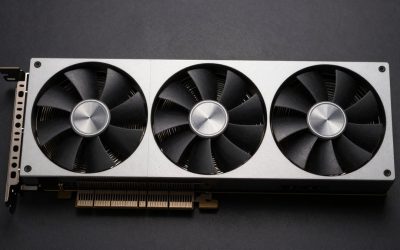
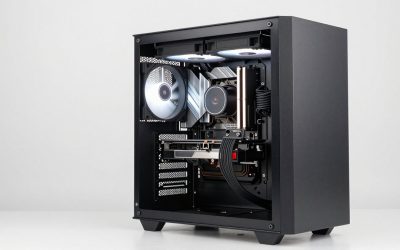
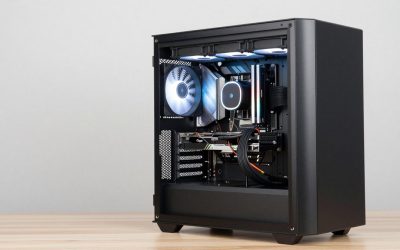
The RX 6500 XT is about 25-40% faster than the RX 6400, so choose it for any normal desktop with a 6-pin power connector and two slots of space. The RX 6400 is the right card only when the PC can’t take anything else: a slim office desktop or small-form-factor build that needs a low-profile, single-slot card running entirely on PCIe slot power. In those systems it’s one of the better upgrades available. Everywhere else, the 6500 XT, or a stronger card, gives better value.
As an Amazon Associate we earn from qualifying purchases at no extra cost to you.



Our Top Picks
 ASRock Radeon RX 6400 Challenger ITX 4GB GraphicsRX 6400 4GB9.89 x 8.55 x 2.52 inches0.6 poundsCheck on Amazon
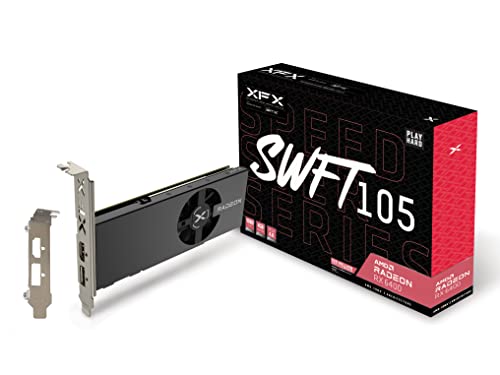
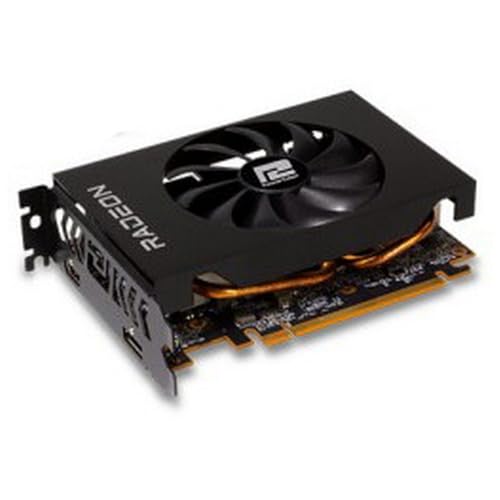

Top 3 picks at a glance
Same Chip, Different Jobs
Both cards launched on 19 January 2022 and use AMD’s Navi 24 RDNA 2 chip, built on a 6 nm process. The RX 6500 XT has more of the chip enabled (1,024 shaders versus 768), runs much higher clocks, and draws about twice the power. The RX 6400 is cut down and tuned for efficiency, with a 53 W TDP that needs no extra power cable. They share the same narrow 64-bit memory bus, 16 MB Infinity Cache and PCIe 4.0 x4 interface, so they also share the same weaknesses.
Side-by-Side Specs
| Specification | Radeon RX 6400 | Radeon RX 6500 XT |
|---|---|---|
| Architecture / process | RDNA 2.0, 6 nm | RDNA 2.0, 6 nm |
| Release date | 19 January 2022 | 19 January 2022 |
| Launch MSRP | $159 | $199 |
| Stream processors | 768 | 1,024 |
| Boost clock | 2,321 MHz | 2,815 MHz |
| Memory | 4 GB GDDR6 | 8 GB GDDR6 (listed; launch cards were 4 GB) |
| Bus / bandwidth | 64-bit / 128.0 GB/s | 64-bit / 143.9 GB/s |
| Cache | 1 MB L2 + 16 MB Infinity Cache | 1 MB L2 + 16 MB Infinity Cache |
| TDP | 53 W | 107 W |
| Power connector | None (slot powered) | 1x 6-pin |
| Width | 1-slot | 2-slot |
| Interface | PCIe 4.0 x4 | PCIe 4.0 x4 |
| Outputs | 1x HDMI 2.1, 1x DisplayPort 1.4a | 1x HDMI 2.1, 1x DisplayPort 1.4a |
The RX 6500 XT launched at $199 with 4 GB. Some board partners later released 8 GB versions, which help in memory-heavy games. Most used listings are still 4 GB, so confirm which version you’re buying.
Gaming Performance
TechPowerUp’s RX 6400 review put the card about 28% behind the RX 6500 XT, which means the 6500 XT is roughly 39% faster. The same review placed the RX 6400 around GTX 1650 level and behind the old RX 570. Tom’s Hardware’s early benchmark coverage pointed to a similar 30% deficit, and aggregate benchmark sites put the 6500 XT’s lead at roughly 25-40%. Overall, the 6500 XT is about one full performance tier higher.
At 1080p, the RX 6500 XT handles many current games at low-to-medium settings around 40-60 fps, while the RX 6400 typically needs low settings, and often FSR upscaling, to reach 30-45 fps in the same titles. Both run esports games like Valorant, CS2 and Rocket League at high frame rates. These ranges vary considerably with game, settings, CPU and driver version.
The PCIe 3.0 problem affects both
Both cards use only four PCIe lanes. On a PCIe 3.0 motherboard, common in the older office PCs these cards often go into, that link runs at half speed. TechPowerUp noted over 10% additional performance loss for the RX 6400 on PCIe 3.0. TechSpot’s review ran the RX 6400 on PCIe 3.0 and found it falling to about 20% behind a PCIe 4.0 RX 6500 XT on average, and far further in memory-heavy titles such as Doom Eternal. The 4 GB RX 6400 is particularly sensitive because it runs out of VRAM sooner.
Ray Tracing, Upscaling and Media
- Ray tracing: Both support hardware RT, but the performance isn’t practical for gaming on either card. It mostly lets RT-required games launch at very low settings.
- Upscaling: Both work with FSR 1/2/3 and XeSS DP4a. FSR is close to essential for the RX 6400 in newer games. Neither supports FSR 4.
- Frame generation: FSR 3 frame generation and AMD Fluid Motion Frames are supported on RDNA 2, but frame generation works best from a base frame rate of about 60 fps, which these cards often don’t reach in demanding games.
- Video: Navi 24 has no hardware video encoder and no AV1 decode. That rules out GPU-encoded streaming and makes either card a poor choice for a modern home-theater PC that needs AV1 playback.
VRAM: 4 GB vs 8 GB
In 2026, 4 GB is a hard limit. Many new releases list 6-8 GB as their minimum, and 4 GB cards need the lowest texture settings, and sometimes still stutter. An 8 GB RX 6500 XT avoids the worst of this and reduces traffic across the slow x4 PCIe link. If you’re choosing between a 4 GB 6500 XT and an 8 GB 6500 XT, the 8 GB version is worth a modest premium. The RX 6400 only exists with 4 GB, which is another reason it suits older games and esports better than new releases.
Power, PSU and Case Fit
PSU calculation
- RX 6400: 53 W + 65 W (typical office CPU) + 150 W headroom = 268 W. Most OEM desktops with 180-300 W power supplies can run it, because it draws all its power through the PCIe slot.
- RX 6500 XT: 107 W + 65 W + 150 W = 322 W, so a 350-400 W unit with a 6-pin PCIe lead.
Physical fit
This is the RX 6400’s main selling point. Its single-slot width and 53 W power draw allow low-profile versions with half-height brackets that fit slim Dell, HP and Lenovo small-form-factor desktops. The RX 6500 XT is a two-slot card, needs a 6-pin cable many OEM power supplies don’t have, and doesn’t come in low-profile form. Before buying an RX 6400 for a slim PC, check that the specific model includes a low-profile bracket. Not all versions do.
Value and Used Pricing
At launch MSRP, with the RX 6500 XT at 100 on a performance index and the RX 6400 at about 72, the RX 6400 cost $2.21 per point and the 6500 XT $1.99 per point. The faster card was slightly better value even at launch. Used, the RX 6400 typically sells for about $70-$100 and a 4 GB RX 6500 XT for about $80-$120. The gap is small, so the 6500 XT is the better buy whenever the PC can power and fit it.
New buyers with a standard ATX case and a 450 W+ power supply should look past both. A used RX 6600 or a new Intel Arc B570 costs somewhat more but delivers roughly double the gaming performance, along with a full x8 link and 8-10 GB of VRAM.
Display Outputs and Multi-Monitor Use
Both cards offer only two display outputs: one HDMI 2.1 and one DisplayPort 1.4a. That’s enough for most single-monitor gaming setups and a basic dual-screen desk, but it rules out three-monitor setups without a DisplayPort hub. Older office PCs being upgraded often have a VGA or DVI monitor, which will need an active adapter. HDMI 2.1 does allow 4K at 120 Hz output to modern TVs, although neither GPU has the power to render demanding games anywhere near that. For media playback, the missing AV1 decoder means some streaming services fall back to CPU decoding or older codecs on these cards.
Which One Fits Your PC?
| Your PC | Pick | Reason |
|---|---|---|
| Slim OEM desktop, low-profile slot, no 6-pin | RX 6400 | Single slot, slot-powered, low-profile versions |
| Standard mid-tower, 350 W+ PSU with 6-pin | RX 6500 XT | About 25-40% faster |
| PCIe 3.0 board and new AAA games | RX 6500 XT 8 GB, or neither | More VRAM reduces x4 link penalties |
| Home-theater PC needing AV1 decode | Neither | Navi 24 lacks AV1 decode |
| Esports at 1080p in a small case | RX 6400 | Runs esports well at about 53 W |
Frequently Asked Questions
How much faster is the RX 6500 XT than the RX 6400?
TechPowerUp’s review data puts the RX 6400 about 28% behind, which makes the 6500 XT roughly 39% faster. Other sources range from about 25% to 40%. The exact gap depends on the game and whether the system uses PCIe 3.0 or 4.0.
Does the RX 6400 need a power connector?
No. Its 53 W TDP is within what the PCIe slot can supply, so it runs without any extra cable. That’s why it works in OEM desktops with small, proprietary power supplies.
Is there a low-profile RX 6500 XT?
Low-profile 6500 XT models are not common, because the card’s 107 W draw and need for a 6-pin connector make them hard to build. For half-height slots, the RX 6400 is the practical choice. Always check the specific model’s bracket and dimensions.
Are these cards good for streaming?
No. Navi 24 has no hardware video encoder, so streaming would rely on the CPU. They also lack AV1 decode, which limits them for modern video playback.
Will the RX 6400 work in a PCIe 3.0 PC?
Yes, it works, but its x4 link runs at half bandwidth on PCIe 3.0, costing roughly 10% or more in many games and more in 1% lows. It’s still a meaningful upgrade over integrated graphics in most older office PCs.
Related guides
More from Amazon
Programs that pair well with the guide above. Offers and eligibility are set by Amazon and may change.
A free business account with business pricing and bulk-buying tools for work, shop or home office.
Create a business accountFree shipping on eligible items, Prime Video and more. Eligible new members can start with a free trial.
Start a Prime free trialAudiobooks and podcasts to listen to on the go. Eligible new members can start with a free trial.
Try Audible freeAd-free music streaming. Eligible new subscribers can start with a free trial.
Try Music Unlimited freeAs an Amazon Associate we earn from qualifying purchases.