
For pure rasterized frame rates at 1080p the RX 5700 XT is still a little faster, so it suits buyers who play older or esports titles and can find one cheaply used, while the Arc A580 is the better pick for anyone who wants hardware ray tracing, modern upscaling with frame generation, HDMI 2.1 and lower power draw. The gap between them is small, which means features, power and price decide this matchup more than raw speed does.
These two cards come from different eras. AMD launched the RX 5700 XT in July 2019 at $399 as a 1440p contender, while Intel’s Arc A580 arrived in October 2023 as a budget card that sat around the $180 mark in launch reviews. Both now fight in the same used and clearance price band, which is why so many budget builders compare them directly.
As an Amazon Associate we earn from qualifying purchases at no extra cost to you.

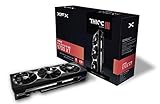

Our Top Picks

Top 3 picks at a glance
Spec Sheet Side by Side
| Specification | Radeon RX 5700 XT | Arc A580 |
|---|---|---|
| Architecture | RDNA 1.0 | Xe-HPG (Generation 12.7) |
| Release date | 7 July 2019 | 10 October 2023 |
| Launch MSRP | $399 | Not listed (about $180 at launch reviews) |
| Shaders | 2560 | 3072 |
| Boost clock | 1905 MHz | 2000 MHz |
| Process | 7 nm | 6 nm |
| TDP | 225 W | 175 W |
| Memory | 8 GB GDDR6 | 8 GB GDDR6 |
| Bus width | 256-bit | 256-bit |
| Bandwidth | 448.0 GB/s | 512.0 GB/s |
| L2 cache | 4 MB | 8 MB |
| Interface | PCIe 4.0 x16 | PCIe 4.0 x16 |
| Power connectors | 1x 6-pin + 1x 8-pin | 2x 8-pin |
| Length | 272 mm (reference) | Varies by board partner |
| Width | 2-slot | 2-slot |
| Outputs | 1x HDMI 2.0b, 3x DisplayPort 1.4a | 1x HDMI 2.1, 3x DisplayPort 2.0 |
On paper the A580 has more shaders, more bandwidth and twice the L2 cache, yet shader counts across AMD and Intel architectures are not directly comparable. Intel’s first-generation Xe-HPG design extracts less performance per shader than RDNA in many games, which is why the older AMD card keeps a slight lead despite the smaller numbers.
Raster Performance: Close, With a Small AMD Edge
According to TechPowerUp’s review of the ASRock Arc A580 Challenger, the A580 landed roughly level with the Radeon RX 6600 and about 8% behind the RX 5700 XT across its game suite. The same review placed the A580 around 10% ahead of the RTX 2060 and only about 9% behind Intel’s own Arc A750. Synthetic-heavy aggregator sites sometimes show a much larger gap in favor of the 5700 XT, but those scores lean on older benchmark tools and do not reflect modern game results as well as full review suites.
In practice that translates to the following picture, with frame rates that vary a lot with settings, CPU and game patch:
- 1080p high settings: both cards usually deliver roughly 60-100 fps in recent mainstream titles, with the 5700 XT a few frames ahead on average.
- 1440p: both can hold roughly 45-70 fps at medium-to-high settings in many games; upscaling is the realistic path to steady 60 fps in demanding releases.
- Older DirectX 11 games: the 5700 XT tends to look stronger here, because Intel’s driver stack historically performed best in DirectX 12 and Vulkan titles. Intel has improved DX11 performance considerably with driver updates since 2023, but the variance between games is still larger on Arc.
Ray Tracing Is a One-Sided Contest
The RX 5700 XT has no hardware ray tracing units at all. RDNA 1 predates AMD’s ray accelerators, so ray-traced effects either run very poorly through software fallbacks or are not offered. More importantly, a growing number of recent games treat ray tracing as mandatory, and those titles will refuse to launch or run unacceptably on a card without RT hardware. The A580 has dedicated ray tracing units and handles light ray-traced effects at 1080p, especially with XeSS upscaling enabled. It is not a ray tracing powerhouse, but it can at least run these games.
Upscaling and Frame Generation
Feature support is where the gap widens in Intel’s favor:
- Arc A580: supports XeSS using Intel’s XMX matrix units, which generally produces better image quality than the generic DP4a path used on non-Intel cards. Intel’s driver released in February 2026 brought XeSS 3 multi-frame generation to Arc A-series cards, with up to 4x generation in supported XeSS 2 games, applied through the Intel Graphics Software override.
- RX 5700 XT: limited to FSR 2 and FSR 3.1 upscaling, FSR 3 frame generation in games that implement it, and the DP4a fallback of XeSS. FSR 4 is built for RDNA 4 hardware and is not officially available on RDNA 1.
Frame generation adds latency and works best when the base frame rate is already around 50-60 fps, so it is not a fix for a card that is struggling. Still, the A580 has the more future-facing toolkit.
VRAM and Memory Headroom
Both cards carry 8 GB of GDDR6 on a 256-bit bus, so neither has an advantage in capacity. At 1080p, 8 GB is workable with high textures in most games, but several recent releases already push past 8 GB at ultra texture settings, which causes stutter and texture pop-in. At 1440p, plan on high rather than ultra textures in demanding titles. The A580’s 512 GB/s of bandwidth and larger L2 cache help it in memory-heavy scenes, but they do not add capacity.
Power, PSU and Case Fit
The A580 has a 175 W TDP against 225 W for the RX 5700 XT. A simple PSU sizing estimate adds GPU TDP, CPU power and around 150 W of headroom for drives, fans, transients and efficiency:
- RX 5700 XT + 105 W gaming CPU: 225 + 105 + 150 = 480 W, so a quality 550 W unit is a sensible floor and 600 W gives more margin for spikes.
- Arc A580 + 105 W gaming CPU: 175 + 105 + 150 = 430 W, so a quality 500-550 W unit is enough.
Connector requirements differ: the 5700 XT needs one 6-pin and one 8-pin, while the A580 needs two 8-pin PCIe plugs. Older budget power supplies sometimes only have one 8-pin and one 6-pin lead, so check before buying the Intel card. Both are 2-slot designs; the reference 5700 XT measures 272 mm, and partner boards for both cards range from compact dual-fan models to longer triple-fan designs, so measure the case clearance first.
Note that TechPowerUp flagged the A580’s power efficiency as weaker than rival cards and highlighted its high idle power draw unless specific motherboard and Windows power settings are applied.
Platform Requirement: Resizable BAR
Arc cards depend on Resizable BAR for good performance, a point TechPowerUp listed among the A580’s drawbacks. Most Intel 10th-gen and newer and AMD Ryzen 3000 and newer platforms support it after a BIOS update, but older systems without ReBAR can lose a large share of performance. The 5700 XT does not have this dependency, which makes it the safer drop-in for an older PC.
Which One to Pick
| Situation | Better pick | Reason |
|---|---|---|
| Older PC without Resizable BAR | RX 5700 XT | Arc loses significant performance without ReBAR |
| 1080p esports and older DX11 games | RX 5700 XT | Slightly higher raster speed, steadier DX11 results |
| Games with mandatory ray tracing | Arc A580 | 5700 XT has no RT hardware |
| 1440p with upscaling and frame generation | Arc A580 | XeSS on XMX plus XeSS 3 frame generation |
| Weak or older PSU | Arc A580 (check for 2x 8-pin) | 50 W lower TDP |
| HDMI 2.1 TV or high-refresh monitor via DP 2.0 | Arc A580 | Newer display outputs |
| Lowest possible price | Whichever is cheaper locally | Performance gap is under about 10% |
Used-Market and Value Notes
The RX 5700 XT is now a used-only card in most regions and usually trades somewhere around $120-$170 depending on condition and cooler. Many units are six or more years old, and some saw cryptocurrency mining duty, so fan wear and dried thermal paste are common. A card with a fresh repaste and working fans is worth a modest premium. The A580 is still found new or as open-box stock in some regions, typically in a similar to slightly higher price band, and a newer card usually comes with remaining warranty.
A quick cost-per-performance check: if the 5700 XT is rated at 100 and the A580 at about 92 based on TechPowerUp’s relative figures, a used 5700 XT at $140 works out to $1.40 per performance point, while an A580 at $160 works out to roughly $1.74. The AMD card wins on raw value, but the A580 buys ray tracing support, newer upscaling, lower power and usually a warranty, which closes much of that gap for many buyers.
Driver Outlook
AMD has focused its newest software features, such as FSR 4, on RDNA 4, and RDNA 1 cards receive fewer game-specific optimizations than they used to. Intel’s Alchemist cards continue to receive driver updates and gained XeSS 3 frame generation in 2026, though Intel’s newest optimization work centers on the Arc B570 and B580 Battlemage cards. For a card expected to last several more years, the A580 has the stronger software runway, while the 5700 XT is best seen as a cheap stopgap.
It is also worth noting that both cards sit below current entry-level options. The Arc B570 and B580, the Radeon RX 9060 XT and the GeForce RTX 5050 and 5060 all offer newer features and generally better efficiency, so stretching the budget to one of those is worth considering if the price difference is modest.
Frequently Asked Questions
Is the RX 5700 XT faster than the Arc A580?
Yes, slightly. TechPowerUp’s review data places the Arc A580 roughly 8% behind the RX 5700 XT in average raster performance. The difference is small enough that most players would not notice it without a frame counter, and it can flip in favor of the A580 in some DirectX 12 titles.
Can the RX 5700 XT run games that require ray tracing?
Generally no. The RX 5700 XT lacks hardware ray tracing units, so games built with mandatory ray tracing either will not launch or run very poorly. The Arc A580 has dedicated RT hardware and can run those titles at modest settings.
Does the Arc A580 work well in an older PC?
Only if the motherboard and CPU support Resizable BAR and it is enabled in the BIOS. Without ReBAR, Arc cards lose a substantial amount of performance and suffer worse frame pacing. In older systems that lack the feature, the RX 5700 XT is the more reliable choice.
What power supply do these cards need?
A quality 550-600 W unit is a sensible target for the RX 5700 XT with a typical gaming CPU, and 500-550 W is usually enough for the Arc A580. The A580 needs two 8-pin PCIe connectors, while the 5700 XT uses one 6-pin and one 8-pin. Always confirm the PSU has the required leads before buying.
Is 8 GB of VRAM enough for these cards in 2026?
It is enough for 1080p gaming at high settings in most titles, but some recent games exceed 8 GB at ultra textures. Dropping textures to high usually removes stutter on both cards. Neither card has a VRAM advantage, since both use 8 GB on a 256-bit bus.
Which card is better for 1440p gaming?
The Arc A580 is the better 1440p option for newer games because XeSS with XMX acceleration and XeSS 3 frame generation help it reach smoother frame rates. The RX 5700 XT has slightly more raw speed but relies on FSR 3.1, which generally looks softer at lower internal resolutions. For older games that do not need upscaling, the 5700 XT holds a small edge.

