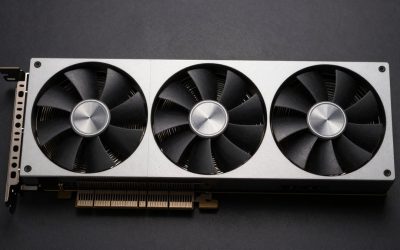
For a new 1080p build, the RTX 5050 is the better buy: it is generally about 15-25% faster than the RX 5700, supports ray tracing, DLSS 4 with Multi Frame Generation and DirectX 12 Ultimate, draws 50 W less and comes with a warranty. A used RX 5700 is only the smarter choice on a very tight budget, where it can deliver most of the 5050’s raster performance for roughly half the money, as long as you accept that some newer games will not run well or at all on it.
These cards are six years apart. The RX 5700 launched in July 2019 at $349 on AMD’s first RDNA architecture, while the RTX 5050 arrived in July 2025 at $249 as the entry point to NVIDIA’s Blackwell-based RTX 50 series. Both carry 8 GB of GDDR6, both target 1080p, and both appear in the same budget searches today, one as a secondhand bargain and the other as the cheapest current-generation GeForce.
As an Amazon Associate we earn from qualifying purchases at no extra cost to you.


Our Top Picks

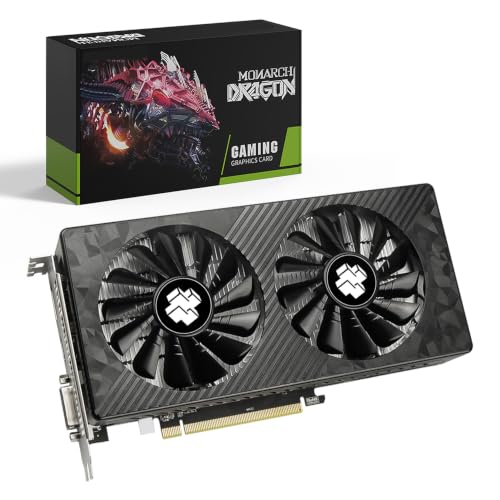


Top 3 picks at a glance
Spec Comparison Table
| Spec | RX 5700 | RTX 5050 |
|---|---|---|
| Architecture | RDNA 1.0 | Blackwell 2.0 |
| Release date | 7 July 2019 | 1 July 2025 |
| Launch MSRP | $349 | $249 |
| Shaders / CUDA cores | 2304 | 2560 |
| Boost clock | 1725 MHz | 2572 MHz |
| Process | 7 nm | 5 nm |
| TDP | 180 W | 130 W |
| Memory | 8 GB GDDR6 | 8 GB GDDR6 |
| Bus width | 256-bit | 128-bit |
| Bandwidth | 448.0 GB/s | 320.0 GB/s |
| L2 cache | 4 MB | 24 MB |
| Interface | PCIe 4.0 x16 | PCIe 5.0 x8 |
| Power connectors | 1x 6-pin + 1x 8-pin | 1x 8-pin |
| Width | 2-slot (268 mm reference length) | 2-slot |
| Outputs | 1x HDMI 2.0b, 3x DP 1.4a | 1x HDMI 2.1b, 3x DP 2.1b |
The older RX 5700 actually has the wider 256-bit bus and 40% more raw bandwidth, but the RTX 5050 compensates with a 24 MB L2 cache, six times larger, and much higher clocks. That cache reduces how often the GPU needs to go out to memory, which is why the narrower bus does not hold it back much at 1080p.
Raster Gaming Performance
Full professional reviews rarely pair these two cards directly, so the clearest picture comes from aggregated benchmark data. Technical.city’s aggregate places the RTX 5050 about 14-19% ahead across 1080p, 1440p and 4K, HowManyFPS reports about 24% across more than 100 games, and 3DMark Time Spy-style tests show roughly 17-21%. Some individual modern games show much larger gaps, beyond 50%, especially titles that use DirectX 12 Ultimate features. A fair summary for typical games is that the RTX 5050 is roughly 15-25% faster.
For context, Notebookcheck described the RTX 5050’s 1080p performance as adequate rather than exciting, and AMD’s RX 9060 measured meaningfully faster in synthetic tests. At 1080p high settings in demanding recent games, expect roughly 40-60 fps on the RX 5700 and 50-75 fps on the RTX 5050, while esports titles comfortably exceed 144 fps on both. These figures vary with settings, CPU, driver version and game patches.
Ray Tracing and Modern Game Compatibility
This is the biggest functional difference. The RX 5700 has no hardware ray tracing and lacks the full DirectX 12 Ultimate feature set, including mesh shaders. A growing list of recent games either require these features, run with heavy penalties without them, or refuse to launch. The RTX 5050 supports DirectX 12 Ultimate and fourth-generation RT cores, so it runs everything, and light ray tracing at 1080p is realistic with DLSS enabled.
Upscaling and Frame Generation
- RTX 5050: Full DLSS 4 support, including the transformer-based Super Resolution model, Frame Generation and Multi Frame Generation, plus Reflex. In a budget card this is a significant extra, since DLSS Quality at 1080p and MFG can turn a borderline 45 fps experience into a smooth-looking one in supported games.
- RX 5700: FSR 2 and 3 upscaling, FSR 3 frame generation where supported, and the DP4a path of XeSS. AMD’s ML-based FSR 4 is not available on RDNA 1. Newer game-specific driver optimizations also tend to focus on more recent AMD architectures.
Frame generation works best with a base frame rate around 50-60 fps; it improves motion smoothness but adds some latency, so it is less useful in competitive shooters.
VRAM and the PCIe x8 Question
Both cards have 8 GB, which is the practical floor for 1080p in 2026. Many current titles need high rather than ultra textures to stay inside 8 GB, and 1440p requires careful settings on either card. Frame generation also consumes some VRAM, which can push the 5050 closer to its limit in heavy games.
The RTX 5050 uses eight PCIe lanes. On a PCIe 5.0 or 4.0 board that is ample, but on an older PCIe 3.0 system bandwidth drops to a quarter of a PCIe 5.0 x8 link, which can hurt performance whenever a game spills past 8 GB of VRAM. If your motherboard is PCIe 3.0, that narrows the 5050’s advantage, while the RX 5700’s x16 link is less sensitive.
Power, PSU and Case Fit
Using GPU TDP plus CPU (about 100 W for a budget gaming CPU) plus roughly 150 W headroom:
- RX 5700: 180 + 100 + 150 = 430 W, so a quality 500-550 W unit is sensible.
- RTX 5050: 130 + 100 + 150 = 380 W, so a good 450 W unit is enough.
The RX 5700 needs both a 6-pin and an 8-pin plug, while the RTX 5050 needs only one 8-pin connector, which suits prebuilt systems and older budget PSUs. The reference RX 5700 is 268 mm long; many RTX 5050 partner cards are compact dual-fan or even single-fan designs, but check the exact model’s length. The 5050’s newer outputs (HDMI 2.1b and DisplayPort 2.1b) also support higher refresh rates at high resolutions than the RX 5700’s HDMI 2.0b.
Value: New vs Used
At launch MSRP the RTX 5050 was clearly the better deal: $249 for roughly 120% of the RX 5700’s performance, versus $349 for the RX 5700 in 2019. Today the RX 5700 is sold almost entirely secondhand, typically around $100-$150 depending on condition and model.
- Used RX 5700 at about $125, indexed at 100: about $1.25 per performance point.
- New RTX 5050 at $249, indexed at about 120: about $2.08 per performance point.
On raw raster value the used RX 5700 wins comfortably. What the extra money buys with the 5050 is DLSS 4, ray tracing, compatibility with newer DX12 Ultimate games, lower power draw and a warranty. If your budget can stretch further, the RTX 5060, RX 9060 XT or Arc B580 deliver noticeably more performance and, in some versions, more VRAM.
Pick This One If
| Situation | Pick |
|---|---|
| New 1080p build, wants latest games | RTX 5050 |
| Absolute lowest budget, older or esports games | Used RX 5700 |
| Prebuilt or 450 W PSU with one PCIe cable | RTX 5050 |
| Older PCIe 3.0 motherboard | RX 5700 is less affected; 5050 still faster on average |
| Wants ray tracing or DLSS frame generation | RTX 5050 |
| Budget can reach about $300 | Skip both: RTX 5060, RX 9060 XT or Arc B580 |
Used RX 5700 Buying Tips
If the used route wins on budget, a few checks reduce the risk. Many RX 5700 cards were run hard for crypto mining, so ask about the card’s history and look for clean fans, intact screws and no signs of a removed cooler. Blower-style reference cards run loud and hot; dual- or triple-fan partner models are more pleasant to live with. Some RX 5700 owners flashed RX 5700 XT firmware for extra clocks, so confirm the card runs stock settings stably before paying.
Also confirm the game list you care about. If any titles on your wishlist require mesh shaders or hardware ray tracing, the RX 5700 is the wrong buy regardless of price, and the RTX 5050 or another current card is the safer path.
Frequently Asked Questions
Is the RTX 5050 faster than the RX 5700?
Yes, on average by roughly 15-25% in typical games according to aggregated benchmark data. In some modern titles that rely on DirectX 12 Ultimate features, the gap is much larger.
Can the RX 5700 run games that need mesh shaders or ray tracing?
No. The RX 5700 lacks hardware ray tracing and mesh shader support, so certain recent games run poorly or will not launch. The RTX 5050 supports the full DirectX 12 Ultimate feature set.
Does the RTX 5050 support DLSS 4 Multi Frame Generation?
Yes. As an RTX 50 series card, it supports DLSS 4 Super Resolution, Frame Generation and Multi Frame Generation in games that implement them.
Is a used RX 5700 still worth buying in 2026?
Only at a low price for older or esports-focused gaming. It offers good raster value but lacks modern features, and driver focus has moved to newer AMD architectures.
What PSU do I need for the RTX 5050?
A quality 450 W unit with one 8-pin PCIe connector is enough with a typical budget CPU. The RX 5700 is better paired with a 500-550 W unit and needs both a 6-pin and an 8-pin plug.
Related guides
More from Amazon
Programs that pair well with the guide above. Offers and eligibility are set by Amazon and may change.
A free business account with business pricing and bulk-buying tools for work, shop or home office.
Create a business accountFree shipping on eligible items, Prime Video and more. Eligible new members can start with a free trial.
Start a Prime free trialAudiobooks and podcasts to listen to on the go. Eligible new members can start with a free trial.
Try Audible freeAd-free music streaming. Eligible new subscribers can start with a free trial.
Try Music Unlimited freeAs an Amazon Associate we earn from qualifying purchases.