
The RX 6800 XT is the stronger card by a wide margin, roughly 40-50% faster than the RTX 3060 Ti in rasterized games at 1440p with twice the VRAM, so it is the better buy for 1440p and 4K gaming whenever the used price gap is reasonable; the RTX 3060 Ti only wins if your budget, power supply or need for DLSS rules out the bigger Radeon. These cards were never in the same class at launch, and the price gap reflected that, but on the used market the difference has narrowed enough that many buyers end up choosing between them.
As an Amazon Associate we earn from qualifying purchases at no extra cost to you.



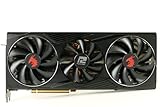
Our Top Picks

Top 3 picks at a glance
Different Tiers, Overlapping Budgets
The RTX 3060 Ti launched at $399 as NVIDIA’s upper mid-range card, while the RX 6800 XT launched at $649 as AMD’s answer to the RTX 3080. Today both are bought mostly used, and the price difference between them is much smaller than the original $250 gap. That makes the question practical: is it worth paying somewhat more for a card from a higher tier?
Spec Comparison
| Spec | RTX 3060 Ti | RX 6800 XT |
|---|---|---|
| Architecture | Ampere | RDNA 2.0 |
| Release date | 1 December 2020 | 28 October 2020 |
| Launch MSRP | $399 | $649 |
| Shaders | 4,864 CUDA cores | 4,608 stream processors |
| Boost clock | 1,665 MHz | 2,250 MHz |
| Process | 8 nm | 7 nm |
| Board power | 200 W | 300 W |
| Memory | 8 GB GDDR6 | 16 GB GDDR6 |
| Memory bus | 256-bit | 256-bit |
| Bandwidth | 448.0 GB/s | 512.0 GB/s |
| Cache | 4 MB L2 | 4 MB L2 + 128 MB Infinity Cache |
| Interface | PCIe 4.0 x16 | PCIe 4.0 x16 |
| Power connectors | 12-pin on Founders Edition; most partner cards use a single 8-pin | 2x 8-pin |
| Length / width | 242 mm, 2-slot | 267 mm, 2-slot |
| Outputs | 1x HDMI, 3x DisplayPort | 1x HDMI, 2x DisplayPort, 1x USB-C |
Core counts are not comparable across brands. The RX 6800 XT runs at much higher clocks and has a 128 MB on-die cache, which is the main reason it performs in the RTX 3080 class despite a similar bus width to the 3060 Ti.
Raster Performance
TechPowerUp’s RX 6800 XT review placed the Radeon about 25% ahead of the RTX 3070 in rasterized games, and TechSpot’s RTX 3060 Ti review (Hardware Unboxed data) found the 3060 Ti about 9% slower than the RTX 3070 at 1440p. Combining those, the 6800 XT ends up around 40% faster than the 3060 Ti, and game-by-game comparisons published since then mostly show 40-50% at 1440p, with individual titles like Shadow of the Tomb Raider and Battlefield V near +45%.
- 1080p: a 30-40% lead is typical, smaller in CPU-limited esports titles.
- 1440p: roughly 40-50%. Where the 3060 Ti averages around 90 fps in a demanding title, the 6800 XT often lands near 125-135 fps, varying with settings, CPU and patches.
- 4K: the gap stays large, and the 3060 Ti’s 8 GB becomes a hard limit in many modern games.
In the newest VRAM-hungry games, the gap can stretch well beyond 50% at 1440p ultra settings, because the 3060 Ti runs out of memory while the 6800 XT does not.
Ray Tracing and Upscaling
This is the RTX 3060 Ti’s strongest area. RDNA 2’s ray tracing loses more performance than Ampere when effects are enabled; TechPowerUp described the 6800 XT’s ray tracing as roughly at RTX 2080 Ti level, which is also roughly RTX 3070 level. Because the 3060 Ti is a step below the 3070, the 6800 XT still tends to be ahead with ray tracing on, just by a much smaller margin than in raster, often in the 10-25% range, and some NVIDIA-optimized titles can be close to even.
Upscaling tips the scale toward NVIDIA:
- RTX 3060 Ti: DLSS 4 Super Resolution with the transformer model gives clean results even in Performance mode at 1440p. The heavier DLSS 4.5 model also runs, but RTX 30 cards lose noticeably more fps with it than newer GPUs. No DLSS Frame Generation (RTX 40/50 only).
- RX 6800 XT: FSR 3.1 today, plus AMD Fluid Motion Frames at the driver level. AMD brought FSR 4.1 to RX 7000 in June 2026 and has announced it for RX 6000 in early 2027, which should close much of the image-quality gap.
- Both: can use FSR 3 frame generation in games that support it.
So a 3060 Ti using DLSS Quality and a 6800 XT running native or FSR can look comparable in a ray-traced game, but the Radeon has more performance to spend before upscaling even enters the picture.
VRAM Headroom: 8 GB vs 16 GB
A rough guide for 2026 games at high settings: about 8 GB for 1080p, 10-12 GB for 1440p, and 12-16 GB for 4K. The 3060 Ti meets the 1080p line and falls short of the 1440p recommendation in many recent releases. The 6800 XT covers all three resolutions comfortably. If you keep cards for several years, this alone is a strong argument for the Radeon.
Power Supply and Case Fit
The 6800 XT draws 100 W more. Using GPU power plus CPU power plus about 150 W of headroom:
- RTX 3060 Ti: 200 W + 125 W + 150 W = about 475 W, so a quality 550 W unit is enough.
- RX 6800 XT: 300 W + 125 W + 150 W = about 575 W, so plan on 650-750 W. AMD’s own guidance for the reference card was 750 W.
The facts list a 12-pin connector for the 3060 Ti, but that applies to the Founders Edition with its adapter; most retail RTX 3060 Ti cards use a single 8-pin. The 6800 XT needs two 8-pin cables. At 267 mm, the reference 6800 XT is longer than the 242 mm 3060 Ti, and many partner 6800 XT models exceed 300 mm with triple fans, so measure your case first.
Value Calculation
At launch prices, with the 3060 Ti indexed at 100 and the 6800 XT at about 145 for 1440p raster:
- RTX 3060 Ti: $399 / 100 = about $4.00 per performance point
- RX 6800 XT: $649 / 145 = about $4.50 per performance point
At MSRP the 3060 Ti was slightly better value. On the used market in late 2026 the balance usually flips: a used 3060 Ti tends to sell for roughly $180-$230 and a used 6800 XT for roughly $280-$350. At the midpoints that is about $2.05 per point for the 3060 Ti and about $2.15 for the 6800 XT, close to equal, but the Radeon delivers twice the VRAM in the bargain.
Pick X If, Pick Y If
| Resolution / budget | Better choice | Reason |
|---|---|---|
| 1080p, tight budget, 500-550 W PSU | RTX 3060 Ti | Lower price and power, enough performance |
| 1080p, ray tracing focus | RTX 3060 Ti | DLSS keeps RT playable with good image quality |
| 1440p, mostly raster games | RX 6800 XT | About 40-50% more performance and 16 GB |
| 1440p high refresh in new AAA games | RX 6800 XT | 8 GB is often a limit |
| 4K | RX 6800 XT | Only realistic option of the two |
| Compact case | RTX 3060 Ti | Shorter cards widely available |
For buyers considering new cards, the RX 9060 XT 16 GB and RTX 5060 Ti 16 GB offer similar mid-range performance with lower power draw and current features, which is worth comparing against used prices.
Driver Notes
RTX 30 cards remain on NVIDIA’s main Game Ready driver branch. AMD moved RX 5000 and RX 6000 cards to a separate driver branch in late 2025 that prioritizes bug and security fixes, with new-game optimization concentrated on RX 7000 and RX 9000. RX 6000 owners still get updates, and the announced FSR 4.1 support for early 2027 shows the series is not being abandoned.
Frequently Asked Questions
How much faster is the RX 6800 XT than the RTX 3060 Ti?
About 40-50% faster in rasterized games at 1440p based on review data and later comparisons. The lead shrinks to the 10-25% range with ray tracing enabled. In VRAM-heavy new games, the gap can be even larger than 50%.
Is the RTX 3060 Ti still good for 1440p?
It can handle 1440p at medium-to-high settings, especially with DLSS. Its 8 GB of VRAM is the main limit, forcing lower textures in many recent games. For high or ultra settings at 1440p, a 12-16 GB card is a safer choice.
Does the RX 6800 XT support FSR 4?
Not yet. FSR 4.1 reached RX 7000 cards in June 2026, and AMD has announced RX 6000 support for early 2027. Today the 6800 XT uses FSR 3.1 and AMD Fluid Motion Frames.
What PSU does the RX 6800 XT need?
A quality 650-750 W unit with two separate 8-pin PCIe cables suits most systems. The card is rated at 300 W and can spike higher briefly. Pairing it with a high-power CPU calls for the upper end of that range.
Which card is better for ray tracing?
Raw ray tracing speed is usually slightly higher on the RX 6800 XT, but the gap is small. The RTX 3060 Ti benefits from DLSS, which offers better upscaling quality than FSR 3. In NVIDIA-optimized ray-traced games, the two can feel similar.

