This review analyzes published product information. We have not performed detailed research of this unit.
As an Amazon Associate, we earn from qualifying purchases.
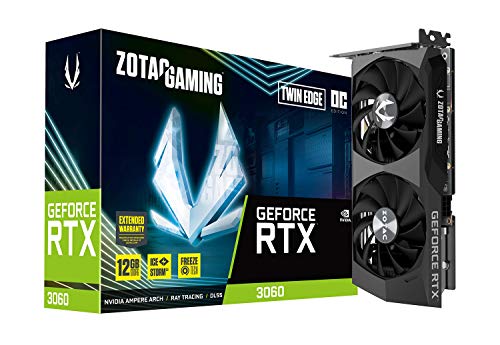
The exact Twin Edge OC under review
The ZOTAC Gaming GeForce RTX 3060 Twin Edge OC, model ZT-A30600H-10M, combines a listed 12GB GDDR6 memory configuration with a 1807 MHz boost clock and four physical display outputs. Those details establish what this particular board offers, but they do not establish how fast it will run your games. This review is based on the supplied retailer specifications, not detailed research or independent measurements.
For a gaming PC upgrade, its most useful documented characteristics are the memory arrangement, output selection and enclosure dimensions. The biggest unresolved buying issue is electrical compatibility: the supplied evidence omits board power, auxiliary power connectors and a recommended power supply. That makes this a card to assess against your existing build, rather than approve solely from the RTX 3060 name.
Specifications that identify this board
| Item | Supplied specification |
|---|---|
| Exact model | ZOTAC Gaming GeForce RTX 3060 Twin Edge OC, ZT-A30600H-10M |
| Architecture | NVIDIA Ampere |
| Specialized cores | Second-generation ray tracing cores; third-generation Tensor cores |
| Memory | 12GB GDDR6, 192-bit interface, 15 Gbps |
| Listed boost clock | 1807 MHz |
| Host interface | PCIe 4.0 |
| Cooling and construction | IceStorm 2.0 cooling, Active Fan Control, Freeze Fan Stop, metal backplate |
| Display connections | Three DisplayPort 1.4a; one HDMI 2.1 |
| Display-related claims | Support for four displays; 8K readiness; HDCP 2.3 |
| Listed graphics APIs | DirectX 12 Ultimate, Vulkan RT API, OpenGL 4.6 |
| Listed dimensions | 8.8 × 4.6 × 1.5 inches |
| Power requirements | Not supplied |
What 12GB tells you—and what it does not
The memory specification has three distinct parts: 12GB capacity, a 192-bit interface and a listed data rate of 15 Gbps. Capacity describes the amount of graphics memory available, while interface width and data rate describe other aspects of the memory subsystem. Treating the 12GB figure as a complete performance summary would overlook both the rest of that subsystem and the processor doing the rendering.
As buying guidance, this configuration deserves attention when graphics-memory capacity is one of your selection criteria. It does not, by itself, justify a particular resolution, texture preset or frame-rate expectation. The evidence contains no game benchmarks, workload results or comparisons with other boards. It also does not establish whether a specific application will benefit from all of the listed memory.
The OC designation identifies this variant, and its published boost clock is 1807 MHz. That is the clock figure to use when distinguishing this listing from another configuration. It should not be read as a promise that the GPU continuously operates at that frequency. No sustained-clock observations or comparison baseline are supplied, so the practical benefit of the OC configuration remains unquantified here.
Rendering features without performance assumptions
The listing identifies NVIDIA Ampere architecture, second-generation ray tracing cores and third-generation Tensor cores. It also lists DirectX 12 Ultimate, Vulkan RT API and OpenGL 4.6 support. These are useful compatibility details when checking software requirements, but feature support and usable performance are separate questions. The presence of ray tracing hardware does not establish which ray tracing settings will be suitable in an individual game.
The same caution applies to the retailer’s VR-readiness claim. Without a named headset, application, connection requirement or performance target, that label is too broad to settle a VR purchase decision. Check the requirements of the software and display device you actually intend to use rather than relying on a readiness badge.
Display connections are a practical strength
Three DisplayPort 1.4a sockets and one HDMI 2.1 socket provide a clearly documented connection layout. Combined with the listing’s four-display support claim, this makes the board worth considering for a gaming desk that also uses several work or communication screens. The connection types matter as much as the total: there is only one listed HDMI output, so a setup built around several HDMI-only monitors needs additional compatibility planning.
The listing also advertises 8K readiness and HDCP 2.3. Neither establishes gaming performance at 8K, and the evidence does not specify the resolution, refresh rate and color-format combinations supported across simultaneous displays. Before committing to a demanding monitor arrangement, verify the exact display modes and connection path. Four outputs should not be interpreted as a guarantee of every possible four-screen configuration.
Case clearance, cooling and the missing power details
The listed dimensions are 8.8 × 4.6 × 1.5 inches. Use those as an initial clearance check, then account for the space occupied by nearby components and any required cabling. The published listing information does not give an explicit expansion-slot requirement or installation-clearance diagram. Dimensions alone therefore cannot certify that the board will fit a particular enclosure.
ZOTAC’s named cooling provisions include IceStorm 2.0, Active Fan Control and Freeze Fan Stop, alongside a metal backplate. These document cooling features and construction, not measured temperatures or noise. The evidence provides no fan-stop thresholds, acoustic testing or sustained-load results, so there is no basis here to call the card silent or unusually cool.
More importantly, obtain the exact model’s power documentation before installation. The listing does not establish the required auxiliary connectors, board power or recommended PSU capacity. Its PCIe 4.0 label is not a substitute for those checks. One catalog field also contains an unrelated processor label; it does not establish a CPU requirement or restrict this card to a particular processor family.
Frequently asked questions
Is the ZT-A30600H-10M suitable for my existing power supply?
The article cannot confirm that it is suitable because the published listing information omits board power, auxiliary power connectors and recommended power-supply capacity. Check the exact model’s power documentation before installation. The PCIe 4.0 label does not replace those checks, and the RTX 3060 name alone is not enough to approve electrical compatibility with an existing build.
Does the 1807 MHz boost clock mean the card will always run at that speed?
No, the 1807 MHz figure is a published boost-clock specification rather than a promise of continuous operation at that frequency. The article provides no sustained-clock observations or comparison baseline, so it does not quantify the practical benefit of this OC configuration. Use the clock figure to distinguish this listing from another configuration.
Can this graphics card support four monitors at any resolution and refresh rate?
No, four outputs do not guarantee every possible four-screen configuration. The listing identifies three DisplayPort 1.4a sockets and one HDMI 2.1 socket, plus a four-display support claim, but it does not specify supported resolution, refresh-rate and color-format combinations across simultaneous displays. Several HDMI-only monitors may require additional compatibility planning.
Does the article establish which processor is required?
No, the article does not establish a CPU requirement or restrict the card to a particular processor family. One catalog field contains an unrelated processor label, which should not be treated as evidence of compatibility requirements. The documented host interface is PCIe 4.0, but that detail does not identify a required processor.
Can the listed features predict gaming performance or a suitable game preset?
No, the listed features cannot predict a particular game preset, resolution or frame rate. The article includes no game benchmarks, workload results or comparisons with other boards. Memory capacity, ray tracing hardware, Tensor cores and graphics API support describe specifications or compatibility, but they do not establish usable performance in an individual game.
Verdict: useful specifications, incomplete build approval
The ZT-A30600H-10M offers a documented 12GB memory configuration, a clear four-output layout and named fan-control features. It is a reasonable candidate to investigate when those characteristics match your needs. However, missing electrical requirements and absent performance testing prevent a firm recommendation for a particular power supply, game preset or display workload.
For broader shopping context, see our graphics card selection guide. For this exact board, settle power compatibility and physical clearance before treating the feature list as a purchase decision.
Sources: supplied retailer listing for the ZOTAC ZT-A30600H-10M. Specifications and readiness labels above are listing claims, not independently verified test results.
Check the exact product and current offer on Amazon