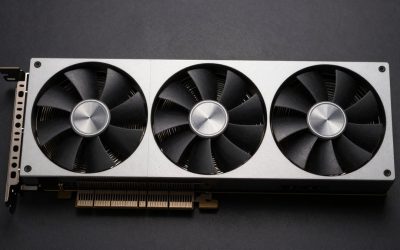
Pick the RX 9070 GRE if you are buying a card for modern 1440p gaming, since it is substantially faster, uses less power, supports FSR 4 and comes with a warranty when bought new; a used RTX 2080 Ti only makes sense as a budget purchase when it costs well under the GRE and you value DLSS support in older and NVIDIA-sponsored games. The 2080 Ti was a flagship in 2018, but seven years of architectural progress now place it a full performance tier below this mid-range RDNA 4 card.
The RTX 2080 Ti launched in September 2018 at $999 as the top Turing GPU and the first consumer card marketed around real-time ray tracing. The RX 9070 GRE arrived in May 2025 at $549 as a trimmed version of AMD’s RX 9070, with a 192-bit memory bus and 12 GB of VRAM. This comparison usually comes up when a buyer finds a used 2080 Ti at an attractive price and wonders whether it can still compete with a current mid-range card.
As an Amazon Associate we earn from qualifying purchases at no extra cost to you.



Our Top Picks
 ASUS Prime Radeon™ RX 9070 GRE EVO OCRX9070GRE|OC|12GB|EVO12 x 5 x 0.1 inches2.4 poundsCheck on Amazon


Top 3 picks at a glance
Seven Years Apart: The Specifications
| Specification | RTX 2080 Ti | RX 9070 GRE |
|---|---|---|
| Architecture | Turing | RDNA 4.0 |
| Release date | 20 September 2018 | 8 May 2025 |
| Launch MSRP | $999 | $549 |
| Shaders | 4352 CUDA cores | 3072 stream processors |
| Boost clock | 1545 MHz | 2790 MHz |
| Process | 12 nm | 4 nm |
| TDP | 250 W | 220 W |
| VRAM | 11 GB GDDR6 | 12 GB GDDR6 |
| Memory bus | 352-bit | 192-bit |
| Bandwidth | 616.0 GB/s | 432.0 GB/s |
| Cache | 5.5 MB L2 | 8 MB L2 + 48 MB L3 |
| Interface | PCIe 3.0 x16 | PCIe 5.0 x16 |
| Power connectors | 2x 8-pin | 2x 8-pin |
| Size | 267 mm, 2-slot | 2-slot |
| Outputs | 1x HDMI 2.0, 3x DP 1.4a, 1x USB Type-C | 1x HDMI 2.1b, 3x DP 2.1a |
The RTX 2080 Ti still has more raw memory bandwidth thanks to its wide 352-bit bus, but the RX 9070 GRE compensates with 48 MB of Infinity Cache and a much larger L2. The GRE’s boost clock is roughly 80 percent higher, built on a 4 nm process against 12 nm. VRAM capacity is nearly the same, 11 GB versus 12 GB.
Rasterized Gaming Performance
Every available source puts the RX 9070 GRE ahead, but the estimates spread widely, partly because few major outlets have tested these two cards directly against each other. 3DMark results compiled by TopCPU show the GRE about 41 to 50 percent ahead across Time Spy and Speed Way. Pangoly rates its raster lead around 32 percent, and GPUPrix estimates over 50 percent. Technical City’s aggregate puts the gap much lower, at around 10 percent, though its per-game tables appear inconsistent. Weighing the evidence, the RX 9070 GRE is likely around 30 to 45 percent faster in modern games at 1440p, with the gap growing in newer titles built around current-generation hardware.
For context, the RTX 2080 Ti performs in the general neighborhood of an RTX 3070, while the RX 9070 GRE sits above the RTX 4070 class in TechPowerUp’s relative performance charts. In practice, a demanding new game that runs in the high 40s to mid 50s at 1440p high on the 2080 Ti would typically land in the 60s to 70s on the GRE, with exact results varying by settings, CPU and game patch.
Ray tracing
The RTX 2080 Ti has first-generation RT cores, while the RX 9070 GRE uses RDNA 4’s heavily reworked ray tracing hardware, which TechPowerUp’s reviews of the RX 9070 family described as a major step forward for AMD. In most ray-traced games, the GRE should hold a clear advantage, though NVIDIA-optimized path-tracing titles remain demanding on both, and neither card is a strong path-tracing option.
Upscaling and Frame Generation
The RTX 2080 Ti’s best remaining asset is DLSS. It supports DLSS 4’s transformer-based Super Resolution and Ray Reconstruction, which keeps it relevant in games with DLSS support. However, Turing does not support NVIDIA’s DLSS frame generation at all, so it cannot use that feature in any game. Owners can use FSR 3.1 frame generation where games include it.
The RX 9070 GRE supports FSR 4, AMD’s machine-learning upscaler, which reviewers found a large improvement over earlier FSR versions in image quality. AMD’s driver can also upgrade many FSR 3.1 games to FSR 4, and the GRE supports frame generation through FSR and driver-level Fluid Motion Frames. DLSS still appears in more games, but the GRE now has a competitive upscaler and access to frame generation, which the 2080 Ti lacks from NVIDIA’s side.
VRAM, Platform and Display Considerations
With 11 GB and 12 GB, both cards sit at a similar memory tier. That is adequate for 1080p and most 1440p gaming, but the newest games at maximum textures with ray tracing can exceed it. Neither card is a strong long-term 4K option for that reason.
A few platform details matter more for the older card. The RTX 2080 Ti is a PCIe 3.0 device, which is not a bottleneck at x16, but it means it never benefits from a newer motherboard. Its HDMI 2.0 output limits 4K TV connections to 60 Hz at full quality, while the GRE’s HDMI 2.1b supports 4K at 120 Hz and variable refresh rate on modern TVs. The GRE’s DisplayPort 2.1a outputs also support higher refresh rate monitors without compression. The 2080 Ti’s USB Type-C port was designed for the VirtualLink VR standard, which never gained wide adoption.
Power and PSU Sizing
The RX 9070 GRE delivers more performance at a lower 220 W rating, compared with 250 W for the RTX 2080 Ti. Using GPU power plus CPU power plus about 150 W of headroom with a 105 W CPU:
- RTX 2080 Ti: 250 + 105 + 150 = 505 W, so a quality 600 W to 650 W unit.
- RX 9070 GRE: 220 + 105 + 150 = 475 W, so a quality 550 W to 650 W unit.
Both cards use two standard 8-pin connectors. The 2080 Ti’s reference length is 267 mm in a two-slot design, and the GRE is also a two-slot card, though partner models of both vary in length, so check your case clearance against the exact model.
Used 2080 Ti Versus New GRE: The Value Math
A used RTX 2080 Ti usually sells in the broad $230 to $320 range, depending on the model and condition. Using the GRE at 138 percent of the 2080 Ti’s raster performance, near the middle of the estimated range, and comparing a used 2080 Ti at $275 with the GRE at its $549 launch price:
- Used RTX 2080 Ti: $275 / 100 = $2.75 per performance point
- New RX 9070 GRE: $549 / 138 = $3.98 per performance point
On raw cost per frame, a used 2080 Ti wins, which is why it remains popular in budget builds. The trade-offs are a seven-year-old card with no warranty, possible wear on fans and thermal paste, no NVIDIA frame generation, older display outputs and a shorter remaining driver support window than a current-generation card. Turing GPUs remain supported, but they are already NVIDIA’s oldest RTX generation.
Which One Should You Choose?
| Your situation | Better pick |
|---|---|
| Building a new 1440p gaming PC | RX 9070 GRE |
| Strict budget around $250 to $300, 1080p or light 1440p | Used RTX 2080 Ti |
| Want frame generation and better upscaling quality | RX 9070 GRE |
| Play many DLSS-only games | RTX 2080 Ti has broader DLSS coverage |
| Gaming on a 4K 120 Hz TV | RX 9070 GRE for HDMI 2.1b |
| Want a warranty and long driver support | RX 9070 GRE |
Checking a Used RTX 2080 Ti
Early RTX 2080 Ti cards had a reputation for memory-related failures, often showing up as artifacts or crashes, so a stress test before purchase is especially worthwhile. Run a demanding game or benchmark for at least 20 to 30 minutes, watch for visual artifacts, check that fans spin quietly, and confirm temperatures stay reasonable. A repasted card with clean fans can still run well, but price any risk into the deal.
Frequently Asked Questions
Is the RX 9070 GRE faster than the RTX 2080 Ti?
Yes. Available benchmark data suggests the RX 9070 GRE is roughly 30 to 45 percent faster in modern rasterized games at 1440p, with synthetic tests showing larger gaps. It also leads in most ray-traced titles.
Can the RTX 2080 Ti use DLSS 4?
It supports DLSS 4 Super Resolution and Ray Reconstruction with the transformer model. It does not support DLSS frame generation or Multi Frame Generation, which require RTX 40 or RTX 50 hardware.
Is the RTX 2080 Ti still good for gaming in 2026?
For 1080p and lighter 1440p gaming, yes, especially with DLSS. It performs roughly at the level of an RTX 3070, which is still capable. Its age, lack of warranty when bought used and missing frame generation are the main drawbacks.
Is 12 GB of VRAM on the RX 9070 GRE enough?
For 1080p and 1440p in most games, yes. Some of the newest titles at maximum textures with ray tracing can exceed 12 GB at 1440p. It is only marginally more than the 2080 Ti’s 11 GB, so VRAM is not a deciding factor here.
What PSU do I need for either card?
A quality 600 W to 650 W unit covers either card with a mainstream CPU. Both use two 8-pin PCIe connectors, so no adapter is required.
Related guides
More from Amazon
Programs that pair well with the guide above. Offers and eligibility are set by Amazon and may change.
A free business account with business pricing and bulk-buying tools for work, shop or home office.
Create a business accountFree shipping on eligible items, Prime Video and more. Eligible new members can start with a free trial.
Start a Prime free trialAudiobooks and podcasts to listen to on the go. Eligible new members can start with a free trial.
Try Audible freeAd-free music streaming. Eligible new subscribers can start with a free trial.
Try Music Unlimited freeAs an Amazon Associate we earn from qualifying purchases.