
The Short Answer
Yes—32GB of DDR5 RAM is enough for modern gaming if gaming is your main use and you choose a two-stick kit that runs at a sensible speed. A 32GB kit, typically configured as 2 x 16GB, gives current PC games enough memory for high settings, background apps, voice chat, and ordinary multitasking. The one condition is that you should move to 64GB if you regularly stream, edit video, run virtual machines, use heavy mods, or keep many demanding applications open while playing.
For a new gaming PC in 2026, 32GB is the practical sweet spot rather than a bare-minimum compromise. It is noticeably more comfortable than 16GB, but 64GB is still unnecessary for most players. Your graphics card, processor, storage drive, and game settings usually have a larger effect on frame rates than moving from 32GB to 64GB.
As an Amazon Associate we earn from qualifying purchases at no extra cost to you.

What You Actually Get
A 32GB DDR5 gaming kit usually contains two 16GB desktop memory modules. Installing both sticks in the correct motherboard slots enables dual-channel operation, which is preferable to buying a single 32GB module. The kit’s advertised speed may be 6000MHz, although memory is more accurately described in MT/s. A “DDR5-6000” kit transfers data at 6000 MT/s.
Two specifications deserve attention: speed and latency. A kit rated at DDR5-6000 with a CAS latency of CL30 is a strong all-around choice for a modern gaming system. It offers a useful balance between bandwidth and responsiveness without requiring an extreme memory overclock. Kits with CL36 or CL40 can still perform well, especially when discounted, but they may have slightly higher latency at the same advertised speed.
To reach the advertised rating, you generally need to enable the memory profile in your motherboard firmware. AMD systems commonly use EXPO profiles, while Intel systems commonly use XMP profiles, though many kits support one platform more explicitly than the other. Without the profile enabled, the RAM may run at a slower default speed. Check your motherboard’s memory support list and your processor platform before buying.
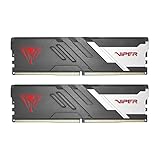
Physical fit matters, too. Standard DDR5 desktop modules are approximately 133mm long, but heat spreader height varies. Low-profile modules are easier to fit under large air coolers, while RGB models can be taller and may interfere with a cooler’s front fan. The two kits often considered in this class illustrate the choices: Patriot Viper Venom DDR5 32GB (2 x 16GB) 6000MHz CL30 emphasizes speed and latency, while Corsair Vengeance RGB RS DDR5 32GB (2 x 16GB) supports speeds up to 6000MHz and adds illuminated heat spreaders. Listed prices for these examples are about $479.99 and $505.99, respectively, so compare current pricing carefully rather than assuming RGB or a familiar brand automatically means better gaming performance.
Capacity is not the same as speed. More gigabytes allow more programs and game assets to remain in memory. Faster memory can improve minimum frame rates in some CPU-limited situations, but the difference is usually modest compared with upgrading a graphics card or processor. DDR5 also requires a compatible motherboard and processor; it cannot be installed in a DDR4-only board.
Pros
- Enough for nearly all current games: 32GB gives modern titles room for their own memory needs while leaving capacity for Windows, a browser, game launchers, and chat software.
- Better longevity than 16GB: A 32GB kit reduces the chance of stuttering caused by memory pressure as game installations and background software become more demanding.
- Good value for a new build: Two 16GB modules are a straightforward configuration and typically cost less than immediately buying 64GB.
- Strong DDR5 performance: DDR5-6000, particularly around CL30, is a sensible target for many current AMD and Intel gaming platforms.
- Easy upgrade path: If your motherboard has four memory slots, you may be able to add another matched 2 x 16GB kit later, although a complete 64GB kit is often more reliable than mixing kits.
- Less heat and complexity than oversized kits: A two-stick 32GB setup places less stress on the memory controller than filling every slot with four modules.
Cons
- Not ideal for heavy multitasking: Streaming, recording, a large browser session, photo or video editing, and a game running together can push beyond 32GB.
- Some demanding games can approach the limit: Large mod packs, extensive texture replacements, simulation games, and poorly optimized releases may use substantially more memory.
- Adding another kit is not guaranteed to be plug-and-play: Four modules can make high memory speeds harder to stabilize, particularly on some processors and motherboards.
- DDR5 platform costs can be high: Memory is only one part of the upgrade. A compatible motherboard and processor may cost more than a DDR4-based alternative.
- Advertised speed requires setup: You may need to enable XMP or EXPO, and a profile that works on one motherboard may require a BIOS update or manual adjustment on another.
- Premium features do not guarantee more frames: RGB lighting, tall heat spreaders, and a higher price do not automatically provide a meaningful gaming advantage.
Who Should Buy It
Buy 32GB DDR5 if you are building or refreshing a mainstream gaming PC, especially with a current midrange or high-end processor. It is suitable for 1080p high-refresh gaming, 1440p gaming, and 4K gaming. Resolution changes the workload for the graphics card far more than for system memory, so a 32GB kit remains sensible even with a powerful graphics card.
It is also a good fit if you play several games, keep Discord and a browser open, use a second monitor, or occasionally record gameplay. Choose a matched 2 x 16GB kit, verify motherboard compatibility, and prioritize a reasonable speed and latency over decorative features. If the Patriot kit is close to the price of slower memory, its DDR5-6000 CL30 specification is attractive. If the Corsair kit is only modestly more expensive and you value its RGB design, it can make sense for a coordinated build.
Who Should Skip It
Skip 32GB and buy 64GB if you stream with multiple production tools, edit 4K video, work with large images or 3D scenes, run local virtual machines, compile large projects, or use heavily modded games. These workloads benefit from additional headroom, and avoiding memory swapping can make the computer feel much smoother.
You should also skip a rushed DDR5 purchase if your existing DDR4 gaming system already has 32GB and meets your needs. Moving to DDR5 generally requires a new motherboard and possibly a new processor, so the total platform cost may not produce a worthwhile gaming improvement by itself. Upgrade when you are already changing the core platform or when your current system is genuinely holding you back.
Cheaper Alternatives
| Option | Cost | Trade-off |
|---|---|---|
| 32GB DDR5-5600, 2 x 16GB | About $90-$150 | Usually a little slower than DDR5-6000, but often delivers nearly the same gaming experience. |
| 32GB DDR5-6000 CL36, 2 x 16GB | About $100-$170 | Higher latency than CL30, with a potential saving if you do not need the lowest practical latency. |
| 32GB DDR4-3600, 2 x 16GB | About $55-$100 | Lower total platform cost, but requires a DDR4-compatible motherboard and does not offer a forward-looking DDR5 platform. |
| 64GB DDR5-6000, 2 x 32GB | About $170-$280 | More capacity for mods and creative work, but higher cost and little benefit in ordinary gaming. |
These are typical price ranges, not guaranteed sale prices. The referenced 32GB Patriot and Corsair kits at $479.99-$505.99 are priced far above what many comparable DDR5 kits cost, so confirm whether a listing includes a bundle, limited availability, or an unusual seller markup before purchasing. For gaming value, a mainstream 32GB DDR5-6000 kit is usually the more sensible target.
FAQ
Is 32GB DDR5 better than 16GB for gaming?
Yes. Many games still run on 16GB, but 32GB provides more room for Windows, browsers, launchers, voice chat, and background utilities. It also reduces the chance of stutter when a game loads large areas or when several applications remain open.
Will 32GB RAM increase FPS?
It can, but only when your current memory capacity is a limitation. If 16GB is causing paging or inconsistent frame times, moving to 32GB can improve smoothness. If you already have sufficient capacity, faster DDR5 may offer a small improvement in CPU-limited games, while a graphics card upgrade usually has a larger effect.
Is DDR5-6000 CL30 worth buying?
It is a strong target for a new DDR5 gaming build, but it is not mandatory. DDR5-5600 or DDR5-6000 CL36 can be good purchases when significantly cheaper. Prioritize motherboard compatibility, a two-stick layout, stable support for XMP or EXPO, and a reasonable total system budget.
Should I buy 2 x 16GB or 1 x 32GB?
Buy 2 x 16GB for a gaming PC. Two modules enable dual-channel operation and generally provide better memory bandwidth. A single 32GB module may leave performance on the table, even though it can make a future upgrade simpler. If you need 64GB, a matched 2 x 32GB kit is usually preferable to combining unrelated modules.


