
Incandescent bulbs have not disappeared, and for good reason. The applications that still demand them are specific but stubbornly common: ovens and refrigerators with high internal temperatures, dimmer circuits that reject LED drivers, exposed-fixture styling where filament aesthetics matter, and enclosed fixtures where LED heat-trapping causes premature failure. The buyer’s problem is that as the category shrank, the remaining options became a minefield of inconsistent wattage labeling, poor filament quality, and wildly uneven color output within a single pack.
What separates a worthwhile purchase from a mediocre one in this space comes down to a few hard factors. Accurate wattage labeling is the first: some bulbs marketed at 75 watts deliver noticeably less output than a genuine 75W filament lamp. Build thickness and shatter resistance determine whether a bulb survives in a garage, a range hood, or anywhere it faces vibration. Color temperature consistency across a multi-pack matters in visible installations. And dimmer compatibility is not a given — even among products marked “dimmable,” owners report buzz, flicker, and poor low-end performance from some models.
As an Amazon Associate we earn from qualifying purchases at no extra cost to you.





Top 3 picks at a glance
Quick Picks
| Product | Best for | Price |
|---|---|---|
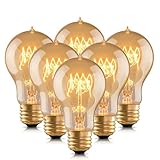
| 75W A19 Frosted (6-Pack) | General household lighting | $22.89 |
| 60W Rough Service Dimmable (6-Pack) | High-vibration areas | $24.99 |
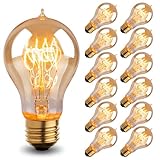
| Vintage Edison Squirrel Cage (12-Pack) | Decorative pendant fixtures | $39.99 |
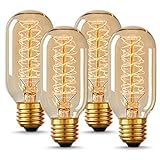
| runquiz Vintage Edison | Testing the vintage look | $23.99 |
| XDYQKJ 75W Shatter-Resistant (12-Pack) | Heavy-use brightness with durability | $35.99 |
| DORESshop 40W Edison | Low-power accent lighting | $13.98 |
| CMA 100W GLS (6-Pack) | Maximum raw brightness | $19.99 |
| Sylvania 25W A19 (2-Pack) | Appliance and small enclosed fixtures | $7.59 |
How We Picked
We compared published specifications, calculated per-bulb value at each pack size, and reviewed aggregated owner feedback for consistency, dimmer behavior, and failure patterns. The criteria that matter most in this category are color temperature accuracy (does 2700K actually look warm and consistent across the pack?), physical durability (glass thickness, filament support quality, shatter ratings), dimmer compatibility under real-world use, and value per unit relative to the wattage you actually receive.
The 8 Best Incandescent Bulbs in 2026
75W A19 Frosted (6-Pack)
A straightforward workhorse for anyone who needs genuine 75-watt output without decorative pretension or rough-service construction.
- Pros: Accurate 75W wattage delivers the brightness you expect. Frosted glass diffuses the filament for softer glare. At roughly $3.81 per bulb, pricing is fair for standard A19 format.
- Con: No shatter-resistant construction — the glass is standard thickness.
Skip it if the fixture sits near a counter, in a garage, or anywhere vibration or impact risk exists.
60W Rough Service Dimmable (6-Pack)
Built for garages, workshops, and porch fixtures near traffic where constant vibration would destroy a standard bulb.
- Pros: Shatter-resistant rough-service glass handles vibration without breaking. Fully dimmable with no buzz or flicker reported by owners. The soft white tone is easy on the eyes in residential settings.
- Con: At 60W, large rooms may feel underlit compared to the 75W and 100W options on this list.
Skip it if you need maximum brightness or a decorative filament appearance.
Vintage Edison Squirrel Cage (12-Pack)
A decorative statement piece for pendant fixtures, restaurant installations, and exposed-socket lamps where filament visibility is the point.
- Pros: The squirrel-cage filament photographs well and reads as authentic vintage at any viewing angle. At 12 bulbs the per-unit cost (~$3.33) is competitive for a specialty product. Dimmable across the range.
- Con: Highest sticker price here, and these require open-air mounting — enclosed fixtures will overheat and shorten filament life.
Skip it for task lighting; these trade output for aesthetics.
runquiz Vintage Edison
The same amber glow and exposed filament design as the 12-pack above, in a smaller quantity for lower commitment.
- Pros: Identical vintage aesthetic — amber color, visible squirrel-cage filament, dimmable. The smaller pack means a lower entry cost to test whether the look works in your space before buying in volume.
- Con: Higher per-unit cost than the 12-pack due to smaller quantity. Not rated for enclosed or rough-service fixtures.
Skip it if you’re wiring a multi-fixture installation — the larger pack offers better economics at scale.
XDYQKJ 75W Shatter-Resistant (12-Pack)
A rare combination of full 75W output and impact-resistant glass, suited to commercial kitchens, utility rooms, and high-traffic residential areas.
- Pros: Genuine 75W paired with shatter-resistant construction is uncommon at this price tier. The 12-pack serves multi-fixture setups efficiently. Warm white tone works in most settings.
- Con: Owners report noticeable brightness variation between individual bulbs in the same pack, which is unappealing in visible or symmetrical installations.
Skip it if color and output uniformity across fixtures is critical.
DORESshop 40W Edison
A low-power option for string lights, nightlight applications, and accent fixtures where a warm glow is sufficient.
- Pros: Lowest price per bulb on this list. The 40W rating is gentle on older wiring circuits. Warm white creates a cozy atmosphere in small or supplemental lighting roles.
- Con: Only 40W output is noticeably dim and inadequate as primary room illumination.
Skip it for functional task lighting — these are strictly decorative or supplemental.
CMA 100W GLS (6-Pack)
The brightest option in this roundup, delivering 1300 lumens per bulb for workshops, high-ceiling rooms, and any fixture where raw output is the priority.
- Pros: 100W and 1300 lumens is the highest output here. The 2700K color temperature reads genuinely warm without appearing orange. At roughly $3.33 per bulb, value is strong for that lumen count.
- Con: Rated for 110–130V only, so unusual circuits need verification. 100W incandescents produce significant heat that may trip dimmers rated below 600W.
Skip it if your dimmer has a low wattage ceiling or heat output near the fixture is a concern.
Sylvania 25W A19 (2-Pack)
Designed for the narrow but important niche of appliance interiors, small enclosed fixtures, and anywhere a higher-wattage bulb would overheat or be simply too bright.
- Pros: Sylvania brings legacy brand reliability and consistent manufacturing quality. The 25W rating suits refrigerator lamps, oven interiors, and tiny fixture enclosures perfectly. At $7.59 total, this is the lowest-cost purchase on the list.
- Con: Only 25W means no meaningful room illumination; the 2-pack is a small quantity for multi-fixture needs.
Skip it if you need functional lighting for any living space.
Buying Guide
Wattage vs. Perceived Brightness
Wattage measures power draw, not light output directly — but in the incandescent category, correlation is tight and predictable. A 25W bulb produces roughly 200 lumens; 40W yields around 400; 60W delivers approximately 800; 75W pushes toward 1,100; and 100W exceeds 1,200 lumens. When a manufacturer labels a bulb “75W equivalent” rather than “75W,” it often means the bulb draws less power while using a higher-temperature filament to approximate brightness. Compare actual wattage labels, not marketing equivalents, to avoid underpowered purchases.
Shatter Resistance and Mounting Environment
Rough-service rated bulbs use thicker glass, reinforced filament supports, and shock-absorbing bases. This matters in locations with vibration: near garage doors, by high-traffic hallways, in range hoods where fans create constant micro-vibration, and in any fixture subject to physical contact. Standard bulbs will fail prematurely in these conditions — not necessarily breaking dramatically, but vibrating the filament until it snaps. If the fixture is enclosed, also check heat dissipation ratings; a 100W bulb in a sealed glass shade can fail in weeks.
Dimmer Compatibility
Incandescents dim more smoothly than most alternatives, but compatibility issues still arise with older solid-state dimmers, low-wattage loads, or mixed circuits containing both incandescent and LED bulbs. Check your dimmer’s minimum load rating — some solid-state models require 40W minimum, meaning a single 25W bulb on a circuit will flicker or buzz. For multi-fixture rooms, sticking to a single product line ensures consistent dimming behavior and color shift across the entire dimmer sweep.
Our Verdict
The CMA 100W GLS 6-Pack is our top overall pick: unmatched brightness in the group, accurate 2700K color temperature, and a per-bulb cost that competes with lower-wattage options. For the budget-conscious buyer, the DORESshop 40W Edison offers the lowest meaningful purchase price and a warm decorative glow that suits accent roles. However, if your installation demands both high output and physical durability in the same package, the XDYQKJ 75W Shatter-Resistant 12-Pack wins despite its premium price — it is the only option here that combines meaningful wattage with impact-rated construction.
FAQ
Are incandescent bulbs still being manufactured?
Yes. Several manufacturers continue producing standard and specialty incandescent bulbs, and the options in this roundup all represent current production available through major retail channels.
Why do incandescent bulbs fail faster than LEDs?
Incandescents produce light by heating a thin tungsten filament until it glows, which causes gradual evaporation of the filament material and eventual breakage. LEDs generate light through semiconductor junctions without a fragile hot element, giving them dramatically longer operational lifespans.
Can I use an incandescent bulb in a fixture designed for LED?
Usually yes, provided the wattage is within the fixture’s rating and the base type matches (most commonly E26). However, enclosed fixtures designed around low LED heat output may trap heat from a higher-wattage incandescent, reducing its life.
What color temperature should I look for in warm lighting?
Incandescent bulbs naturally produce light between 2700K and 2900K, which reads as a comfortable warm white. Anything below 2500K shifts toward deep amber, which some find overly orange for general use but appropriate for purely decorative settings.


